The volumetric weight formula is length × width × height ÷ dimensional divisor, with the result compared against actual scale weight. Whichever number is bigger is what the carrier bills you for. Express couriers commonly use a divisor of 5,000, while general air freight typically runs on 6,000. Get the divisor wrong and your shipping quote will be wrong too.
TL;DR:
- Using the correct divisor, either 5,000 or 6,000, significantly impacts the volumetric weight calculation and thus your shipping cost.
- Always measure dimensions in one unit system and include packaging to avoid underestimating the volumetric weight.
- The chargeable weight is the higher value between actual scale weight and volumetric weight, rounded according to carrier-specific rules.
- Different service types and carriers apply various divisors; verify these before quoting or shipping to prevent unexpected charges.
- Consolidating shipments through a forwarder can lower costs for recurring or complex freight, especially when managing multiple SKUs or customs procedures.
How Do You Calculate Volumetric Weight Step by Step?
Getting an accurate number takes five minutes and a tape measure, but the order of operations matters. Skip a step and you’ll either underquote your customer or get blindsided by a carrier invoice that doesn’t match your estimate.
- Measure the outer dimensions. Include the box, any pallet wrap, and anything sticking out. If a handle or a foam corner adds half an inch, that half inch counts. Carriers measure the outermost points, not the product inside.
- Keep every measurement in one unit system. Mixing centimeters and inches mid calculation is the single most common error small shippers make. Pick centimeters and kilograms, or inches and pounds, and stay there.
- Calculate the volume. Multiply length × width × height. A box measuring 40 cm × 30 cm × 20 cm gives you 24,000 cubic centimeters.
- Select the right divisor for your carrier and service. This is the step people rush, and it’s the one that changes your cost the most. A 5,000 divisor and a 6,000 divisor on the same box produce two different bills.
- Divide volume by divisor to get volumetric weight, then round according to that carrier’s rule. Some round up to the next 0.5 kg, others to the next full kilogram.
- Compare volumetric weight to actual scale weight. The dimensional weight rule is simple: carriers bill whichever figure is higher, every time.
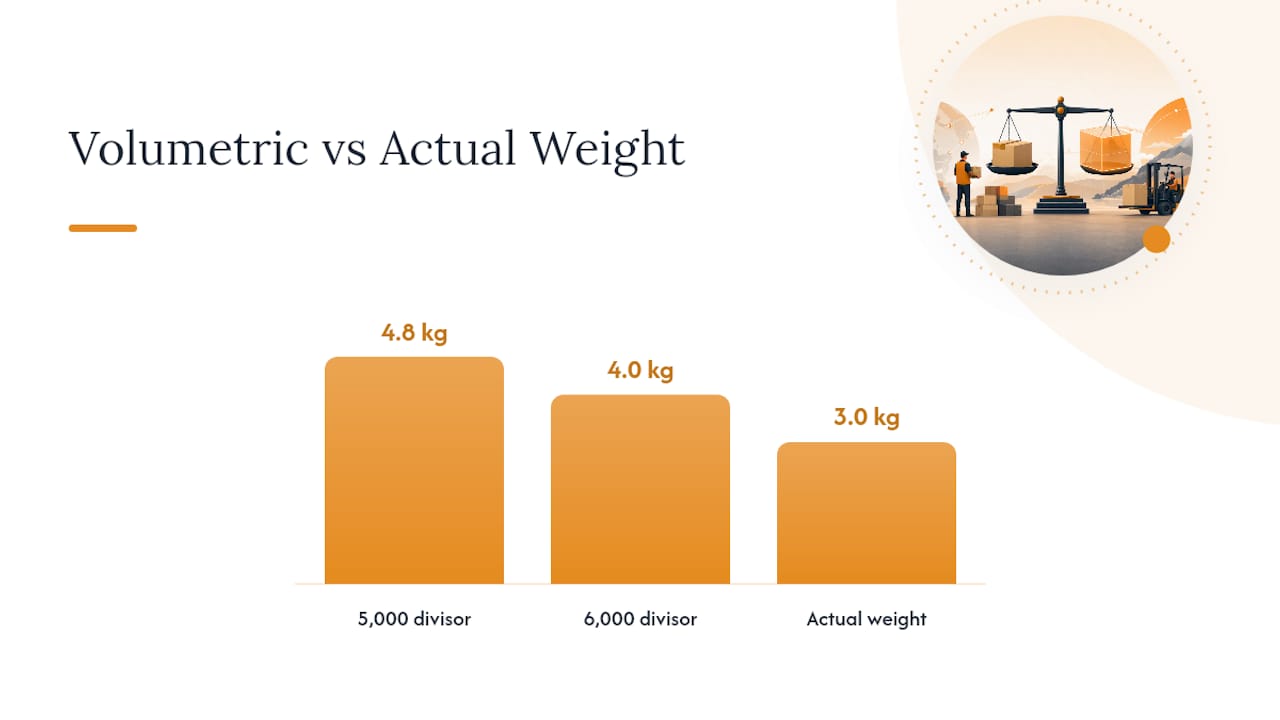
Run that box through the math: 24,000 ÷ 5,000 = 4.8 kg volumetric weight. If the actual item weighs 3 kg, you’re billed for 4.8 kg, not 3.
Pro Tip: Build a simple spreadsheet with columns for length, width, height, divisor, and a formula cell that auto-calculates volumetric weight. Once it’s set up, quoting a new SKU takes seconds instead of a recalculation from scratch.
Keep a printed checklist near your packing station: unit system confirmed, dimensions include packaging, divisor matches carrier and service tier, rounding rule applied, final number compared to actual weight. That last step gets skipped more often than you’d think.
Which Dimensional Divisor Should You Use?
The divisor isn’t arbitrary. It reflects how much cargo space a pound or kilogram of freight is allowed to occupy before a carrier starts losing money on low-density shipments. Lighter, bulkier boxes eat more truck or plane space per pound than dense ones, so carriers protect their margins by charging for volume once a shipment crosses that threshold.
- 5,000 (cm³/kg): the standard for most express couriers. DHL documents this divisor for its per-piece express calculations, and other door-to-door networks use the same figure.
- 6,000 (cm³/kg): the baseline set by IATA/TACT rules for general air freight, which covers most non-express air cargo bookings.
- 139 and 166 (in³/lb): the imperial equivalents of 5,000 and 6,000. Use 139 for express in inches and pounds, 166 for general air freight.
- 194 (in³/lb): occasionally used by carriers with looser density thresholds, mostly on domestic or regional lanes.
- USPS and other domestic carriers often apply their own divisor for domestic parcels that differs from their international rate, so check the specific service tier before assuming a universal number.
Converting between metric and imperial divisors is straightforward: divide the metric divisor by 36 (5,000 ÷ 36 ≈ 139 and 6,000 ÷ 36 ≈ 166.7, close enough to reflect the cm³/kg to in³/lb conversion factor baked into each standard). In practice, it’s faster to just measure once in your preferred unit and stick with the matching divisor.
Worked Examples: Small, Bulky, and Dense Shipments
Numbers make this concrete faster than any explanation. Here are three shipment types small sellers deal with constantly, each run through both common divisors.
- Small box, moderate weight. Dimensions: 30 cm × 20 cm × 15 cm = 9,000 cm³. At 5,000: 9,000 ÷ 5,000 = 1.8 kg. At 6,000: 9,000 ÷ 6,000 = 1.5 kg. If the actual weight is 2 kg, actual weight wins under both divisors, and you’re billed 2 kg.
- Bulky, light item (think a lampshade or inflatable display). Dimensions: 60 cm × 50 cm × 40 cm = 120,000 cm³. At 5,000: 24 kg. At 6,000: 20 kg. If the item only weighs 4 kg on a scale, volumetric weight dominates the invoice completely, and the divisor choice alone swings your bill by 4 kg.
- Dense, heavy item (a case of tools or metal hardware). Dimensions: 40 cm × 30 cm × 25 cm = 30,000 cm³. At 5,000: 6 kg. At 6,000: 5 kg. If actual weight is 12 kg, actual weight wins outright, and the volumetric formula never even comes into play.
The pattern holds across all three: light and bulky items get penalized by volumetric weight, dense items rarely trigger it. One caution worth flagging here: once a shipment fills a full pallet or occupies dedicated space in a ULD, some carriers switch to a flat positional rate instead of running the per-piece formula at all, which can override every calculation above.
Volumetric Weight vs Actual Weight: Chargeable Weight and Rounding
Chargeable weight is simply the higher of the two numbers, volumetric or actual, and it’s what actually shows up on your invoice or airway bill. Carriers don’t average the two figures or split the difference. They take whichever is larger and bill accordingly, which is why understanding both numbers before you ship matters more than knowing just one.
Rounding rules vary by carrier and mode, and they can move your final bill more than you’d expect:
- Some carriers round up to the nearest 0.5 kg.
- Others round up to the next full kilogram, even if you’re only 100 grams over.
- Imperial-based carriers often round up to the next whole pound.
- CalculatorLib’s worked examples show how a shipment sitting at 4.1 kg volumetric weight can round up to a full 5 kg bill depending on the carrier’s policy.
To verify which weight actually got billed, check the airway bill or invoice line labeled “chargeable weight” or “billed weight.” If that number doesn’t match either your volumetric or actual weight calculation, ask the carrier directly. Discrepancies usually trace back to a wrong divisor or a rounding step applied differently than expected.
How Service and Carrier Type Change Your Cost Expectations
Not every shipment gets treated the same way, even when the boxes are identical. The mode you choose and the service tier you book both shift which divisor applies and how much room you have to negotiate.
- Express door-to-door services tend to use tighter divisors, 5,000 in metric or 139 in imperial, because their network economics favor dense, fast-moving parcels over bulky ones.
- General air freight usually runs on the looser 6,000 or 166 divisor, giving bulkier shipments a bit more breathing room before volumetric weight kicks in.
- Road and sea freight calculate volume differently altogether, often in cubic meters rather than a dimensional divisor, and a CBM-based calculation becomes the relevant math instead.
- Domestic parcel carriers sometimes apply their own divisor, separate from international rates, so a box shipped domestically and internationally on the same carrier can price out differently.
- Palletized or consolidated shipments frequently shift to positional billing once they occupy a defined space, meaning the per-piece formula stops applying and a flat rate for that pallet or ULD position takes over.
Knowing which category your shipment falls into before you request a quote saves you from comparing numbers that were never meant to be compared. A 6,000 divisor quote and a 5,000 divisor quote on the same dimensions will never match, and that’s not a mistake on anyone’s part.
Practical Ways to Lower Your Volumetric Charges
Most sellers pay more in DIM charges than they need to simply because packaging habits formed early never get revisited. A few adjustments usually pay for themselves within the first shipment.
- Choose box sizes that fit the product tightly instead of defaulting to one standard size for everything you ship.
- Remove void space with better internal fitting rather than padding with extra layers of bubble wrap that inflate outer dimensions.
- Consider flat-pack, folding, or vacuum-sealed formats for soft goods, since compressing the outer dimensions directly lowers the volumetric calculation.
- Split oversized, low-density shipments into denser parcels when the product allows it, rather than shipping one giant lightly filled box.
- Ask every carrier for their specific DIM policy in writing, including the divisor and rounding rule, before you finalize a quote.
- Include exact dimensions in your own customer-facing quotes so you’re not absorbing a DIM surcharge you didn’t price in.
- For frequent, multi-piece shipments, ask about freight consolidation or palletization, which can spread fixed costs and sometimes shift billing away from strict per-piece DIM math. Cost drivers like these are covered in more depth in this guide to Amazon seller freight cost factors.
Pro Tip: Pull a sample of last month’s shipping invoices and manually recheck three or four DIM charges against your own formula. Sellers who do this monthly catch mispriced divisors and rounding errors long before they compound into a real budget problem.
When a DDP Forwarder Beats Calculating It Yourself
Running the formula on one box is easy. Running it correctly across dozens of SKUs, multiple cartons, and monthly restocks from overseas suppliers is where small sellers start losing hours and money to small math errors and inconsistent carrier quotes.
When shipments are multi-piece, recurring, or crossing customs, consolidating them through a forwarder often lowers your per-unit landed cost more reliably than chasing individual parcel rates. That’s the operational gap ForwarderOne is built around. Its DDP service bundles customs clearance, duties, and delivery into one workflow instead of leaving you to reconcile separate volumetric calculations for every carrier leg. Sellers also get a dedicated account manager rather than a support queue, and ForwarderOne reports over 99% on-time delivery across the shipments it handles, a meaningful number when inventory timing affects stock availability during peak sales periods.
If you’re comparing one or two boxes, a parcel carrier’s dimensional calculator is often enough. Once you’re managing recurring restocks from China or Korea into US or Mexico fulfillment centers, request a DDP freight quote instead of stitching together per-piece parcel estimates. The formula stays the same either way. What changes is who’s absorbing the complexity of applying it correctly at scale.

What Sellers Should Actually Do With This Formula
Three things matter more than the formula itself: measure everything in one consistent unit before you touch a calculator, pick a conservative divisor when you’re estimating a quote for a customer, and always run the comparison against actual weight before you commit to a price. Skip any of those three and your numbers will drift from what the carrier eventually bills.
The formula itself rarely surprises anyone once they’ve run it a few times. What catches sellers off guard is scale: one miscalculated divisor on a single box is a rounding error, but the same mistake repeated across fifty cartons a month is a real dent in margin. That’s the point where I’d stop trusting a spreadsheet and start auditing invoices, or requesting a forwarder quote instead of a parcel-by-parcel estimate.
If your shipments are getting palletized, arriving on a regular cadence, or triggering DIM surcharges you didn’t expect, that’s not a sign you did the math wrong. It’s a sign the math has outgrown a single-box calculation. Treat the volumetric weight formula as your baseline sanity check, not your entire shipping cost strategy.
— Keven
Where to Verify Divisors and Carrier Rules
Confirm your numbers directly against carrier sources: DHL’s volumetric weight guide for the 5,000 divisor, UPS’s chargeable weight calculator, and Wikipedia’s dimensional weight overview for the 6,000 general air freight standard.
Sources
- Dimensional weight
- What is volumetric weight and how is it calculated? | DHL Express
- Dimensional-volumetric weight calculator | CalculatorLib
FAQ
What Is the Formula for Volumetric Weight?
Volumetric weight equals length × width × height divided by a dimensional divisor, most commonly 5,000 for express services or 6,000 for general air freight. Carriers then bill whichever is greater, volumetric weight or actual scale weight.
Why Do Some Carriers Divide by 6,000?
The 6,000 divisor comes from IATA/TACT industry rules for general air freight, which set that figure as the baseline density threshold for standard air cargo. It gives bulkier shipments more room before volumetric charges kick in compared to the tighter divisors express services use.
Why Do Express Couriers Use 5,000 Instead of 6,000?
Express door-to-door networks run tighter density economics than general air freight, since their pricing model favors compact, fast-moving parcels. DHL and similar express carriers document 5,000 as their standard divisor, which produces a higher volumetric weight than 6,000 on the same box.
What’s the Difference Between Volumetric and Actual Weight?
Actual weight is what the shipment weighs on a scale. Volumetric weight is a calculated figure based on the box’s outer dimensions divided by the carrier’s divisor, and the carrier always bills the larger of the two numbers.
How Do I Know Which Divisor My Shipment Falls Under?
Check the carrier’s published DIM policy for your specific service tier, since express, general air freight, and domestic parcel services often use different divisors even within the same carrier. When shipments are frequent or palletized, a forwarder can confirm the applicable rate in writing before you commit to a booking.
Need chargeable-weight math checked before you book?
ForwarderOne helps ecommerce sellers compare chargeable weight, DDP scope, customs duties, and final delivery before a shipment leaves the supplier.