A cargo tracking system is defined as a digital logistics platform that consolidates shipment data from carriers, ports, and IoT sensors into a single interface, delivering real-time visibility from origin to destination. Businesses that ship internationally depend on this visibility to prevent delays, protect inventory, and keep customers informed. Modern platforms cover ocean, air, and road transport under one dashboard, making fragmented carrier portals obsolete. For Amazon sellers moving goods from China to US fulfillment centers, understanding what a cargo tracking system does is the first step toward controlling your supply chain rather than reacting to it.
What is a cargo tracking system and how does it work?
A cargo tracking system is a digital visibility tool that pulls shipment events from multiple sources and presents them as a unified timeline. The industry term for the broader practice is “supply chain visibility,” and cargo tracking is its most operationally immediate layer. Stakeholders including freight forwarders, importers, customs brokers, and warehouse managers all rely on the same data stream to coordinate their work.
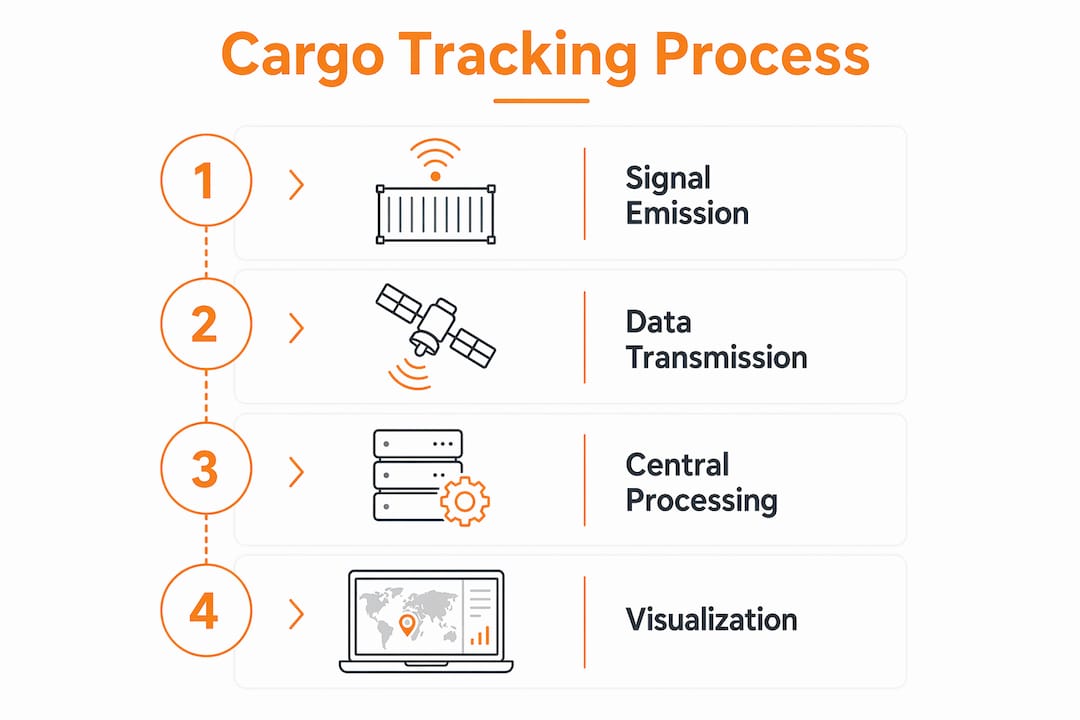
The system operates through a four-step data flow: signal emission, data transmission, centralized processing, and visualization. Each step adds a layer of intelligence that transforms raw location pings into actionable logistics information. Modern platforms integrate data from 75 to over 250 global carriers, which means a single shipment touching three different carriers still appears as one continuous record.

Unique identifiers are the entry point for any tracking query. Businesses enter a container number formatted under ISO 6346 standards, a Bill of Lading, a booking ID, or an Air Waybill number. The system then returns a verified event timeline covering milestones like gate-in, vessel loading, customs clearance, and gate-out. Those milestones matter more for planning than raw GPS coordinates do.
How does cargo tracking work: the technology behind it
Cargo tracking technology starts at the physical asset. GPS transponders emit location signals from containers and vehicles. RFID tags identify individual items as they pass through warehouse gates and port terminals. IoT sensors record environmental data like temperature, humidity, and vibration. Each device generates a data point, and the system collects all of them continuously.
Data transmission moves those signals to a central server. GPS data travels via satellite or mobile networks. RFID readers relay data over local radio frequencies. IoT sensor feeds often use cellular or low-power wide-area networks. The transmission method depends on where the cargo is: a container at sea uses satellite, while a truck on a highway uses cellular.
Centralized processing is where the real work happens. The platform normalizes data from dozens of carriers and terminals into a consistent format. It cross-references carrier feeds against port terminal data and vessel schedules to catch discrepancies. Multi-source validation filters out incorrect or outdated data, producing a single reliable record instead of conflicting reports from separate sources.
Visualization turns that processed data into something usable. Dashboards display shipment milestones, current location, estimated arrival, and exception alerts. Businesses can see at a glance which shipments are on time, which are delayed, and which need immediate action.
Pro Tip: Never rely on a single carrier’s portal for tracking data. Carrier self-reported data contains gaps. Platforms that validate against terminal feeds and vessel data deliver far more accurate status updates.
Key technologies used in cargo tracking systems
The hardware and software stack behind a cargo tracking system determines how much visibility a business actually gets. Each technology serves a specific function, and the best platforms combine several of them.
- GPS (Global Positioning System): Provides real-time geographic location of containers, trucks, and vessels. GPS is the backbone of location tracking for road and ocean freight.
- RFID (Radio Frequency Identification): Identifies individual items or containers as they pass through checkpoints. RFID excels at warehouse control and port gate management.
- Telemetry systems: Monitor vehicle and driver performance data including speed, fuel use, and route adherence. Telemetry is most valuable for road freight operations.
- IoT sensors: Track environmental conditions inside containers. Temperature-controlled pharmaceuticals, fresh produce, and electronics all benefit from sensor-based condition monitoring.
- Cloud-based platforms: Store and process all incoming data centrally. Cloud architecture allows multiple stakeholders to access the same data simultaneously from any location.
| Technology | Primary function | Key advantage | Limitation |
|---|---|---|---|
| GPS | Real-time location | Works globally, including at sea | No item-level detail |
| RFID | Item identification at checkpoints | High accuracy at gates and warehouses | Limited range, requires readers |
| IoT sensors | Environmental monitoring | Protects sensitive cargo | Adds hardware cost |
| Telemetry | Vehicle performance data | Supports driver accountability | Road freight only |
| Cloud platforms | Data storage and access | Multi-user, multi-device access | Requires reliable internet |
The distinction between tracking and monitoring is worth understanding clearly. Tracking answers “where is my cargo?” Monitoring answers “what condition is my cargo in?” Mature logistics operations combine both for complete supply chain control.
What are the benefits of cargo tracking for businesses?
Real-time shipment visibility is the most direct benefit. Businesses know exactly where their goods are at every stage, which eliminates the need to chase carriers for updates. That time savings compounds across hundreds of shipments per year.
Proactive exception management is where cargo tracking systems create the most financial value. AI-enhanced platforms detect delays, route deviations, and customs holds before they escalate. The system sends an alert, and the logistics team can rebook, reroute, or notify the customer before the problem becomes a crisis. This moves cargo management from reactive to proactive.
The benefits extend across the full supply chain:
- Improved on-time delivery rates: Milestone alerts let teams intervene early when a shipment falls behind schedule.
- Customer transparency: Businesses can share accurate ETAs with customers instead of estimates based on outdated carrier data.
- Theft and spoilage reduction: IoT sensor alerts flag temperature excursions or unexpected stops, protecting high-value or perishable cargo.
- Inventory planning accuracy: Reliable arrival data feeds directly into warehouse staffing and stock replenishment decisions.
- Reduced administrative work: API and EDI integrations automate milestone data syncing with TMS and ERP systems, cutting manual data entry significantly.
For Amazon sellers specifically, stock availability during peak periods like Q4 depends entirely on knowing when inventory will arrive. A cargo tracking solution that feeds accurate ETAs into inventory planning prevents stockouts during the highest-revenue weeks of the year.
Pro Tip: Connect your cargo tracking software to your ERP or TMS via API. Automated milestone syncing removes the manual update cycle and gives your operations team faster reaction time when something goes wrong.
The importance of cargo tracking also shows up in risk management. Businesses that can document a shipment’s full event history have a much stronger position when filing insurance claims or disputing carrier charges. Good tracking data is also evidence.
How to use a cargo tracking system effectively
Using a cargo tracking system well requires more than entering a tracking number and waiting. The following steps describe how to extract full operational value from the platform.
- Enter the correct identifier. Use the container number (ISO 6346 format), Bill of Lading, booking ID, or Air Waybill. Each identifier type returns different data sets. Container numbers give the most complete ocean freight timeline.
- Read milestones, not just location. Gate-In, Vessel Load, Customs Clearance, and Gate-Out events tell you more about operational progress than a map pin does. Each milestone signals a specific action your team may need to take.
- Set up exception alerts. Configure the dashboard to notify you when a shipment misses a milestone or enters a delay status. Waiting to notice a problem is far more costly than receiving an automated alert.
- Validate data across sources. Single-source carrier data is often incomplete. Use platforms that cross-reference carrier feeds with terminal and vessel data for a more accurate picture.
- Automate data flow into your business systems. Connect the tracking platform to your TMS or ERP via API or EDI integration. This removes the manual step of copying milestone updates into spreadsheets or order management tools.
The most common mistake businesses make is treating a cargo tracking system as a lookup tool rather than a management tool. The real value comes from acting on the data, not just reading it. Businesses that build workflows around milestone alerts and automated integrations get measurably better outcomes than those who check tracking numbers manually.
Goods in transit insurance is another layer worth pairing with tracking data. Platforms that provide transit insurance coverage alongside tracking give businesses both visibility and financial protection in a single workflow, which is particularly useful for high-value shipments.
Cargo tracking is more than a location service
The most common misconception I encounter is that cargo tracking is just a fancier version of a package tracking number. It is not. A consumer tracking number tells you a parcel moved from one city to another. A cargo tracking system tells you which vessel your container is on, whether it cleared customs, whether the temperature inside stayed within spec, and whether your ETA has shifted by two days because of a port congestion event in Los Angeles.
The gap between those two things is the gap between reacting to problems and preventing them. I have seen businesses lose significant revenue not because their cargo was lost, but because they did not know it was delayed until it was too late to adjust their inventory position. The quality of data integration is what separates a useful system from a passive one. Hardware matters less than how intelligently the platform processes and presents the data it collects.
AI-driven exception management is the development I find most significant right now. The shift from “here is where your cargo is” to “here is what you need to do about it” is a fundamental change in how logistics teams operate. Businesses that adopt platforms with proactive alerting will have a structural advantage over those still checking portals manually. The technology is available. The question is whether your workflows are built to use it.
— Keven
ForwarderOne’s approach to freight visibility and delivery
Cargo tracking data is only as useful as the logistics operation behind it. ForwarderOne combines freight forwarding with built-in shipment visibility for Amazon sellers moving inventory from China, Korea, and Mexico to US fulfillment centers.
ForwarderOne’s DDP freight forwarding services cover customs clearance, duties, and last-mile delivery in a single workflow. Sellers get milestone updates without needing to manage multiple carrier portals or piece together data from separate systems. With over 99% on-time delivery and a dedicated account manager on every shipment, ForwarderOne gives small and mid-sized sellers the same supply chain control that larger operations pay significantly more to achieve. For sellers shipping from China to the US, that level of visibility directly protects stock availability during peak sales periods.
Key Takeaways
A cargo tracking system delivers real-time supply chain visibility by consolidating data from carriers, ports, and IoT sensors into a single platform, making proactive logistics management possible for businesses of any size.
| Point | Details |
|---|---|
| Core definition | A cargo tracking system consolidates multi-source shipment data into one real-time visibility platform. |
| Four-step data flow | Signal emission, transmission, centralized processing, and dashboard visualization drive every modern system. |
| Tracking vs. monitoring | Tracking locates cargo; monitoring checks its condition. Combining both gives full supply chain control. |
| Multi-source validation | Cross-referencing carrier data with terminal and vessel feeds produces accurate, reliable shipment records. |
| Business value | API and EDI integrations automate milestone syncing, reducing manual work and accelerating decision-making. |
FAQ
What is a cargo tracking system in simple terms?
A cargo tracking system is a digital platform that shows you where your shipment is and what has happened to it at every stage of transit. It pulls data from carriers, ports, and sensors into one place so you do not have to check multiple sources.
How does real-time shipment tracking actually work?
The system collects signals from GPS transponders, RFID readers, and IoT sensors, then transmits that data to a central platform that normalizes and displays it as a shipment timeline. Most platforms integrate data from dozens of carriers to maintain a continuous record even when cargo changes hands.
What is the difference between tracking and monitoring?
Tracking answers “where is my cargo?” by reporting location and milestone events. Monitoring answers “what condition is my cargo in?” by recording temperature, humidity, and vibration data from IoT sensors inside the container.
What identifiers do I need to track a shipment?
You need a container number (formatted under ISO 6346), a Bill of Lading, a booking ID, or an Air Waybill number. Container numbers provide the most complete event timeline for ocean freight shipments.
Why is multi-source data validation important in cargo tracking?
Single-carrier data often contains gaps or errors. Platforms that validate carrier feeds against terminal data and vessel schedules produce a more accurate and complete shipment record, which is the foundation for reliable logistics decisions.
Need freight visibility before your next reorder?
ForwarderOne coordinates pickup, customs, delivery appointments and milestone updates for sellers moving inventory from China, Korea and Mexico to US fulfillment centers.