Express freight service is defined as a dedicated, time-critical shipping method that uses exclusive vehicles, direct routing, and guaranteed delivery windows to move cargo faster than standard freight. Unlike regular shipping, express freight skips terminal consolidation entirely and dispatches within hours of booking. Businesses facing stock-outs, production stoppages, or missed retail deadlines rely on it as a supply chain safety net. The service covers shipments typically over 150 lbs and spans three primary modes: road-express, rail-express, and air-express. Understanding how each tier works, what it costs, and when to use it gives you a real edge in managing urgent logistics.
What is express freight service and how does it work?
Express freight service operates on one core principle: the shipment moves on its own dedicated vehicle with no stops, no terminal transfers, and no shared space. Expedited freight dispatches within hours and often carries a single shipment only, unlike standard freight that consolidates multiple loads at regional terminals. That single-shipment model eliminates the delays that terminal handling creates.
The mechanics behind express freight’s speed come down to three operational features. First, direct routing removes every intermediate stop between origin and destination. Second, exclusive equipment means no waiting for other cargo to fill a trailer. Third, team drivers enable near-continuous transit by legally rotating behind the wheel, overcoming hours-of-service regulations that cap solo drivers at 11 hours per day. A cross-country run that takes a solo driver four to five days can drop to two days with a relay team.

Real-time tracking is standard in express freight, not optional. Shippers receive committed delivery windows rather than estimated ranges. That distinction matters when you are coordinating a production line restart or a retail floor restock.
Key operational features of express freight include:
- Exclusive vehicle use: No freight sharing means no delays caused by other shippers’ cargo.
- Direct routing: Cargo moves point to point without terminal consolidation stops.
- Team drivers: Two drivers rotate shifts, keeping the truck moving nearly around the clock.
- Real-time tracking: Live location updates tied to a committed delivery window, not an estimate.
- Same-day or next-day dispatch: Loads depart within hours of booking confirmation.
Pro Tip: Plan your express freight booking before the shipment is fully loaded. Planning starts before loading finishes to eliminate any gap between cargo readiness and truck departure.
What service tiers and express shipping options are available?
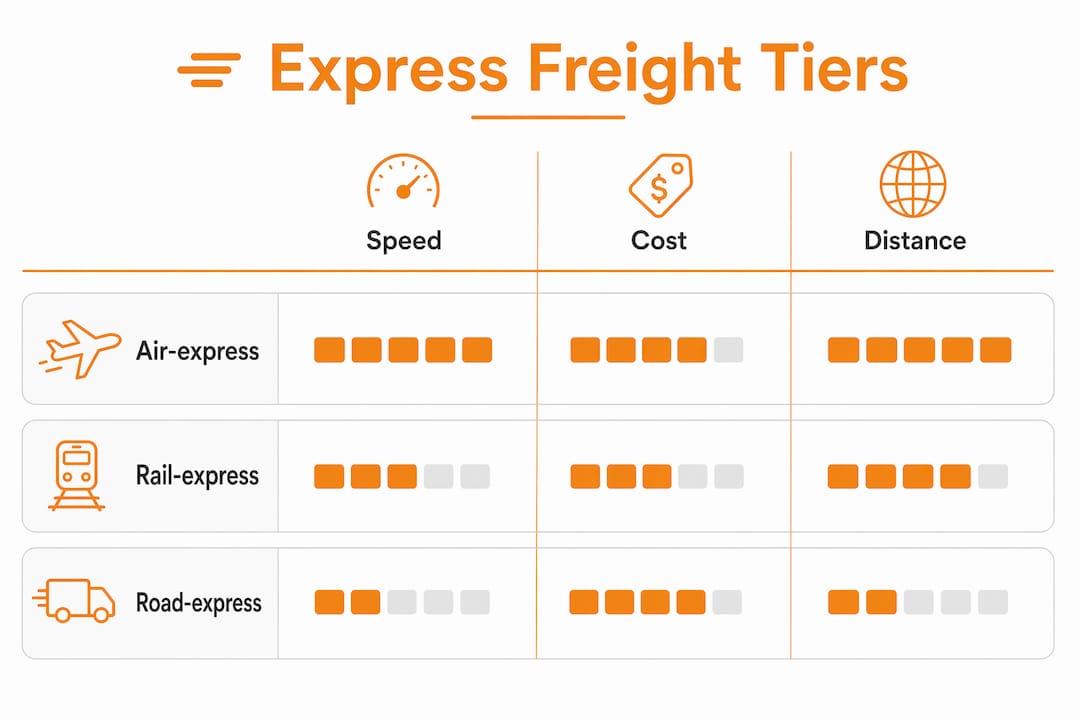
Express freight categorizes into three tiers based on urgency, distance, and cost tolerance. Each tier uses a different transport mode and delivers a different speed-to-price ratio.
Road-express
Road-express is the standard entry point for expedited ground shipping. It covers regional and national corridors with next-business-day delivery as the benchmark. This tier suits palletized cargo that needs to move fast within a 500–1,000 mile radius. Cost is lower than air-express, and dispatch is faster than rail because trucks access more origin and destination points directly.
Rail-express
Rail-express occupies the middle tier. It uses premium priority rail lanes that move faster than standard intermodal rail but cost less than air. This option works well for heavier freight moving across longer corridors where air costs are prohibitive. Transit times sit between road-express and air-express, making it a practical choice when the deadline is tight but not same-day.
Air-express
Air-express is the fastest tier, offering same-day or early next-morning delivery. It carries the highest cost and suits lightweight, high-value, or critically urgent cargo. One important nuance: regional ground “hot shot” services can outperform air-express on total transit time once airport handling, security screening, and transfer delays are factored in. Always calculate door-to-door time, not just flight time, before choosing air.
| Tier | Speed | Best for | Relative cost |
|---|---|---|---|
| Road-express | Next business day | Regional palletized cargo | Moderate |
| Rail-express | 2–3 days priority | Heavy cross-country freight | Lower than air |
| Air-express | Same day or next morning | Lightweight, urgent, high-value cargo | Highest |
Choosing the right tier requires matching your deadline to the tier’s realistic door-to-door time, not just its advertised speed. Weight, dimensions, and pickup location all affect which tier is actually available for your shipment.
What are the benefits and key considerations of express freight?
The primary benefit of express freight is protecting revenue. Express freight serves as a business continuity tool rather than just a faster shipping option. A halted production line or an empty retail shelf costs far more per hour than the premium on an express shipment. The math usually favors paying for speed.
Supply chain responsiveness is the second major benefit. When a supplier ships late or a customs delay pushes your inventory behind schedule, express freight gives you a recovery option that standard shipping cannot provide. That flexibility is worth building into your logistics budget as a contingency line item.
The cost considerations are real and require careful planning:
- Price premium: Express freight costs significantly more per pound than standard LTL or FTL shipping.
- Cubic conversion charges: Carriers apply cubic conversion rates such as 333 kg per cubic meter to calculate billable weight. Bulky, lightweight cargo often costs more than its actual weight suggests.
- Limited availability: Exclusive vehicles are not always immediately available in every market, especially in rural areas.
- Pricing transparency: Get a full quote that includes fuel surcharges, dimensional weight calculations, and any after-hours dispatch fees before committing.
Pro Tip: Always provide exact dimensions and weight before booking. Cubic conversion is one of the most common sources of unexpected surcharges in express freight pricing. A few centimeters of inaccuracy can shift your billable weight significantly.
The premium paid for express freight is justified when the cost of not delivering on time exceeds the shipping upgrade cost. That calculation should be explicit, not assumed.
How does express freight differ from standard freight?
The difference between express freight and standard freight is not just speed. It is a fundamentally different operational model. Standard LTL freight moves through terminals over three to five days, consolidating multiple shippers’ cargo at each stop. Express freight dispatches same-day or next-day and moves as a single dedicated load with no terminal contact.
Practitioners also draw a clear line between parcel express and express freight. Parcel express handles small packages under 150 lbs through carrier networks. Express freight handles larger, palletized loads that require dedicated vehicles and continuous trucking teams. Sending a pallet through a parcel network creates damage risk and transit delays that a dedicated express freight vehicle avoids entirely.
| Feature | Standard freight | Express freight |
|---|---|---|
| Dispatch time | 1–2 business days | Same day or within hours |
| Routing | Multi-terminal consolidation | Direct, point to point |
| Vehicle use | Shared with other shippers | Exclusive to your shipment |
| Transit time | 3–5 days (LTL) | As low as 2 days cross-country |
| Delivery window | Estimated range | Committed, guaranteed time |
| Tracking | Periodic updates | Real-time continuous |
Understanding freight cost factors helps you evaluate when the express premium makes financial sense versus when standard shipping is sufficient. The decision point is always the cost of a missed deadline versus the cost of the upgrade.
For Amazon sellers specifically, the stakes are higher. A stockout during peak season can suppress your listing ranking for weeks. That downstream cost often dwarfs the express freight premium paid to avoid it. ForwarderOne’s freight tracking systems give sellers the visibility needed to catch delays early and trigger express options before a stockout becomes inevitable.
Key Takeaways
Express freight service is the most reliable way to protect revenue and supply chain continuity when standard shipping cannot meet a critical deadline.
| Point | Details |
|---|---|
| Core definition | Express freight uses exclusive vehicles and direct routing to guarantee delivery windows. |
| Three service tiers | Road-express, rail-express, and air-express each offer different speed and cost trade-offs. |
| Team drivers cut transit time | Relay drivers reduce cross-country transit from 4–5 days to as little as 2 days. |
| Cubic conversion matters | Always calculate dimensional weight to avoid unexpected surcharges on bulky shipments. |
| Express freight protects revenue | The cost of a missed deadline typically exceeds the express shipping premium. |
Express freight is a decision tool, not a last resort
Most shippers treat express freight as an emergency option. I think that framing costs them money.
The businesses that use express freight most effectively treat it as a planned decision variable, not a panic button. They know their critical inventory thresholds, they know which SKUs cannot go out of stock, and they have pre-negotiated express rates ready to activate. When a delay hits, they move within hours instead of spending two days getting quotes.
The cubic conversion issue is where I see the most avoidable surprises. Shippers focus on weight and ignore dimensions. Then they get a bill that is 30% higher than expected because their cargo triggered a dimensional weight calculation. Measure everything before you book, every time.
Air-express is also overused. I have seen shipments where a dedicated ground hot shot service delivered faster door to door than an air option because the airport handling added six hours to the total transit. Always calculate the full door-to-door time before paying the air premium.
The right mindset is this: express freight is a business continuity investment. The question is never “can I afford express freight?” The question is “what does it cost me if this shipment is late?” Answer that honestly and the tier decision becomes straightforward.
— Keven
How ForwarderOne handles urgent freight for Amazon sellers
Time-critical shipments require a logistics partner who already has the infrastructure in place, not one building it after you call.
ForwarderOne specializes in moving inventory from China to US fulfillment centers with over 99% on-time delivery. The platform’s all-inclusive DDP shipping service manages customs, duties, and final delivery in a single workflow, removing the friction that slows urgent shipments down. For Amazon sellers who cannot afford a stockout during peak season, ForwarderOne assigns a dedicated account manager to each client, so urgent freight decisions get handled by someone who already knows your supply chain. Explore ForwarderOne’s full freight forwarding services to find the right option for your next time-critical shipment.
FAQ
What is the express freight definition in logistics?
Express freight is defined as a dedicated, time-critical shipping service that uses exclusive vehicles, direct routing, and guaranteed delivery windows for shipments typically over 150 lbs. It differs from standard freight by skipping terminal consolidation entirely.
How does express freight work differently from standard LTL?
Express freight dispatches same-day or next-day on a dedicated vehicle moving directly to the destination, while standard LTL consolidates multiple shippers’ cargo across several terminal stops over three to five days.
What is the difference between parcel express and express freight?
Parcel express handles small packages under 150 lbs through shared carrier networks. Express freight handles larger, palletized loads on dedicated vehicles with continuous team drivers, making it suitable for time-critical bulk cargo.
When should a business use expedited shipping over standard freight?
A business should use expedited shipping when the cost of a missed delivery deadline, such as a production stoppage or retail stockout, exceeds the premium cost of the express service.
What causes unexpected charges in express freight pricing?
Cubic conversion calculations are the most common source of surprise charges. Carriers apply dimensional weight formulas, such as 333 kg per cubic meter, so bulky but lightweight cargo often bills higher than its actual weight.
Need an urgent freight recovery plan?
Send origin, cargo specs, destination, and deadline. ForwarderOne will compare express, air, ocean, and DDP options before you overpay for speed.