A freight forwarder handles duties by managing customs documentation, coordinating with licensed brokers, and keeping your shipments compliant from origin to destination. For Amazon sellers and logistics managers moving goods from China to US fulfillment centers, this role is the difference between smooth delivery and costly delays. The term “duty handling” is informal shorthand for what the industry calls customs clearance coordination, a structured process that freight forwarders perform on your behalf. Understanding why freight forwarder handles duties, and where their authority ends, gives you real control over your supply chain.
Why do freight forwarders handle duties in international shipping?
Freight forwarders handle duties because they sit at the center of every document, carrier, and compliance requirement in a cross-border shipment. They are the single point of contact between you, the shipping carrier, and the customs authorities at the destination port. When goods move from China to a US Amazon warehouse, the forwarder coordinates the entire chain: booking cargo space, preparing transport documents, and working with a licensed customs broker to file the formal entry with US Customs and Border Protection.
The importance of freight forwarders in this process comes down to specialization. Customs rules change frequently, tariff classifications are complex, and a single error on a commercial invoice can hold your shipment for days. Forwarders prepare all transport documents and coordinate with licensed brokers to prevent shipment rejections. That coordination is not optional. It is the mechanism that keeps your inventory moving.
Forwarders also coordinate complex logistics such as booking ocean freight, air freight, and ground transportation while consolidating cargo to reduce costs. They do not own ships or planes. They use their carrier relationships and volume to get you better rates and faster transit times than you could negotiate alone.
What tasks do freight forwarders perform related to customs duties?
Freight forwarder role in customs covers a specific set of tasks that most sellers underestimate until something goes wrong. Here is what a qualified forwarder does on every shipment:
- Document preparation. The forwarder prepares the Bill of Lading, commercial invoice, packing list, and any certificates of origin required for your product category. These documents are the foundation of every customs entry.
- HS code classification. Forwarders check tariff codes and classify goods to the Harmonized System to reduce import risks. An incorrect HS code triggers the wrong duty rate and can result in fines or seizure.
- Customs broker coordination. Forwarders work with licensed customs brokers to file the formal entry with CBP. The broker calculates the exact duty owed and submits the entry on your behalf.
- Duty estimation. Before your goods ship, a good forwarder gives you a landed cost estimate that includes duties, fees, and freight charges. This prevents budget surprises at the port.
- Compliance monitoring. Forwarders track regulatory changes, flag potential issues with your product descriptions, and alert you before a shipment reaches customs.
- Duty payment coordination. When a forwarder offers integrated brokerage or a Delivered Duty Paid (DDP) service, they collect duty funds from you in advance and pay CBP directly.
Pro Tip: Always ask your forwarder to confirm the HS code for your product before the first shipment. Forwarders identify incorrect HS code classifications early and save businesses thousands in demurrage fees. Getting this right from the start is far cheaper than correcting it after a hold.
How do freight forwarders differ from customs brokers in duties management?
Clients often confuse freight forwarding with customs brokerage, not realizing that only licensed brokers can file customs entries and calculate duties. This confusion causes real problems when a shipment arrives and no one has filed the entry. The table below shows the core differences.
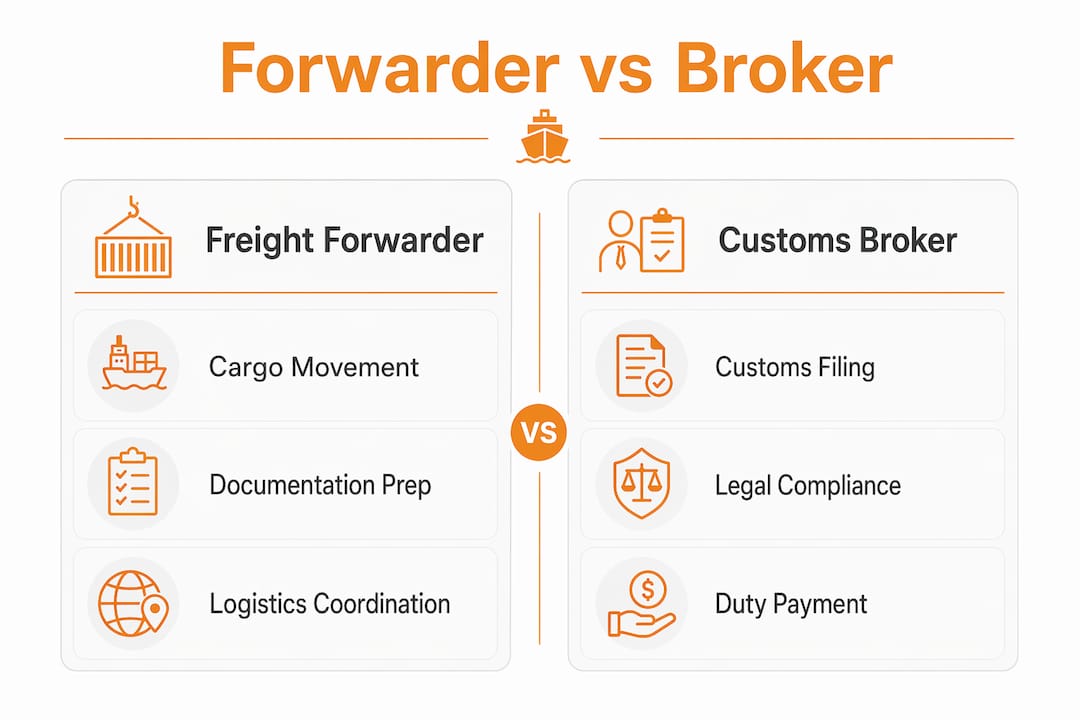
| Function | Freight forwarder | Licensed customs broker |
|---|---|---|
| Primary role | Moves cargo from origin to destination | Files customs entries and calculates duties |
| Licensing requirement | No federal license required for forwarding | Must hold a CBP-issued license |
| Document preparation | Bills of Lading, packing lists, commercial invoices | Formal entry filings, duty calculations |
| Legal liability for duties | Acts as agent; cannot assume importer liability | Files on behalf of importer; bound by CBP rules |
| Customs entry filing | Cannot file without broker involvement | Core function |
| Best for | Route planning, carrier booking, consolidation | Regulatory compliance, duty accuracy |
The legal line is clear. Forwarders cannot legally file customs entries without broker involvement, and delays happen when a forwarder lacks an in-house brokerage or a strong broker partnership. The importer of record, meaning you, remains legally liable for duty accuracy regardless of who coordinates the process.
Many forwarders now integrate brokerage services or partner with licensed brokers to offer end-to-end shipping and customs clearance. This integration eliminates coordination gaps and speeds up customs processing. When you evaluate a forwarder, ask directly whether they have in-house brokerage or a dedicated broker partner. The answer tells you how much coordination risk you are taking on.
Why is using a freight forwarder for duties beneficial for e-commerce sellers?
The benefits of how freight forwarders manage duties go beyond convenience. They translate directly into lower costs and fewer stockouts, both of which hit your Amazon seller metrics hard.
- Single point of contact. You deal with one team instead of managing a carrier, a broker, a warehouse, and a customs agent separately. This cuts administrative time and reduces the chance of information falling through the cracks.
- Cost savings through consolidation. Forwarders consolidate smaller shipments into full containers, spreading freight costs across multiple sellers. Combined with expert route selection, this lowers your per-unit shipping cost.
- Error prevention. A forwarder who knows your product catalog catches misclassifications and incomplete invoices before they reach CBP. Incorrect invoices commonly cause shipment holds that forwarders cannot fix alone once the shipment is in customs.
- Proactive problem solving. Good forwarders monitor your shipment status and flag issues before they become delays. This matters most during peak seasons like Q4, when a one-week hold can mean lost sales during the holiday window.
- Reduced landed cost. Bundling customs brokerage with freight forwarding reduces landed costs by 8–15% and cuts administrative time for importers. That margin improvement compounds across every shipment you send.
The 8–15% landed cost reduction is not a rounding error. On a $50,000 shipment, that is $4,000–$7,500 back in your pocket per order. For small and mid-sized Amazon sellers, that difference funds the next inventory buy.
For a detailed walkthrough of the full process, the US customs clearance steps for e-commerce importers shows exactly where forwarder involvement matters most.
What are common challenges when freight forwarders handle duties?
Knowing why use a freight forwarder is only half the equation. The other half is avoiding the mistakes that undermine the relationship and slow your shipments.
- Providing inaccurate product information. The importer of record holds legal responsibility for accurate customs declarations. If your commercial invoice lists vague descriptions like “plastic parts” instead of the specific product, CBP will flag it. Your forwarder cannot fix bad data you provided.
- Assuming the forwarder is also the broker. Many sellers believe their forwarder files the customs entry. Unless the forwarder has in-house brokerage, a separate licensed broker does that work. Clarify this before your first shipment.
- Delayed document submission. Ocean freight to the US requires ISF (Importer Security Filing) submission at least 24 hours before loading. Missing this deadline triggers fines. Your forwarder needs your product details early enough to meet this window.
- Choosing a forwarder without broker partnerships. A forwarder who outsources broker coordination to an unfamiliar third party adds a communication layer that slows clearance. Select a forwarder with a direct broker relationship or in-house capability.
- Ignoring compliance updates. US tariff rules on Chinese goods have changed repeatedly since 2018. A forwarder who tracks these changes proactively protects you from paying the wrong duty rate.
Pro Tip: Freight forwarders are most effective when shippers provide transparent and accurate product details upfront. Build a product information template with your HS code, country of origin, declared value, and product description. Share it with your forwarder before every new SKU ships.
For guidance on selecting the right partner, the how to choose a freight forwarder guide for Amazon sellers covers the key questions to ask before signing.
Key Takeaways
A freight forwarder handles duties by coordinating documentation, partnering with licensed customs brokers, and managing compliance so you avoid delays, penalties, and excess costs.
| Point | Details |
|---|---|
| Forwarders coordinate, brokers file | Only licensed customs brokers can file entries; forwarders manage the surrounding logistics. |
| Bundled services cut landed costs | Combining freight forwarding with brokerage reduces landed costs by 8–15% per shipment. |
| Accurate invoices are your job | The importer of record is legally liable for duty accuracy; bad data from you causes holds. |
| HS code errors are expensive | Misclassification triggers wrong duty rates, fines, and delays that cost thousands to resolve. |
| In-house brokerage speeds clearance | Forwarders with integrated brokerage eliminate coordination gaps and process entries faster. |
The role gap most sellers never see coming
Most of my clients come in thinking their freight forwarder handles everything customs-related. They sign on, hand over the shipment, and expect duties to just get paid. The reality is more layered than that, and the gap between expectation and reality is where delays live.
The sellers who avoid problems are the ones who treat their forwarder as a partner, not a vending machine. They send complete commercial invoices. They confirm HS codes before the first shipment. They ask whether their forwarder has in-house brokerage or a named broker partner. These are not complicated questions. They are the questions that separate a smooth Q4 from a shipment sitting at the port in november while your competitors restock.
The trend I see accelerating in 2026 is full-service DDP shipping, where the forwarder collects duties upfront and handles every step through final delivery. For Amazon sellers, this model removes the biggest variable in landed cost calculations. You know your total cost before the goods leave the factory. That predictability is worth more than most sellers realize until they have experienced a surprise duty bill on a high-volume shipment.
Treat your forwarder as the expert they are. Give them clean data, ask direct questions about their broker relationships, and review your HS codes annually as tariff rules shift. The sellers who do this consistently outperform those who treat forwarding as a commodity purchase.
— Keven
How ForwarderOne handles duties for Amazon sellers
ForwarderOne is built specifically for small and mid-sized Amazon sellers shipping inventory from China to US fulfillment centers. Its DDP freight forwarding service covers customs coordination, duty payments, and final delivery in a single workflow, so you never manage a separate broker relationship or face surprise fees at the port.
With over 99% on-time delivery and a dedicated account manager on every account, ForwarderOne gives you the visibility and reliability your Amazon business needs, especially during peak sales periods when stockouts cost real money. If you want a forwarder that manages duties, compliance, and delivery end to end, explore ForwarderOne’s China to USA DDP shipping options and see how the service fits your current shipping volume.
FAQ
Why does a freight forwarder handle duties instead of the seller?
Freight forwarders manage the coordination of duties because they have the carrier relationships, document expertise, and broker partnerships to do it efficiently. The seller remains the importer of record and holds legal liability, but the forwarder handles the operational complexity.
Can a freight forwarder file customs entries directly?
No. Freight forwarders cannot legally file customs entries without a licensed customs broker. They either employ in-house brokers or partner with licensed brokers to complete the filing on your behalf.
What is DDP shipping and how does it relate to duty handling?
DDP, or Delivered Duty Paid, is a shipping arrangement where the forwarder collects duties upfront and pays them directly to customs. It gives sellers a fixed landed cost and removes the risk of unexpected duty bills at the destination port.
What happens if my commercial invoice is inaccurate?
CBP will hold your shipment, and your forwarder cannot release it without corrected documentation. The importer of record may also face fines. Accurate product descriptions, declared values, and HS codes on every invoice prevent this outcome.
How do I know if my freight forwarder has strong customs brokerage capabilities?
Ask directly whether they have in-house licensed brokers or a named broker partner they work with on every shipment. A forwarder who cannot name their broker relationship is a coordination risk you should not take.
Need duties handled before your shipment arrives?
Send product descriptions, declared value, HS code assumptions, supplier city and destination. ForwarderOne will align freight booking, broker coordination, duty payment and delivery in one DDP plan.