What is cargo insurance and how does it protect your goods?
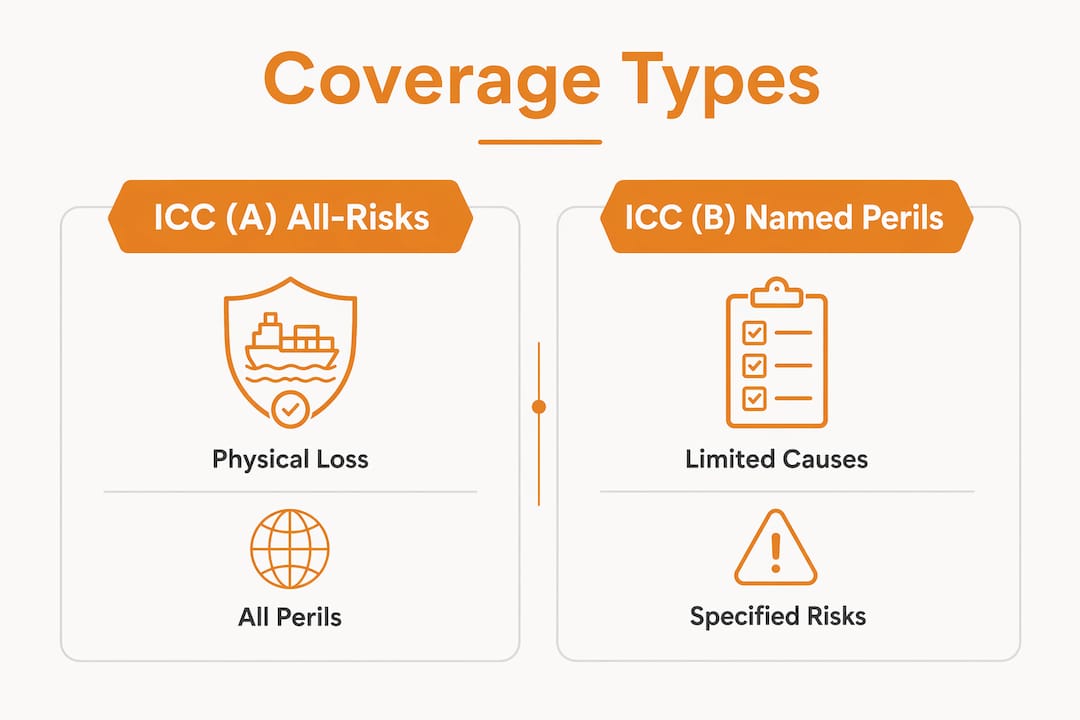
Cargo insurance is a first-party contract between an insurer and the cargo owner that pays for physical loss, theft, or damage to goods during transit by sea, air, road, or rail. The key word is first-party: the policy indemnifies you, the cargo owner, regardless of who caused the loss. You don’t need to prove the carrier was negligent. You file a claim, document the damage, and get paid.
Here’s what that means in practice:
- Coverage basis: Policies are typically written on the commercial invoice value plus freight, plus 10% for anticipated profit, so you recover 110% of invoice value rather than just the bare cost of goods.
- Scope of transit: Coverage runs door to door, from the moment cargo leaves the shipper’s premises to delivery at the consignee’s location, including loading and unloading.
- Standard framework: The Institute Cargo Clauses (ICC) set the three main coverage categories: ICC (A) all-risks, ICC (B) named perils, and ICC (C) basic coverage.
- Distinct from carrier liability: Carrier liability is a separate legal obligation, capped by international convention, often at $500 per package or $2 per kilogram, that requires proving fault. Cargo insurance bypasses that entirely.
- Who buys it: The party bearing risk of loss during transit, typically the shipper or consignee depending on the sale terms, arranges the policy.
Why cargo insurance matters more than most shippers realize
Carrier liability is capped at amounts that rarely reflect real commercial value. Ocean shipments often reference COGSA-style liability limits of $500 per package. Air cargo follows limits of $2 per kilogram under the Montreal Convention. A single container of electronics or apparel can run into hundreds of thousands of dollars, and the carrier’s legal obligation covers a fraction of that.

Cargo insurance fills that gap directly. It stabilizes trade flows and gives companies the financial footing to absorb a loss without disrupting operations or balance sheets. Banks and trade finance institutions often require proof of cargo coverage before advancing payment on international shipments, so the policy does double duty as both protection and a financing enabler.
The practical benefits stack up quickly:
- Financial recovery: Full commercial value reimbursed, not a capped per-package amount.
- No fault requirement: You don’t spend months building a negligence case against a carrier.
- Supply chain continuity: A covered loss doesn’t stall your next production run or inventory reorder.
- Credit access: Lenders and banks treat insured cargo as lower-risk collateral.
- Peace of mind: You can commit to delivery timelines with customers without betting the business on a single shipment.
The global cargo insurance market generates tens of billions in premiums annually, reflecting how widely businesses treat it as a non-optional cost of doing business internationally.
Types of cargo insurance coverage: ICC (A), (B), and (C) compared
The Institute Cargo Clauses give you three tiers of protection. Choosing the right one comes down to cargo value, route risk, and how much uncertainty you’re willing to carry.
- ICC (A) all-risks: The broadest form. Covers all physical loss or damage unless a specific exclusion applies. Most high-value cargo is insured here.
- ICC (B) named perils: Covers specific listed risks including water damage, fire, explosion, collision, and total loss. Narrower than ICC (A) but broader than ICC (C).
- ICC (C) basic: Covers only major casualties: sinking, fire, collision, and stranding. Theft and water damage are generally not included.
| Coverage Type | Scope | Typical Use Case |
|---|---|---|
| ICC (A) All-Risks | All physical loss/damage except named exclusions | High-value goods, electronics, apparel |
| ICC (B) Named Perils | Listed risks including water damage and fire | Mid-value cargo, bulk commodities |
| ICC (C) Basic | Major casualties only (fire, sinking, collision) | Low-value bulk cargo, raw materials |
Beyond the ICC tiers, policies come in two formats: single-shipment policies for one-off moves, and open cover (continuous) policies that automatically cover every shipment within agreed parameters. Freight forwarders often hold open cover agreements with marine underwriters and issue certificates of insurance at booking, which is faster and simpler for regular shippers. You can explore coverage categories in detail if you’re deciding between policy types for e-commerce inventory.

What cargo insurance actually covers, and what it doesn’t
A standard all-risks policy under ICC (A) covers physical loss or damage from causes including:
- Fire, explosion, and lightning
- Sinking, stranding, or collision of the vessel
- Overturning or derailment of land transport
- Jettison and washing overboard
- Theft and pilferage
- Water entering the conveyance
- Loss of packages during loading or unloading
Coverage typically runs from the shipper’s warehouse to the consignee’s door, so gaps between transport legs are generally closed under a well-written door-to-door policy.
Common exclusions are where claims get denied. Read these carefully before binding:
- Inherent vice: Spoilage, deterioration, or damage caused by the nature of the goods themselves, not an external event.
- Inadequate packaging: If the goods weren’t packed to withstand normal transit, the insurer can reject the claim.
- Delay: Loss of market or consequential financial loss from late delivery is excluded unless specifically endorsed.
- War and strikes: Standard policies exclude war, strikes, riots, and civil commotion unless you add a separate endorsement.
- Willful misconduct: Any loss caused intentionally by the insured voids coverage.
Who pays for cargo insurance, and when is it required?
The answer depends almost entirely on the Incoterm governing the sale. Under CIF and CIP, the seller is contractually obligated to arrange and pay for insurance. Under every other Incoterm, including FOB, EXW, and DDP, there is no contractual obligation. The party bearing risk of loss at any given point in transit is the one with a commercial reason to insure.
- CIF (Cost, Insurance, Freight): Seller arranges insurance to the destination port.
- CIP (Carriage and Insurance Paid To): Seller arranges insurance to the named destination.
- FOB, EXW, DAP, DDP: No insurance obligation on either party, but the buyer typically carries the risk once goods are loaded.
Best practice, regardless of Incoterm, is for the cargo owner to arrange their own coverage rather than rely on the counterparty’s policy. A seller’s CIF policy covers minimum terms only, often ICC (C), which leaves the buyer exposed to theft and water damage. Freight forwarders play a practical role here: they advise on coverage needs and can arrange policies through their open cover agreements, often at competitive rates. Understanding why sellers use freight forwarders helps clarify how that advisory role works in practice.
Cargo insurance vs. carrier liability: the gap most shippers miss
Many shippers assume the carrier will cover a loss. That assumption leaves real money on the table. Carrier liability and cargo insurance are fundamentally different instruments.
- Carrier liability is a legal obligation capped by international conventions (Hague-Visby for ocean, Montreal Convention for air, CMR for road). The cap is $500 per package or $2 per kilogram, far below invoice value for most commercial shipments.
- Fault requirement: You must prove the carrier caused the loss. Carriers have numerous legal defenses, and the process takes time.
- Cargo insurance is a first-party contract that pays the insured value regardless of fault. No litigation, no waiting for the carrier to accept responsibility.
- Speed of recovery: A cargo claim typically resolves faster than a carrier liability dispute, which can drag on for months.
- Subrogation: After paying you, the insurer pursues the carrier on their own. You’re out of the dispute entirely.
The practical upshot: carrier liability is a legal backstop, not a financial safety net. Cargo insurance is the actual financial protection.
How to choose the right cargo insurance policy for your shipment
Start with the shipment’s commercial value and the route’s risk profile. A $500 shipment of low-value goods moving domestically by truck needs different coverage than $80,000 of consumer electronics moving from China to a US fulfillment center.
- High-value or sensitive cargo: Always go ICC (A) all-risks. The premium difference over ICC (C) is small relative to the exposure.
- Insured value basis: Confirm the policy covers 110% of invoice value to account for freight costs, insurance premiums, and anticipated profit.
- Read the exclusions: Packaging requirements, temperature controls for perishables, and war/strikes endorsements are the three areas where claims most often fail.
- Mode-specific clauses: Air shipments use the Institute Cargo Clauses (Air) rather than the standard ICC (A/B/C) ocean clauses. Confirm your policy matches the transport mode.
- Single shipment vs. open cover: If you ship regularly, an open cover policy is more efficient and often cheaper per shipment than buying individual policies each time.
Pro Tip: Consult a specialized marine insurance broker or your freight forwarder before binding coverage on high-value or unusual cargo. They can identify route-specific risks, like piracy corridors or theft-prone transshipment ports, that a standard policy may not address without an endorsement.
How to obtain cargo insurance
Getting covered is straightforward. You can go through a freight forwarder, a licensed insurance broker, or directly through a marine underwriter.
- Gather shipment details: Commercial invoice, packing list, bill of lading or airway bill, commodity description, and declared value.
- Choose a policy type: Single-shipment certificate for a one-off move, or open cover if you ship regularly.
- Declare the insured value: Invoice value plus freight plus 10%, as standard practice.
- Select coverage tier: ICC (A) for broad protection, ICC (B) or © for lower-value or bulk cargo.
- Receive the certificate: Your insurer or forwarder issues a certificate of insurance, which you may need to present to banks, buyers, or customs authorities.
Documentation matters from day one. Proper packaging and photos taken before loading are not just good practice. They’re what separates a paid claim from a denied one. ForwarderOne’s cargo insurance guide for importers walks through the documentation checklist in detail.
How to file a cargo insurance claim
Act fast. Most policies require written notice of loss within a specific window, often 3–7 days of delivery, and missing that deadline can void the claim entirely.
- Notify the insurer immediately upon discovering loss or damage.
- Document everything: Photographs of damaged goods, packaging, container seals, and the delivery receipt with exceptions noted.
- Obtain a survey report if the loss is significant. The insurer may appoint a surveyor to inspect the damage.
- Submit the claim package: Commercial invoice, packing list, bill of lading, survey report, photos, and the delivery exception note.
- Cooperate with subrogation: If the insurer recovers from the carrier, you may need to assign your rights to them.
The single biggest reason claims get denied is documentation failure, not policy exclusions. Photos, seal numbers, and delivery exception notes are the operational backbone of a successful claim.
What drives cargo insurance premiums
Premiums are not flat. Underwriters price each risk based on several factors:
- Commodity type: Electronics, pharmaceuticals, and luxury goods carry higher premiums than raw materials or bulk commodities.
- Declared value: Higher insured value means higher premium, though the rate per dollar often decreases at scale.
- Mode of transport: Ocean freight generally carries lower rates than air for equivalent goods; road and rail vary by route.
- Origin and destination: High-theft corridors, politically unstable regions, and transshipment hubs with poor security records push premiums up.
- Packaging quality: Well-packaged cargo in certified containers attracts better rates.
- Claims history: A shipper with frequent past claims pays more than one with a clean record.
- Coverage tier: ICC (A) costs more than ICC (C) for the same shipment, reflecting the broader scope of protection.
When cargo insurance made the difference for real businesses
These scenarios illustrate why coverage matters beyond theory.
Container theft at a transshipment port: An importer shipping consumer electronics through a high-risk transshipment hub discovered an entire pallet missing on arrival. Carrier liability covered $500 per package. The cargo insurance policy, written at 110% of invoice value under ICC (A), covered the full commercial loss within weeks.
Water damage from a vessel incident: A clothing brand’s shipment was stored in a container that took on water after a vessel incident at sea. The goods were a total loss. Without ICC (A) coverage, the brand would have absorbed the entire cost. The policy paid out, and the brand reordered in time for the season.
Truck collision on a domestic leg: An Amazon seller’s inventory, already cleared through customs on a DDP shipment, was damaged in a truck collision on the final mile to the fulfillment center. The cargo policy covered the domestic leg because it was written door to door, not just port to port.
Each of these situations shares one feature: the carrier’s liability was either insufficient or disputed. The cargo policy paid regardless.
Key Takeaways
Cargo insurance is the only reliable way to recover full commercial value when goods are lost or damaged in transit, because carrier liability caps leave most of the financial risk with the cargo owner.
| Point | Details |
|---|---|
| First-party coverage | Cargo insurance pays the cargo owner regardless of fault, unlike carrier liability which requires proving negligence. |
| Standard insured value | Policies are typically written at 110% of invoice value to cover freight, premiums, and anticipated profit. |
| ICC coverage tiers | ICC (A) all-risks is the broadest form; ICC (C) covers only major casualties like fire and sinking. |
| Carrier liability gap | Ocean shipments often reference $500-per-package limits, far below actual commercial value for most goods. |
| Claims hinge on documentation | Photos, delivery exception notes, and timely notice are what determine whether a claim gets paid. |
Ship smarter with ForwarderOne’s built-in cargo protection
ForwarderOne handles freight forwarding from China to US fulfillment centers under a fully managed DDP service, with cargo insurance guidance built into every shipment. Whether you’re moving a single container or running continuous inventory replenishment, the team helps you select the right coverage tier, prepares the documentation, and keeps your supply chain moving even when something goes wrong. Explore ForwarderOne’s freight forwarding services to see how cargo insurance fits into a complete DDP shipping solution built for Amazon sellers.
Need cargo protection built into your freight plan?
ForwarderOne helps ecommerce sellers match insurance coverage, documentation, customs clearance, and final delivery in one managed shipping workflow.