
As of August 19, 2026, CBP's published tariff overview highlights additional-duty programs covering steel, aluminum, autos and auto parts, certain semiconductors, copper, timber and lumber, and specified upholstered wooden products. Other goods may also be affected by the base HTSUS rate, Section 301 measures, antidumping or countervailing duty orders, or country-specific actions.
That verification trail runs through four places: the Harmonized Tariff Schedule of the United States (HTSUS), U.S. Trade Representative (USTR) lists, U.S. Customs and Border Protection (CBP) advisories, and the Federal Register. None of them are optional if you actually need a number you can rely on.
Before you go further, here’s where to look first:
- HTSUS for the base duty tied to your product’s HS code
- USTR Section 301 lists for China-specific measures and active exclusions
- CBP’s tariff overview and the Federal Register for current country-specific programs, interaction rules, and effective dates
Pro Tip: Find your product’s 6-to-10 digit HTS code first. Everything else, the base rate, the Section 301 add-on, the exclusions, is indexed to that code, not to a product’s common name.
Key Takeaways
Tariff exposure depends on a product’s exact HTS code, its country of origin, and whichever mix of Section 232, Section 301, and reciprocal duties currently applies to it.
| Point | Details |
|---|---|
| Common tariffed categories | CBP currently highlights steel, aluminum, autos and auto parts, certain semiconductors, copper, timber and lumber, and specified upholstered wooden products. |
| Check interaction rules | More than one duty can apply, but CBP publishes exclusions and non-stacking rules; do not add program rates mechanically. |
| Verify before you ship | Confirm rates through HTSUS, USTR lists, CBP overviews, and the Federal Register, not secondhand summaries. |
| Price impact is measurable | A tariff changes landed cost immediately; the retail-price effect depends on supplier pricing, inventory timing, margins, and pass-through. |
| Hands-off option exists | ForwarderOne can coordinate classification inputs, customs clearance, duty estimates, and DDP delivery in one shipment plan. |
Where to verify tariffs yourself
- HTSUS (USITC): the definitive base duty rate by HS code.
- CBP’s U.S. Tariff Overview: a plain-language summary of additional-duty programs, exceptions, and interaction rules.
- USTR Section 301 lists: China-specific measures and active exclusions.
- Federal Register: the legal text and effective dates behind every proclamation.
- WTO Tariff Database: applied rates for cross-country comparison.
Representative Examples of Goods Currently Subject to Tariffs
Tariff exposure varies wildly by category, and the differences aren’t subtle. Here’s what the current landscape looks like across the sectors importers ask about most.
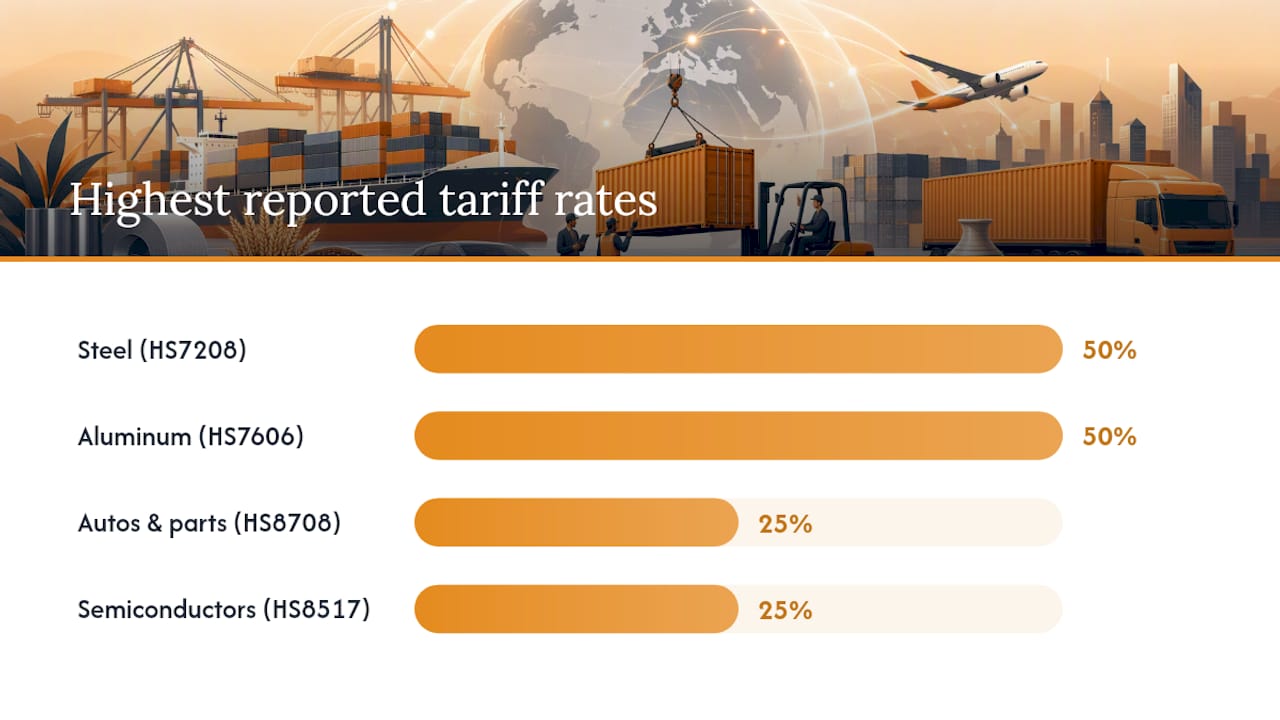
Steel and steel derivatives. CBP’s February 2026 overview lists a 50% Section 232 rate for covered steel and derivatives from most origins, with a 25% rate for covered UK goods and an exception for qualifying U.S.-melted and poured steel. Coverage is defined by the listed HTS provisions, not by a product’s common name.
Aluminum and aluminum derivatives. The same CBP overview lists a 50% Section 232 rate for covered aluminum and derivatives from most origins, 25% for covered UK goods, 200% for covered Russian aluminum, and an exception for qualifying U.S.-smelted and cast aluminum.
Autos and auto parts. Covered passenger vehicles, light trucks, and parts are generally subject to Section 232 duties, but USMCA eligibility and country-specific arrangements can change the result. Confirm the applicable HTS and Chapter 99 provisions.
Certain semiconductors and derivatives. CBP lists a 25% Section 232 rate for specified products together with detailed end-use and technical exceptions.
Timber, lumber, and upholstered wooden products. CBP’s overview identifies additional Section 232 duties for specified softwood timber and lumber, upholstered wooden products, cabinets, vanities, and parts.
Copper and mixed-metal derivatives. Covered copper content can be subject to Section 232 duties. CBP also provides special reporting and interaction rules when an article contains copper, steel, aluminum, and non-metal content.
The rate a specific shipment actually pays depends on country of origin and the provisions and exclusions effective on its entry date, so treat these examples as a starting point, not a final answer.
Which Tariff Programs Actually Apply to Your Goods
Several legal mechanisms shape current U.S. tariff exposure, and their interaction depends on the product, origin, entry date, and controlling Chapter 99 provisions.
Section 232 covers national security tariffs, the legal basis for the steel, aluminum, and auto duties described above. Section 301 targets specified products from particular trading partners, most visibly China, through lists that USTR periodically amends and may subject to exclusions. Do not carry forward the 2025 IEEPA tariff stack as current advice: the June 2026 CBP rule records the February 2026 termination of certain IEEPA tariffs. Check the measures actually in force on the entry date. The product’s applicable HTSUS base rate is the starting point; origin, preference eligibility, Chapter 99 provisions, and program interaction rules determine the final treatment.
More than one duty can affect the same entry, but the interaction is not simple addition. CBP’s current overview and IEEPA FAQ include explicit exceptions and non-stacking rules for combinations of Section 232 and IEEPA programs.
- Start with the base HTSUS rate for the exact 10-digit classification.
- Identify the country of origin and any applicable Section 301 or country-specific measure.
- Check whether a Section 232 program covers the product or specified content.
- Apply the controlling Chapter 99 provisions, exclusions, and non-stacking rules for the entry date.
Two similar products can still have very different landed costs because classification, origin, covered material value, end use, and program exceptions all matter. Use CBP’s current tariff overview as a high-level map, then verify the controlling legal notice.
How to Verify If a Specific Product Is Subject to Tariffs
Guessing costs money. Here’s the actual sequence to confirm what you’ll owe on a real shipment.
- Identify the HS/HTS code. Everything downstream depends on getting this right, down to the 8 or 10 digit level.
- Check the HTSUS for the applicable base duty. Then review any preference rules, special rates, and current trade actions.
- Check USTR’s Section 301 lists and active exclusions. Coverage and exclusion dates can change, so use the version effective on the entry date.
- Consult current CBP guidance and HTSUS Chapter 99 provisions for Section 232 or other applicable adjustments tied to the goods and entry date.
- Search the Federal Register for the specific proclamation and its effective date, because a trade action can change during the year.
- Check for antidumping or countervailing duty (AD/CVD) orders through official Commerce, USITC, and CBP resources, then confirm the case-specific cash-deposit requirements and interactions with your broker.
For lookup tools beyond the government sites themselves, the Customs Info Database requires an HS code and account registration but returns applied rates by country, and the WTO Tariff Database shows member-country applied rates for cross-border comparison.
- Ambiguous product descriptions can lead to misclassification.
- Composite goods may require separate value reporting for covered metal content and non-metal content under CBP implementation rules.
- HTSUS chapter notes and annexes frequently contain exceptions that the main tariff line doesn’t mention.
Pro Tip: If your product’s country of origin changed recently, say you moved final assembly from China to Vietnam, don’t assume the tariff exposure moved with it. Rules of origin for tariff purposes often hinge on where the last “substantial transformation” happened, not just final assembly.
Exemptions, Exclusions, and Ways to Reduce Exposure
Exclusions, origin rules, and program-specific exceptions can change the assessed rate when the shipment qualifies and the documentation supports the claim.
- U.S.-origin melt, pour, smelt, and cast provisions can change Section 232 treatment for qualifying covered content when the applicable reporting and documentation requirements are met.
- USMCA and other FTA origin rules may provide preferential base-duty treatment or qualify goods for program-specific exceptions when every origin requirement is met.
- Published exclusions and exceptions apply only to the products, origins, uses, and dates stated in the controlling notice or HTSUS provision.
- Program-specific exclusion processes, when open, may let eligible parties request relief under the published rules and filing window.
- Duty drawback may allow recovery of eligible duties when goods are later exported or destroyed, subject to the program, claim type, and documentation requirements.
Pro Tip: Keep supplier certificates of origin on file from day one. Retroactively proving where a product was made, once customs asks, is far harder than producing the paperwork you already had.
What Tariffs Change in Your Landed Cost
An additional duty raises landed cost as soon as the entry is assessed. The eventual retail-price effect depends on how much the importer absorbs, passes to customers, negotiates with suppliers, or offsets through sourcing and logistics changes.
Model the shipment at the HTS-code level before issuing a purchase order. Keep a dated record of the rate source, origin analysis, exclusions, and broker assumptions so a later change can be traced instead of guessed.
A logistics provider’s view on tracking tariff lists
Landed-cost surprises often begin when a tariff assumption changes after a purchase order is placed. Build a repeatable check into sourcing: model duty exposure at the actual HTS code before ordering, record the source and effective date, and keep supplier origin documentation current. Ask your customs broker to confirm the controlling provisions for the planned entry date.
DDP shipping that handles the tariff math for you
Tariff research is a necessary part of landed-cost planning, and getting it wrong is expensive. ForwarderOne’s DDP workflow can coordinate classification inputs, customs clearance, duty estimates, and delivery in one shipment plan, subject to the final entry facts and customs assessment.
The service includes tariff classification support at the HTS level, full customs clearance from China or Korea to U.S. and Mexico fulfillment centers, DDP pricing that bakes duties into a single upfront quote, and landed-cost estimates before you commit to a purchase order. A dedicated account manager can walk through tariff scenarios for your specific product line before you ship, not after. If you’re sourcing product that touches any of the categories above, get a shipping quote and see the full landed cost before your inventory leaves the factory.
Frequently Asked Questions
What goods are most commonly subject to tariffs right now? CBP’s current overview highlights steel, aluminum, autos and auto parts, certain semiconductors, copper, timber and lumber, and specified upholstered wooden products. Other coverage depends on the HTS code, origin, and active trade measures.
How do I find the tariff rate for a specific item? Identify its HTS code and country of origin, check the HTSUS base rate, then review applicable Chapter 99 provisions, exclusions, and CBP’s current non-stacking guidance.
Can a product be exempt from tariffs even if its category usually isn’t? Yes. Product-specific exclusions, qualifying origin rules, U.S.-melted or poured steel and U.S.-smelted or cast aluminum provisions, and other program-specific exceptions may apply when their documentation requirements are met.
Do tariffs apply differently depending on where a product ships from? Country of origin is often one of the biggest variables in the final rate. Identical products from different countries can receive different treatment under applicable Section 301, country-specific, preference, and exception rules.
Where can I check if a tariff rate has changed recently? Use the HTSUS and CBP’s current tariff overview as starting points, then confirm the controlling proclamation, Executive Order, Federal Register notice, and CBP implementation guidance.
Model the landed cost before cargo moves
ForwarderOne can coordinate classification inputs, customs clearance, duty estimates, DDP freight, and final delivery in one shipment plan.