A freight spot rate is the real-time, one-off price quoted to move a shipment on short notice, reflecting current market supply and demand conditions. Unlike contract rates locked in for 12–24 months, spot rates change daily, sometimes hourly, based on available truck or vessel capacity at any given moment. For logistics professionals and business owners managing shipping costs, understanding spot freight pricing is the difference between reacting to the market and using it to your advantage.
What is a freight spot rate and how does it work?
A freight spot rate is real-time, one-off pricing for immediate or short-notice shipment capacity. The rate reflects what carriers are willing to accept right now, not what was negotiated months ago. When your routing guide fails or a volume surge hits, the spot market is where you turn.
Spot rates apply across every major transport mode: full truckload (FTL), less-than-truckload (LTL), ocean freight, and air freight. Each mode has its own spot market dynamics, but the core mechanic is the same. A shipper needs capacity, a carrier has it, and a price is agreed on the spot.

The term “spot market” comes from commodity trading, where goods are bought and sold for immediate delivery at the current price. Freight adopted the same concept. Platforms like DAT and project44 publish spot rate indexes by lane, giving shippers a benchmark to evaluate whether a quote is fair or inflated.
What factors determine freight spot rates?
Spot rates move based on a combination of supply, demand, and shipment-specific variables. No two lanes price the same way, and no two weeks look identical on the same lane.
The primary drivers include:
- Carrier capacity: When trucks or vessels are scarce, rates spike. When capacity is loose, rates fall. This is the single biggest variable in spot freight pricing.
- Seasonality: Peak periods like the pre-holiday rush in Q4 or Chinese New Year in Q1 tighten capacity fast and push spot rates sharply higher.
- Fuel costs: Fuel surcharges move with diesel prices and are often itemized separately from the base rate. A quote that looks competitive can become expensive once surcharges are added.
- Shipment specifics: Weight, volume, origin, and destination all affect price. Chargeable weight is calculated as the higher of actual weight versus volumetric weight, which directly affects the final cost.
- Weather and disruptions: Port congestion, severe weather, and labor actions reduce available capacity and push spot rates up quickly.
- Accessorial fees: Liftgate charges, terminal handling fees, and residential delivery fees are often excluded from the base spot quote. Accessorial fees can raise the final freight cost substantially, so always ask if a quote is all-in or base-only.
Pro Tip: Before accepting any spot quote, ask the carrier or broker to itemize every surcharge. A base rate that looks 15% cheaper than your contract rate can end up costing more once fuel, liftgate, and handling fees are added.
Spot rate volatility is real and consequential. Rates that are favorable in February can be punishing by October on the same lane. Tracking lane-level trends over time gives you the context to judge whether today’s quote is a deal or a trap.
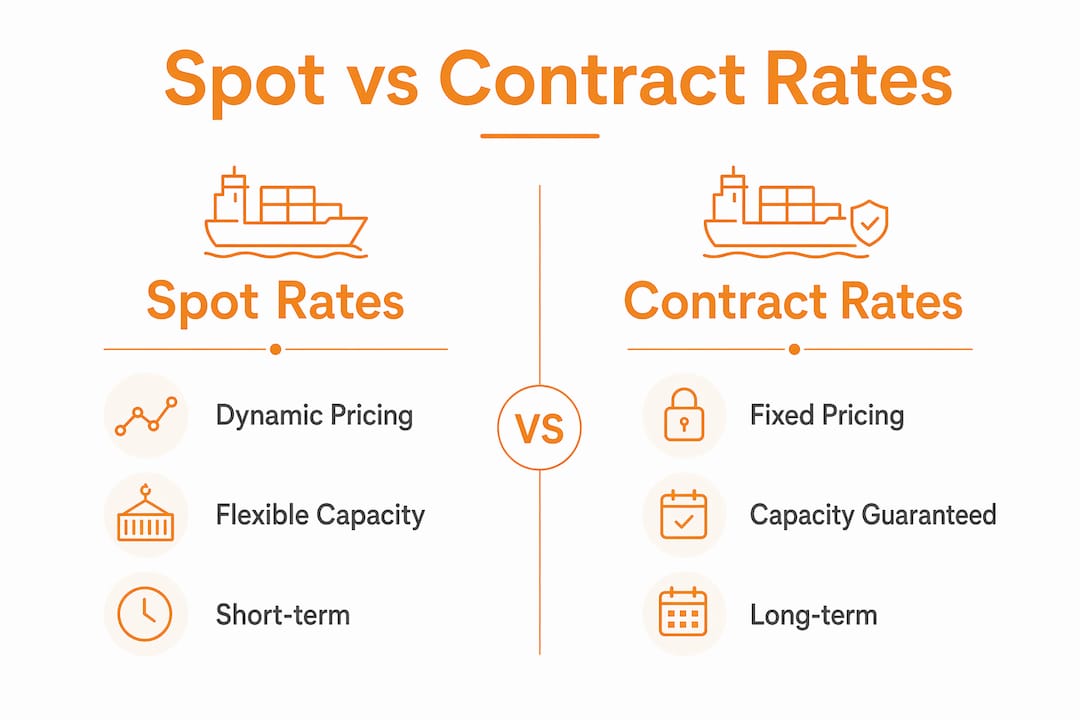
How do freight spot rates differ from contract rates?
Contract rates and spot rates solve different problems. Knowing which to use, and when, is a core logistics competency.
Contract rates are negotiated for fixed terms, typically 12–24 months, and lock in pricing and capacity commitments between shippers and carriers. Spot rates are transactional, with no ongoing commitment on either side. That difference in structure creates very different risk profiles.
| Feature | Spot rates | Contract rates |
|---|---|---|
| Pricing structure | Market-driven, changes daily | Fixed for contract term |
| Commitment | None, one shipment at a time | Mutual volume and capacity commitment |
| Price stability | Low, highly volatile | High, predictable for budgeting |
| Best use case | Urgent shipments, overflow, lane gaps | Regular lanes with predictable volume |
| Cost in tight markets | Higher than contract | Protected from market spikes |
| Cost in loose markets | Can be lower than contract | May overpay vs. market rate |
| Visibility | Requires active market monitoring | Built into procurement cycle |
Spot freight is often more expensive than contract freight during peak demand but can be cheaper when capacity is loose. That asymmetry is why most shippers use both, not one or the other.
Contract rates favor cost predictability and supply chain planning. Spot rates favor flexibility. The risk with over-relying on spot is that a capacity crunch can hit exactly when you need to move the most product, and you pay whatever the market demands.
Pro Tip: Review your contract rates against current spot benchmarks at least quarterly. If spot rates on a key lane have been consistently below your contract rate for 60 days or more, you have a strong case for a mini-bid or renegotiation.
What are the strategic benefits and risks of using freight spot rates?
The biggest misconception about spot rates is that they are a last resort. Forward-thinking shippers use spot market data proactively to inform contract negotiations, identify lane inefficiencies, and respond to volume surges without locking in capacity they may not need.
The genuine benefits of spot freight include:
- Flexibility: You book only what you need, when you need it. No volume commitments, no penalties for underutilization.
- Market intelligence: Spot rates reveal what capacity actually costs right now. That data is invaluable when entering contract negotiations or evaluating carrier performance.
- Speed: Spot bookings can happen in hours. When a supplier ships early or a sales spike empties your warehouse, the spot market moves faster than any contract amendment.
- Lane coverage: Carriers under contract may decline loads on low-priority lanes. The spot market fills those gaps.
The risks are equally real:
- Price spikes: During Q4 or supply disruptions, spot rates can surge well above contract levels, destroying freight budgets built on averages.
- Hidden costs: The administrative burden of booking spot freight includes manual load posting, broker calls, and waiting for responses. That overhead offsets cost savings and consumes team time.
- Lack of visibility: Shippers often overpay for spot freight by accepting the first quote due to a lack of unified pricing visibility. Pressure to move a shipment fast leads to poor rate decisions.
- No capacity guarantee: In a tight market, spot capacity disappears. Carriers prioritize contract customers, leaving spot shippers scrambling.
The most effective approach is a deliberate mix. Use contracts for your core, high-volume lanes. Use spot for overflow, urgent shipments, and lanes where you lack the volume to negotiate a contract rate. Then use spot data to continuously pressure-test your contracts.
How can you use spot rate data to reduce freight costs?
Spot rate data is most powerful when used systematically, not just when you need a truck today. Here is a practical framework for turning market data into cost savings.
-
Track lane-level spot trends weekly. Platforms like DAT publish spot rate indexes by lane and mode. Monitoring these weekly tells you whether rates are rising or falling on your key routes, so you can time bookings and contract renewals strategically.
-
Compare spot and contract rates side by side. Viewing spot pricing alongside contract rates enables informed procurement decisions under time pressure. If your contract rate on a lane is consistently above spot, that lane is a renegotiation candidate.
-
Automate spot booking where possible. The administrative overhead of manual spot procurement is a real cost. Digital freight platforms that automate load posting and carrier matching reduce that burden and improve the speed and quality of spot decisions. For sellers moving goods from China to US fulfillment centers, freight tracking systems that unify rate visibility across modes are particularly valuable.
-
Insist on all-in quotes. Never compare a base spot rate to an all-in contract rate. Ask every carrier or broker to include fuel surcharges, accessorials, and any terminal fees in the quote before you evaluate it.
-
Use spot data to trigger mini-bids. Successful companies monitor contract performance against spot benchmarks to identify savings opportunities. When spot rates drop significantly below your contract rate on a lane for 60 or more days, issue a targeted mini-bid to reset pricing.
-
Build a spot rate history by lane. Seasonal patterns repeat. If spot rates on your China-to-Los Angeles lane spike every September ahead of Q4, you can book contract capacity earlier or pre-position inventory to avoid peak pricing entirely.
Understanding how freight cost factors interact with spot market conditions gives you a real edge in planning shipments and avoiding overpayment.
Key Takeaways
Effective freight cost management requires treating spot rates as a strategic data source, not just a fallback pricing option.
| Point | Details |
|---|---|
| Spot rate definition | A spot rate is real-time, one-off pricing based on current carrier capacity and demand. |
| Key cost drivers | Weight, volume, mode, fuel surcharges, and accessorial fees all affect the final spot price. |
| Spot vs. contract | Contract rates offer stability; spot rates offer flexibility but carry price risk in tight markets. |
| Strategic use | Use spot market data to benchmark contracts, trigger mini-bids, and fill lane gaps efficiently. |
| Avoid overpayment | Always request all-in quotes and compare multiple carriers before accepting a spot rate. |
Why spot rates deserve more respect than they get
Keven here. After years of watching logistics teams treat spot freight as a necessary evil, I have a strong opinion: the problem is not spot rates. The problem is how most shippers use them.
The teams that get burned by spot rates are the ones who only enter the spot market under pressure. They are scrambling for a truck at the worst possible moment, accepting the first quote, and then blaming the market for the cost. That is not a spot rate problem. That is a planning problem.
The shippers who use spot rates well treat the spot market like a live data feed. They check lane rates regularly, even when they do not need a truck today. They use that data to challenge their contract carriers, to time their procurement cycles, and to spot capacity trends before they become emergencies.
The technology available in 2026 makes this easier than ever. Unified rate visibility tools, automated load matching, and lane-level analytics have removed most of the friction that made spot procurement painful. The shippers still complaining about spot rates are the ones who have not updated their processes to match the tools available.
My honest advice: stop treating spot and contract as two separate strategies. They are one strategy. The spot market tells you what capacity is worth right now. Your contracts lock in the capacity you need most. Use both, compare them constantly, and let the data drive your decisions.
— Keven
ForwarderOne’s approach to freight rate management
Freight rate decisions get complicated fast, especially when you are moving inventory from China to US fulfillment centers on tight timelines and tighter margins.
ForwarderOne is built for exactly that situation. The platform offers DDP shipping from China to the USA with transparent, all-in pricing that covers customs, duties, and delivery in a single workflow. No surprise surcharges, no rate ambiguity. For small and mid-sized Amazon sellers who need reliable capacity without the overhead of managing multiple carriers, ForwarderOne’s FBA freight forwarding service delivers over 99% on-time performance with a dedicated account manager handling the details. If you want freight costs that are predictable and capacity that shows up when you need it, that is the starting point.
FAQ
What is a freight spot rate in simple terms?
A freight spot rate is the price a carrier charges to move a shipment right now, based on current market supply and demand. It is a one-time transaction with no ongoing commitment from either party.
Are spot rates always higher than contract rates?
Not always. Spot freight is often more expensive than contract freight during peak demand but can be cheaper when carrier capacity is loose and demand is low.
What fees are excluded from a base spot rate?
Base spot rates typically exclude accessorial fees like fuel surcharges, liftgate charges, and terminal handling fees. Always ask for an all-in quote to understand the true cost before committing.
How do I know if a spot rate is fair?
Compare the quoted rate against published lane benchmarks from index providers. Tracking spot rates on your key lanes weekly gives you the context to judge whether a quote reflects current market conditions or is inflated.
When should I use spot rates instead of contract rates?
Use spot rates for urgent shipments, overflow volume, and lanes where you lack the consistent volume to negotiate a contract. Use contract rates for your core, high-frequency lanes where price stability and capacity guarantees matter most.
Need spot and contract rates compared for your next shipment?
Send your route, cargo specs, timeline, and target landed cost. ForwarderOne can compare DDP, spot, and planned freight options before you lock in capacity.