Yes, you can ship certain hazardous materials to FBA, but only after confirming the ASIN is eligible and lining up documentation like a Safety Data Sheet or Battery Test Summary. Before you book a truck, do three things: check the item’s status in Manage Dangerous Goods Classification, gather your SDS and BTS files, and confirm your packaging meets Limited Quantity or Excepted Quantity rules. Skip any of these and Amazon will reject the shipment at intake.
TL;DR:
- Sellers must verify ASIN classification status in Seller Central before shipment, as products under review cannot be shipped until cleared.
- Accurate documentation, including SDS and BTS files, is essential, with proper naming and version control to prevent rejection and facilitate appeals.
- Packaging must meet specific tier requirements (Limited Quantity, Excepted Quantity, or full hazmat) with visible markings verified before shipping.
- The upcoming Partnered Carrier expansion improves booking options for certain hazmat modes but does not eliminate the need for proper classification and documentation compliance.
- Maintaining organized records of SDS, BTS, exemption sheets, and shipment evidence is critical for quick resolution of intake rejections or flagged shipments.
Quick Eligibility Checklist: Is My Product a Dangerous Good for FBA?
Before you build a shipment plan, you need a straight answer on whether your SKU counts as hazmat under FBA dangerous goods shipping rules. Amazon doesn’t leave this to guesswork. Every ASIN gets a classification status you can see directly in Seller Central, and that status determines everything downstream, from which carrier options appear to whether you need an SDS on file at all.
Start in Manage Dangerous Goods Classification, found under the Inventory menu. This tool shows you whether an ASIN is classified as a dangerous good, flagged for review, or cleared for normal fulfillment. If it’s under review, Amazon is actively evaluating the product, usually triggered by a new listing, a category change, or a customer complaint. Don’t create a shipment for a SKU in review status until it resolves. Shipping into that gap is one of the fastest ways to get a carton rejected at the reception dock.
If you’re not sure whether your product needs review in the first place, pull up Section 14 of your SDS, the “Transport Information” section. This is where the real answer lives. Look for:
- A UN number (like UN3480 for lithium ion batteries or UN1950 for aerosols)
- The proper shipping name and hazard class
- Battery-specific attributes if applicable — UN3481 (batteries packed with equipment) or UN3091 (batteries contained in equipment)
- Flags for flammability, corrosivity, or oxidizing properties, common triggers for nail polish, cleaning sprays, and cosmetics
Products with none of these markers typically ship as standard inventory. Products with any of them need the full FBA hazmat requirements treatment: documentation, packaging verification, and in many cases, routing through the dangerous goods intake process rather than standard Send to Amazon.
Once you know where a SKU stands, build a folder for it. At minimum, keep the current SDS (PDF, not a photo of a printout), the BTS if batteries are involved, any applicable exemption sheet, and a screenshot of the ASIN’s classification status with a timestamp. This becomes your evidence packet if a shipment gets flagged or an appeal becomes necessary.
Pro Tip: Rename your SDS files with the UN number and revision date before uploading (e.g., “UN3481_SDS_2026-01.pdf”). Amazon’s reviewers and your own team will find the right version in seconds instead of digging through five files named “Sheet1_final_v2”.
What the FBA Dangerous Goods Program Requires
Amazon’s Dangerous Goods program isn’t a bolt-on to standard FBA. It’s a parallel set of storage, handling, and acceptance rules built around the reality that hazmat needs different fire suppression, ventilation, and staff training than a shelf of phone cases. Fulfillment centers that accept hazmat route those items into segregated storage zones staffed by employees trained specifically in dangerous goods handling, separate from the general receiving flow.
That separation is also why hazmat ASINs face a stricter intake check. A pallet of standard inventory gets scanned and shelved. A pallet flagged as dangerous goods gets checked against its declared UN ID, packing group, and quantity before it’s cleared to move past the dock.
The Partnered Carrier change announced by Amazon in 2026
Amazon is expanding its Partnered Carrier program to cover more dangerous goods shipping modes, letting more sellers book compliant hazmat freight directly through Seller Central instead of sourcing their own hazmat-certified carrier. On paper, that’s a real convenience: fewer phone calls to freight brokers who specialize in regulated materials, fewer surprises about whether a given carrier will even touch UN3480 batteries.
Here’s what it does not do. It does not replace ASIN eligibility checks, and it does not substitute for SDS or BTS documentation. Industry observers tracking the rollout note that the expansion smooths carrier selection for supported modes but leaves every classification and paperwork requirement exactly where it was. If your ASIN isn’t cleared and your documentation isn’t uploaded, a Partnered Carrier slot won’t get your shipment accepted. Think of it as removing a logistics bottleneck, not a compliance one.
For sellers, the practical shift is this:
- Air and small parcel hazmat shipments gain more Partnered Carrier routing options, cutting the need to negotiate directly with a third-party hazmat carrier for smaller volumes.
- LTL and FTL hazmat freight still often requires more manual carrier coordination, though the expansion is gradually extending coverage here too.
- Routing decisions made through Partnered Carrier still need to match what you declared in Send to Amazon. If Amazon routes your shipment to a fulfillment center that doesn’t handle your hazard class, that mismatch traces back to a declaration error on your end, not a system failure.
Keep your own routing records regardless of which carrier option you choose. Screenshot the confirmed routing, save the bill of lading, and note the fulfillment center assignment. If a shipment gets stopped somewhere in transit, you’ll want a clean paper trail showing what you declared and what Amazon confirmed, not a scramble to reconstruct it from memory.
Documentation Sellers Must Have Before Shipping
Every piece of hazmat paperwork in FBA compliance for hazmat traces back to one goal: proving your product can move through the supply chain without surprising anyone about what it is or how it behaves under stress. Three documents cover almost every scenario you’ll run into.
- Safety Data Sheet (SDS). Section 14, “Transport Information,” is the section carriers and Amazon actually care about. It needs to state the UN number, the proper shipping name, the hazard class and packing group, and emergency response guidance. An SDS missing Section 14 entirely, or one with a generic “not regulated” note that doesn’t match your product’s actual composition, will get flagged.
- Battery Test Summary (BTS). Required for lithium metal and lithium ion cells or batteries, the BTS documents that your battery passed the eight tests under UN 38.3 (altitude simulation, thermal test, vibration, impact, and others). If you’re shipping anything with UN3480, UN3481, or UN3091 markings, expect Amazon to request this before clearing the ASIN.
- Exemption sheets. Some products qualify for a materially reduced testing or documentation burden under specific transport exceptions, small lithium cell counts or certain limited-quantity consumer goods. If your item qualifies, the exemption sheet documents why, and you upload it in the same Manage Dangerous Goods Classification interface where you’d otherwise submit an SDS.
Upload fields inside Manage Dangerous Goods Classification accept PDF documents tied directly to the ASIN, so match your file to the product it covers exactly. A generic “battery SDS” that doesn’t specify the model number invites a rejection, since reviewers can’t confirm it applies to your listing.
One detail worth knowing: even a small lithium battery order still needs UN 38.3 evidence on file. There’s no informal threshold where a handful of units skips the BTS requirement. If your product contains a lithium cell, the paperwork applies regardless of order size.
Naming and version control matter more than sellers expect. Keep a master folder per ASIN with the SDS, BTS, and any exemption sheet, each labeled with a revision date. When manufacturers update formulations or battery specs, the SDS changes too, and an outdated document is a common reason valid products get flagged during a routine re-review. If you ever need to appeal a suppressed listing, having a dated document trail showing exactly what was on file at the time of shipment is often what turns the appeal around. For battery-specific SKUs, a step-by-step SDS and UN 38.3 checklist is worth bookmarking before your next shipment.
Packaging and Quantity Rules: LQ, EQ, and Full Hazmat
Choosing the right packaging tier is where most sellers either save real money or accidentally invite a shipment rejection. Three tiers exist, and the difference between them comes down to how much hazardous material is in each package and how strictly it’s regulated in transit.
Limited Quantity (LQ) covers small amounts of hazardous material packaged specifically to reduce risk during transport. LQ shipments follow reduced paperwork and labeling requirements compared to fully regulated hazmat, but they still need the diamond-shaped LQ mark on the outer packaging. Most consumer aerosols, nail polish, small flammable liquids, and many battery-powered devices ship under LQ provisions.
Excepted Quantity (EQ) applies to even smaller amounts, typically measured in grams or milliliters per inner packaging, and carries the lightest documentation burden of the three. EQ shipments use a distinct square-shaped mark with red hatching along the border rather than the LQ diamond.
Full HazMat classification applies once quantities exceed LQ or EQ thresholds, or when the material’s hazard class doesn’t qualify for either exception. Full hazmat shipments need proper shipping papers, placarding on larger freight, and often a hazmat-certified carrier for the transport leg.
| Tier | Typical use case | Outer marking | Shipping papers required |
|---|---|---|---|
| Excepted Quantity (EQ) | Very small amounts per inner package (grams/mL range) | Square mark with red hatched border | Generally not required |
| Limited Quantity (LQ) | Consumer aerosols, small flammables, battery-powered devices | Diamond “Y” mark, black on white/orange | Reduced shipping description |
| Full HazMat | Larger quantities or higher hazard classes | Full hazard class diamond placard | Full shipping papers, placards on freight |
Mode matters just as much as quantity. Air transport applies tighter limits than ground transport for the same UN number, since aviation authorities restrict certain hazard classes more aggressively than DOT ground rules allow. A quantity that clears LQ thresholds for a truck shipment might exceed the air LQ limit for the same product, which is why sellers shipping internationally or via air-only carriers need to check both sets of limits before packing a single carton.
The authoritative source for exact thresholds by UN number is the Hazardous Materials Table in 49 CFR §172.315, which lists LQ exceptions column by column against each hazard class. Cross-reference your specific UN number here rather than relying on a generic “aerosols are always LQ” assumption. Some aerosol formulations carry hazard properties that push them past the LQ exception depending on propellant type and can size.
A few practical rules worth internalizing:
- Never mix LQ, EQ, and fully regulated hazmat packages loosely in the same carton without separating and marking each tier correctly.
- Outer packaging marks must be visible without opening the box; a correct SDS on file doesn’t help if the physical carton is unmarked.
- When in doubt about a borderline product, Labelmaster’s practical LQ guidance walks through packaging tests and marking requirements in plain language, useful for cross-checking your own packaging decisions before you commit to a print run of labels.
Step-by-Step: Creating a Compliant FBA Hazmat Shipment
Building a hazmat shipment in Send to Amazon follows the same skeleton as a standard shipment, with several extra checkpoints layered in. Miss one and the system either blocks the shipment plan or, worse, lets it through and gets flagged at the dock.
- Confirm ASIN eligibility first. Before opening a shipment plan, check Manage Dangerous Goods Classification for each SKU going into the shipment. An ASIN under review shouldn’t go into a shipment plan yet; wait for a clear status.
- Gather your documentation. Have the SDS, BTS (if applicable), and any exemption sheet ready as PDFs before you start. You’ll be prompted to upload these during the dangerous goods declaration step, and having them staged saves you from abandoning a half-finished shipment plan to go find a file.
- Plan your carton packing with separation in mind. Group hazmat SKUs by hazard class and packaging tier. Don’t combine LQ and full hazmat items in the same carton unless your packaging and marking account for both.
- Start the shipment plan and declare dangerous goods. When Amazon detects a hazmat ASIN in your plan, it triggers a declaration step. Here you’ll enter the UN ID, hazard class, packing group, and quantity per unit. This information should match your SDS exactly. A mismatch between what’s declared and what’s on the SDS is a common cause of intake rejection, according to Amazon’s own Dangerous Goods Shipping Guide.
- Choose your shipping mode. Small parcel, LTL, or FTL, depending on volume. Hazmat mode options are sometimes narrower than for standard inventory, since not every carrier accepts every hazard class.
- Select Partnered Carrier if your mode and hazard class qualify. With the April 2026 expansion, more air and small parcel hazmat shipments can book directly through this option. For LTL and FTL hazmat, check whether Partnered Carrier is available for your specific lane; if not, you’ll need to book your own hazmat-certified carrier.
- Upload SDS and exemption documents where prompted. The system will flag which SKUs still need documentation attached. Don’t skip a flagged upload hoping it clears later; the shipment plan generally won’t finalize with missing required documents.
- Print and apply carton marks. LQ diamonds, EQ marks, or full hazmat placards need to go on the actual cartons, not just exist in your digital paperwork. Double check the mark matches the packaging tier you declared.
Freight-level details shift depending on how you’re shipping. Parcel shipments need correct box marks and an accurate declared weight; a mismarked hazmat parcel can get held at a regional sort facility before it ever reaches an Amazon dock. LTL and FTL shipments add a layer: your bill of lading needs to reflect the same hazard class and UN ID you declared in Send to Amazon, and pallets need to be built so hazmat cartons are accessible and clearly marked, not buried in the middle of a mixed pallet. If you’re new to pallet-level requirements, the FBA pallet compliance rules cover labeling and stacking standards that apply on top of hazmat marking.
Once the shipment is on its way, collect evidence as you go rather than after a problem surfaces. Photograph each carton’s marks before it leaves your facility. Save the bill of lading and tracking number together. Keep a timestamped copy of the SDS version you used for that specific shipment, since manufacturers occasionally revise formulations mid-year.
Pro Tip: If a shipment gets rejected at intake, don’t resubmit blindly. Pull the rejection reason from Seller Central first; it usually points to a specific document or mark, not a vague “hazmat issue.” Fixing the actual flagged item on the first appeal is faster than guessing your way through three resubmissions.
If intake rejects a shipment, the appeal process leans heavily on the evidence you collected. Submit the exact SDS version used, the BTS if batteries are involved, and photos of the carton marking as it left your facility. A documentation checklist built specifically to prevent rejections is worth reviewing before your first hazmat shipment, since most rejected shipments trace back to one of a handful of repeat mistakes.
Common Mistakes, Red Flags, and How to Prevent Account Problems
Most hazmat shipping problems in FBA aren’t exotic. They’re the same handful of errors repeated across thousands of sellers, and nearly all of them are preventable with a five-minute check before shipment creation.
Misclassification tops the list. Sellers assume a product doesn’t need hazmat handling because it “seems like a normal consumer good,” then get surprised when an aerosol sunscreen or a battery-powered gadget triggers a review. Check Section 14 of the SDS every time, not just when a product looks obviously hazardous.
Missing documentation comes next. An SDS that doesn’t specify transport information, or a battery product shipped without a BTS on file, will stall a shipment plan or trigger a suppression notice after the fact.
Improper marking causes rejections even when the paperwork is perfect. A carton correctly declared as LQ but shipped without the diamond mark printed on the outside doesn’t match what the carrier or fulfillment center expects to see.
Mixing prohibited items into a shipment, intentionally or not, is a fast way to get an entire shipment held. Some hazard classes simply aren’t accepted at all into FBA regardless of documentation, and mixing them with eligible SKUs risks the whole carton getting flagged.
Failing to separate packaging tiers in the same carton, LQ and full hazmat items boxed together, is a subtler version of the same problem.
Amazon signals trouble in a few specific ways: a dangerous goods information request appearing in Seller Central, a restricted-products notice on a specific ASIN, or outright suppression of a listing pending review. The moment you see any of these, pull the exact reason cited, gather the correct document or fix the marking issue, and respond directly rather than resubmitting the same shipment plan unchanged.
Retain your hazmat records for at least as long as the product remains active in your catalog, and ideally longer. Keep SDS versions, BTS files, exemption sheets, and shipment-level evidence like carton photos and bills of lading in one organized location per ASIN. This isn’t just tidy record-keeping. It’s the difference between a same-week appeal resolution and a multi-week suppression while you scramble to reconstruct paperwork you should have saved the first time.
Emergency Contact and Routing Requirements for Hazmat Shipments
Every hazmat shipment needs an emergency response contact reachable around the clock, a requirement that comes from federal transport rules, not from Amazon specifically. The DOT’s guidance on shipper and carrier responsibilities makes clear that this obligation applies even to Limited Quantity shipments, not just fully regulated hazmat. If a truck carrying your product is involved in an incident, first responders need a number that connects them to someone who can identify the material and advise on handling it safely.
Many sellers meet this requirement through a third-party emergency response service that maintains SDS data on file and answers hazmat calls 24/7, since staffing an in-house line around the clock isn’t practical for a small or mid-sized operation. Whichever route you choose, this contact number typically needs to appear on your shipping papers for full hazmat shipments and should match the SDS on file for the product involved.
Routing considerations layer on top of this. Once a shipment is in transit, its declared hazard class determines which fulfillment centers can legally receive it, since not every FBA facility maintains the storage infrastructure for every hazard category. If Amazon’s system routes your shipment somewhere that doesn’t handle your declared class, that’s almost always a sign your declaration doesn’t match what the receiving facility expects, worth catching before the truck leaves your dock rather than after.
Regulatory Agencies That Govern Hazmat Shipping to FBA
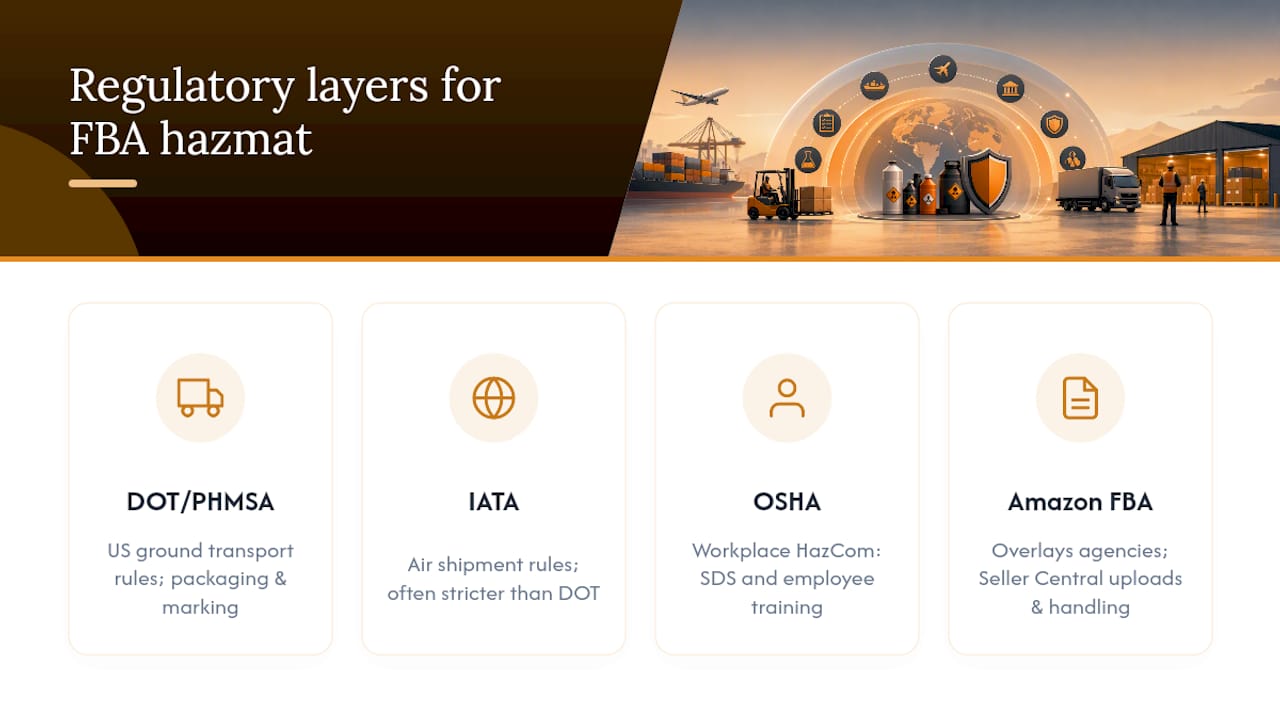
Three federal frameworks shape nearly every rule you’ll run into when shipping hazmat to FBA, and knowing which one governs which piece of your process saves a lot of confusion.
The Department of Transportation (DOT), through the Pipeline and Hazardous Materials Safety Administration, writes the ground transport rules under 49 CFR. This is where the Hazardous Materials Table lives, along with the packaging, marking, and shipping paper requirements that apply to trucks moving hazmat within the US.
The International Air Transport Association (IATA) governs hazmat rules for air shipments, and its Dangerous Goods Regulations are typically stricter than DOT ground rules for the same UN number. If any part of your shipment moves by air, whether that’s an international leg or a domestic air carrier, check IATA limits separately rather than assuming your ground-cleared packaging automatically qualifies.
OSHA enters the picture on the workplace side rather than the transport side. If your team is packing, labeling, or handling hazmat products in-house, OSHA’s Hazard Communication Standard governs how SDS information gets communicated to employees and what training they need before handling regulated materials.
Amazon’s own dangerous goods program sits on top of all three, translating federal transport and workplace rules into specific Seller Central requirements: what gets uploaded where, which ASINs get flagged, and how fulfillment centers physically handle regulated inventory once it arrives.
Training and Certification for Hazmat Shipment Preparers
Anyone in your operation who classifies, packages, or prepares paperwork for hazmat shipments needs formal training under DOT rules, and this applies whether that person is a full-time warehouse employee or a part-time contractor helping during a busy season. Training generally needs to be refreshed on a recurring cycle, and new hires need it before they independently prepare a hazmat shipment, not after.
Training typically covers general awareness of hazard classes, function-specific training on the exact tasks that person performs (classification, packaging, marking, documentation), and safety training on emergency response basics. The DOT’s guidance is explicit that this obligation exists even for businesses shipping only Limited Quantity materials, a detail many small sellers miss since LQ carries lighter documentation burdens elsewhere.
If you’re a small seller handling hazmat prep yourself, this training requirement still applies to you personally. Several third-party providers offer DOT hazmat training courses designed for shippers rather than carriers, often completable in a few hours online, and these typically issue a certificate you should keep on file alongside your other compliance documents.
If you outsource packing and prep to a freight forwarder or 3PL, confirm their staff carries current hazmat training rather than assuming it. This is a fair question to ask any provider before handing over battery-heavy or aerosol inventory, and a provider unwilling to answer it directly is a red flag worth noting.
Special Labeling Requirements for FBA Hazmat Shipments
Labeling for FBA hazmat shipments works on two layers, and sellers who only handle one of them run into trouble at intake. The first layer is the standard FBA labeling every shipment needs: FNSKU barcodes, carton labels, and shipment ID markings that apply regardless of what’s inside the box. The second layer is hazmat-specific marking required by transport regulations, and this is where hazmat shipping regulations add real complexity on top of routine FBA prep.
Every hazmat carton needs its hazard marking visible on the outside without opening the box. That’s the LQ diamond, the EQ square with red hatching, or a full hazard class placard, matching whichever tier applies to that specific package. These marks need to be printed clearly, sized correctly, and placed where a warehouse worker or inspector can see them immediately, not tucked onto a side panel behind other labels.
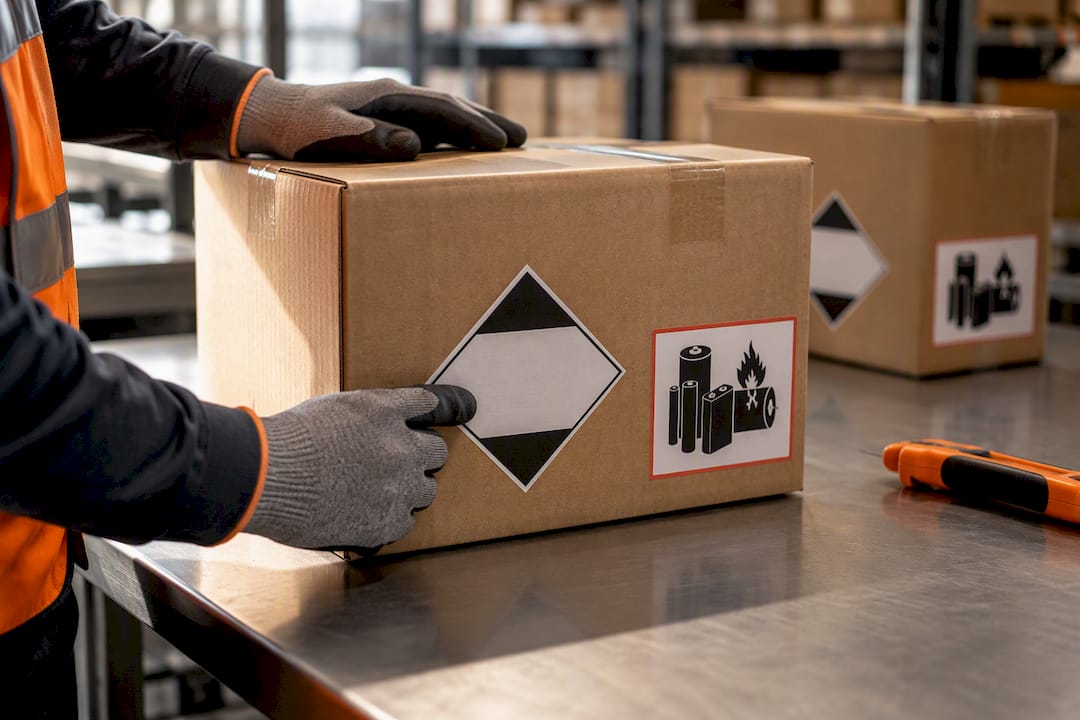
Battery-specific shipments often carry an additional lithium battery mark, distinct from the general hazard diamond, indicating the battery type and whether it’s packed with, or contained in, equipment. Mixing up UN3480 (batteries alone) marking with UN3481 (batteries with equipment) marking is a common error that triggers a hold even when the underlying paperwork is correct.
Placement matters as much as content. A hazmat mark that’s the right symbol but positioned where it gets obscured by a shipping label or stacking tape doesn’t satisfy the requirement in practice, even if it technically exists on the carton.
Handling Lithium Batteries in FBA Shipments
Lithium batteries get their own subclass of rules within hazmat shipping because their failure mode, thermal runaway, poses a distinct fire risk that other hazard classes don’t share. If your product contains a lithium metal or lithium ion cell, expect a more detailed documentation and packaging path than most other hazmat categories.
The core requirement is UN 38.3 testing evidence, documented in your Battery Test Summary, proving the battery passed eight specific stress tests including altitude simulation, thermal cycling, vibration, and impact. This applies whether you’re shipping loose batteries (UN3480), batteries packed alongside equipment (UN3481), or batteries installed inside equipment (UN3091), though packaging and marking differ across these three categories.
State of charge matters for lithium ion batteries specifically. Batteries shipped above a certain charge percentage face tighter restrictions than those shipped at a lower charge, since a fully charged cell carries more stored energy to release if it fails in transit. Check your specific product’s state-of-charge requirements against current transport rules rather than assuming a blanket exemption applies.
Damaged, defective, or recalled lithium batteries fall under an entirely separate and stricter set of rules, and these should never enter a standard FBA hazmat shipment. If a battery-powered return comes back damaged, route it through a proper hazardous waste disposal channel rather than attempting to reship or restock it.
For sellers shipping battery products regularly, a dedicated lithium battery SDS and UN 38.3 checklist is worth keeping on hand, since battery documentation gets flagged more often than almost any other hazmat category.
Managing Returns and Disposal of Hazmat FBA Inventory
Returns complicate hazmat logistics in ways standard inventory returns don’t. A customer sending back an unopened aerosol product is a routine return. A customer sending back a damaged lithium battery device, or one with a cracked cell, is a hazmat incident that needs different handling from the moment it re-enters the supply chain.
Amazon’s standard FBA return process isn’t built to handle every hazmat return scenario, and some hazmat categories simply aren’t accepted back into standard reverse logistics at all. Sellers with battery-heavy catalogs should check their specific ASIN’s return settings, since some hazmat products default to non-returnable status precisely because reverse hazmat logistics carries the same classification and packaging burden as outbound shipping.
Disposal is where sellers most often go wrong. A damaged battery or a leaking aerosol can’t simply go into standard trash or recycling, regardless of how the return arrived. These items typically need routing through a certified hazardous waste disposal service, and the cost of doing this correctly is a legitimate business expense worth budgeting for if you sell hazmat categories at any volume.
If you’re managing returns processing in-house rather than through Amazon’s removal orders, make sure whoever handles physical inspection of returned hazmat items has the same training as your outbound shipping team. A damaged lithium cell handled incorrectly during inspection carries real fire risk, not just a compliance headache.
Insurance and Liability Coverage for Hazmat FBA Shipments
Standard cargo insurance policies frequently exclude or limit coverage for hazardous materials, which means a policy that fully protects your standard inventory shipments might leave a hazmat shipment significantly underinsured or entirely uncovered. Before shipping any meaningful volume of hazmat inventory, confirm with your insurance provider whether your existing cargo policy actually extends to your specific hazard class, rather than assuming general cargo coverage applies uniformly.
Liability exposure runs in two directions worth thinking about separately. First, there’s the shipment itself: a hazmat incident in transit, a fire, a leak, a spill, can trigger cleanup costs, carrier claims, and regulatory penalties that dwarf the value of the product itself. Second, there’s product liability: if a defective battery or mislabeled chemical causes harm after reaching a customer, that’s a separate exposure from the transport incident and typically needs its own coverage layer.
Freight forwarders and DDP providers that handle hazmat regularly often carry cargo insurance structured specifically for regulated materials, which is one practical reason sellers with meaningful hazmat volume choose a managed logistics route rather than self-insuring through a general policy that may not actually respond to a hazmat claim. Ask any provider directly whether their cargo insurance covers your specific hazard class before assuming a blanket policy applies.
When to Use a Freight Forwarder or Managed Hazmat Service
Here’s where conventional advice tends to undersell the real tradeoff. Sellers often treat hazmat shipping as a DIY problem right up until a rejected shipment or a suppressed listing forces the question, and by then they’ve usually lost more time and inventory availability than a managed service would have cost from the start.
The volume threshold where a forwarder starts paying for itself is lower than most sellers assume. If you’re running battery-heavy SKUs or moving LTL and FTL hazmat freight regularly, rather than the occasional small-parcel aerosol shipment, the coordination burden of managing your own carrier relationships, documentation review, and appeal process typically outweighs the cost of handing it to a provider who does this daily.
What should you actually demand from a managed hazmat provider before signing on? A short list of non-negotiables:
- Direct experience handling SDS review and Battery Test Summary paperwork, not just general freight coordination
- A 24/7 emergency hazmat contact number that meets DOT requirements, not a general customer service line
- Cargo insurance that explicitly covers your hazard class, confirmed in writing rather than assumed
- FBA-specific prep and labeling capability, since hazmat marking and standard FBA labeling both need to happen correctly on the same carton
Vet any provider by asking pointed questions: Have they shipped your specific hazard class before? Can they name the UN numbers they’ve handled? Do they review your SDS before booking freight, or after a problem surfaces? A provider that answers vaguely or defers every hazmat question to “we’ll figure it out” is a red flag worth taking seriously, since the cost of a wrong answer here is a suppressed listing, not just a delayed shipment.
How ForwarderOne Handles Hazmat FBA Shipments for You
If the documentation, classification, and carrier coordination above sound like more than you want to manage alongside actually running your Amazon business, that’s exactly the gap a managed logistics partner is built to close. ForwarderOne works with small and mid-sized Amazon sellers moving inventory from China and Korea to US fulfillment centers, and its all-inclusive DDP shipping model folds customs, duties, and delivery into one workflow instead of leaving you to coordinate each piece separately.

For hazmat-specific shipments, that same all-in-one approach extends to the paperwork that trips up most sellers: SDS handling, FNSKU labeling, and the documentation review that needs to happen before a battery-heavy or aerosol shipment ever reaches a carrier. Every account gets a dedicated account manager who tracks your shipment through customs clearance and final delivery, and ForwarderOne states it maintains a better than 99% on-time delivery rate, a meaningful number if a suppressed hazmat ASIN is costing you sales velocity while you wait on a fix.
Whether you’re moving a first battery-powered product line or scaling up aerosol and cosmetics SKUs through FBA prep services, the path forward is the same: talk to ForwarderOne about your specific hazard class and shipment volume before your next booking, and let a dedicated account manager map the documentation and routing plan directly to your Amazon FBA freight forwarding needs.
Sources
- Electronic Code of Federal Regulations — 49 CFR §172.315
- Sell on Amazon — Learn about selling dangerous goods (hazmat) with Amazon FBA
- Amazon Shipping Dangerous Goods Shipping Guide (PDF)
- Labelmaster — Shipping limited quantities
FAQ
Is FBA Still Profitable in 2026 for Sellers Shipping Hazmat?
FBA remains a viable model for hazmat sellers in 2026, and the Partnered Carrier expansion actually lowers logistics friction for eligible shipping modes. Profitability still depends on managing the added documentation and packaging costs hazmat carries versus standard inventory, so factor SDS prep, BTS testing, and compliant packaging into your margin calculations upfront rather than treating them as an afterthought.
What Counts as an FBA Shipment When Hazmat Is Involved?
An FBA shipment is any inbound inventory transfer you create through Send to Amazon, and a hazmat shipment follows the same basic structure with extra declaration steps for UN ID, hazard class, and packing group. You’ll also need to upload supporting documents like an SDS or BTS during the shipment creation process before Amazon will finalize the plan.
Why Does My Amazon Package Say Hazmat on It?
A package marked hazmat contains a product that met a dangerous goods classification under transport regulations, commonly triggered by batteries, aerosols, or flammable liquids in the item. Amazon applies this marking because federal rules under 49 CFR require it, not as an arbitrary internal label.
Is It Better to Do FBM or FBA for Hazmat Products?
Both models require the same underlying compliance, classification, SDS or BTS documentation, and correct packaging, since those obligations come from federal transport law rather than from Amazon’s fulfillment choice. FBA adds Amazon’s own intake review and storage requirements on top of that baseline, while FBM shifts carrier selection and hazmat handling entirely onto you, which is where a managed provider like ForwarderOne often reduces the operational burden for sellers without in-house hazmat expertise.
Does the April 2026 Partnered Carrier Update Mean I Skip Classification Checks?
No. The Partnered Carrier expansion simplifies carrier booking for supported hazmat shipping modes, but it doesn’t replace ASIN eligibility checks, SDS uploads, or BTS requirements. Every classification and documentation step covered in Amazon’s dangerous goods program still applies regardless of which carrier option you select.
Need hazmat FBA checks before pickup?
ForwarderOne coordinates SDS/BTS review, carton marking, freight routing, customs handoffs, and FBA delivery planning before regulated goods move.