Hidden freight forwarding fees are undisclosed charges that appear on your final invoice after you have already committed to a shipment. The industry term for the full cost of getting goods to their destination is “landed cost,” and most initial quotes cover only a fraction of it. Initial ocean freight quotes typically cover about 63% of total landed cost, meaning hidden fees can inflate your final invoice by nearly 60%. For e-commerce sellers shipping from China to US fulfillment centers, that gap destroys profit margins fast. Learning to avoid freight forwarder hidden fees starts with understanding exactly what those fees are and where they hide.
What are common types of hidden freight forwarding fees?
The most expensive surprise in freight forwarding is not a single large charge. It is a cluster of smaller fees that nobody mentioned during the quote stage.
Fuel and currency surcharges are the most common offenders. Bunker Adjustment Factor (BAF) and Currency Adjustment Factor (CAF) are applied by carriers to offset fuel price swings and exchange rate shifts. Forwarders often quote the base ocean freight rate and list these as “subject to change,” which means you absorb any increase between booking and sailing.

Port and terminal handling charges cover the physical movement of your container at origin and destination ports. These fees are real and unavoidable, but they are frequently omitted from the headline quote. Destination charges like drayage and chassis rental alone can push the destination cost portion well beyond what the initial quote suggests, with operators treating quoted freight as only 60–70% of true landed cost.
Customs brokerage and exam fees catch many sellers off guard. Standard customs entry fees are predictable, but Customs and Border Protection (CBP) exam fees are not. A physical or X-ray exam can add hundreds of dollars per shipment, and your forwarder cannot always predict them. Ask upfront whether exam fees are included or billed separately.
Demurrage and detention are the fees that punish slow cargo pickup. Free time at ports usually lasts 4–7 calendar days. After that, demurrage charges of $100–$500 per container per day apply. During peak seasons like Q4, port congestion shortens effective free time even further.
Other fees that commonly appear without warning include:
- Delivery appointment and re-delivery fees: Amazon FBA warehouses require scheduled delivery windows. A missed appointment triggers a re-delivery charge.
- Chassis rental: Ports do not always have chassis available. When your trucker needs to rent one, that cost passes to you.
- Liftgate fees: If the delivery location lacks a loading dock, a liftgate truck is required at extra cost.
- ISF filing fees: The Importer Security Filing (ISF) must be submitted 24 hours before vessel departure. Some forwarders charge separately for this.
Pro Tip: Ask every forwarder: “Please itemize every charge that could appear on my final invoice that is not included in this quote.” A trustworthy forwarder answers in detail. An evasive one tells you what you need to know about their pricing practices.
How do you request quotes that expose hidden shipping charges?
Comparing freight quotes without a standard framework is like comparing restaurant bills where one includes tax and tip and the other does not. You need a structured Request for Quote (RFQ) process.
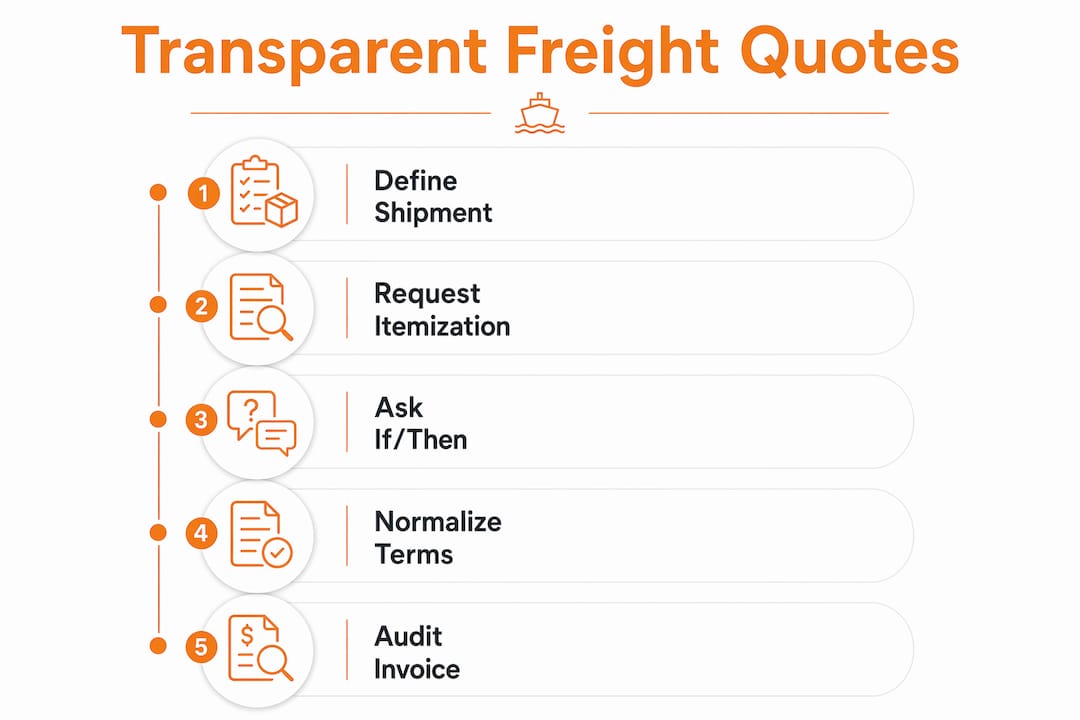
Step 1: Define your shipment completely. Provide the HS code, cargo dimensions, weight, origin address, and destination address. Vague cargo details give forwarders room to add surcharges later when the actual cargo does not match assumptions.
Step 2: Specify Incoterms. Matching Incoterms across all quotes is non-negotiable for an apples-to-apples comparison. DDP (Delivered Duty Paid) means the forwarder covers duties and delivery. EXW (Ex Works) means you cover almost everything. Mixing these terms makes quote comparison meaningless.
Step 3: Request a line-item breakdown. Your RFQ should explicitly require separate line items for:
- Origin charges (pickup, export customs, origin terminal handling)
- Main carriage (ocean or air freight, fuel surcharges, BAF, CAF)
- Destination charges (import customs, terminal handling, drayage, chassis rental, delivery)
- Accessorial fees (ISF filing, exam fees, liftgate, re-delivery)
Step 4: Ask for “if/then” clauses. Request that the forwarder state in writing: “If a CBP exam is triggered, the additional cost is X.” “If free time is exceeded, demurrage is billed at Y per day.” This forces disclosure of conditional charges before they happen.
Step 5: Normalize payment terms. Prepaid freight (where the shipper pays the forwarder) and collect freight (where the consignee pays the carrier) produce different cost structures. Confirm which applies to each quote before comparing totals.
| Cost Category | What to request | Why it matters |
|---|---|---|
| Origin charges | Itemized pickup and export fees | Often excluded from base quotes |
| Main carriage | Freight rate plus all surcharges | BAF and CAF can add 10–20% |
| Destination charges | Drayage, chassis, terminal fees | Can double the destination cost |
| Customs and duties | Brokerage fee plus exam fee estimate | Exam fees are unpredictable |
| Accessorial fees | Liftgate, re-delivery, ISF | Triggered by specific conditions |
Pro Tip: The lowest freight quote is frequently the one missing the most cost categories. If one quote is significantly cheaper than the others, it is not a better deal. It is an incomplete picture.
Best practices for negotiating and managing freight costs
Getting a detailed quote is step one. Negotiating its terms and auditing the final invoice is where sellers recover real money.
Negotiate free time before you book. Standard free time of 4–7 days sounds adequate until your Amazon warehouse schedules a delivery appointment two weeks out. Ask your forwarder to negotiate extended free time with the carrier at the booking stage. This costs little upfront and can save hundreds per shipment during busy periods.
Audit every invoice against the Bill of Lading. A freight invoice audit compares your final invoice line by line against the Bill of Lading (BoL) and the original quote. Duplicate charges, incorrect weights, and unapproved accessorial fees appear regularly. Catching one error per quarter can recover thousands of dollars annually.
Key auditing checks to run on every invoice:
- Confirm the freight rate matches the booked rate on the BoL.
- Verify that fuel surcharge percentages match the carrier’s published rate for that sailing date.
- Check that any exam fees were actually incurred and documented by CBP.
- Confirm free time dates and that demurrage charges, if any, are mathematically correct.
- Look for duplicate line items, especially on terminal handling charges.
Build communication protocols with your forwarder. Forwarders who provide FMC or IATA licenses, online shipment tracking, and proactive status updates are measurably more transparent than those who go silent between booking and delivery. Set an expectation at the start of each shipment: you want a notification if any charge is expected to deviate from the quote.
Know when to switch providers. If a forwarder repeatedly delivers invoices that differ materially from quotes, that is not a billing error. It is a business practice. Sellers who treat freight forwarder selection as a one-time decision pay for that mistake on every shipment.
Pro Tip: Negotiating specific terms for demurrage free time, customs exam fees, and re-delivery charges upfront can save thousands annually and prevents disputes that are nearly impossible to resolve after the fact.
Tools and checklists to track freight forwarding costs
A freight cost checklist aligned with your shipment schedule gives you a real-time view of where money is going and where it is at risk of leaking.
The most effective tracking system covers five areas:
| Tracking area | What to monitor | Action trigger |
|---|---|---|
| Free time expiration | Container arrival date plus free time days | Schedule pickup before day 4 |
| Invoice vs. quote variance | Line-by-line comparison on every invoice | Dispute any unexplained charge within 5 days |
| Surcharge rate changes | BAF and CAF rates per carrier per sailing | Flag increases above 5% from quote |
| Customs exam status | CBP exam notifications per shipment | Confirm exam fees match CBP documentation |
| Delivery appointment status | FBA warehouse appointment confirmation | Re-book immediately if appointment is missed |
Beyond the checklist, document every shipment in a shared log that includes the original quote, all amendments, the final invoice, and any dispute correspondence. This record becomes your evidence base if a billing dispute escalates. Sellers who maintain detailed records resolve disputes faster and recover more money than those who rely on memory or email threads alone.
For Amazon FBA sellers specifically, aligning your shipment schedule with Amazon seller freight factors like lead times, restock limits, and warehouse appointment availability reduces the risk of detention fees caused by scheduling mismatches.
Key Takeaways
Avoiding hidden freight forwarding fees requires itemized quotes, proactive negotiation, and disciplined invoice auditing on every single shipment.
| Point | Details |
|---|---|
| Quotes cover only part of the cost | Initial quotes typically represent 60–70% of true landed cost; budget for the rest. |
| Itemized RFQs expose hidden charges | Demand line-item breakdowns for origin, main carriage, destination, and accessorial fees. |
| Free time management saves money | Track container arrival dates and schedule pickup before demurrage kicks in at day 4–7. |
| Invoice audits recover real dollars | Compare every invoice against the Bill of Lading to catch duplicate or incorrect charges. |
| Transparency signals a trustworthy forwarder | Forwarders who provide FMC/IATA credentials, tracking, and proactive updates are safer partners. |
What I have learned about freight quotes after years in this industry
The most common mistake I see e-commerce sellers make is treating the freight quote as the cost of shipping. It is not. It is the cost of moving a container from point A to point B under ideal conditions. Everything that deviates from ideal, and something always does, costs extra.
The sellers who control their freight costs best do one thing differently: they treat every quote as a partial view of total cost and immediately ask what is missing. That single habit, asking “what is not in this quote,” changes the entire dynamic with a forwarder. It signals that you know how freight pricing works, and that signal alone tends to produce more honest quotes.
The other insight I would share is about relationships. Sellers who switch forwarders constantly based on the lowest quote spend more money over time, not less. A forwarder who knows your cargo, your Amazon warehouse requirements, and your seasonal patterns will proactively flag issues before they become fees. That kind of institutional knowledge has real dollar value that never shows up in a quote comparison.
The uncomfortable truth about freight forwarding is that the industry’s pricing structure rewards sellers who ask hard questions and punishes those who do not. The information asymmetry is real. But it is entirely closeable with the right questions, the right documentation, and a forwarder who operates transparently.
— Keven
ForwarderOne’s approach to transparent freight pricing
E-commerce sellers who have spent months chasing down surprise charges on freight invoices tend to arrive at the same conclusion: the problem is not the fees themselves. The problem is not knowing about them until it is too late.
ForwarderOne built its service model specifically for Amazon FBA sellers who need full cost visibility from the start. Its all-inclusive DDP freight forwarding service covers customs, duties, and last-mile delivery in a single quoted price, with no surprise destination charges added after booking. Every shipment includes a dedicated account manager, real-time tracking, and over 99% on-time delivery. Sellers moving inventory from China to US fulfillment centers can get a fully itemized quote through ForwarderOne’s FBA shipping services and see exactly what they are paying before committing to a single container.
FAQ
What are freight forwarder hidden fees?
Hidden freight forwarding fees are charges not included in the initial quote that appear on the final invoice, such as fuel surcharges, terminal handling, demurrage, and customs exam fees. Initial quotes often cover only 60–70% of total landed cost.
How do I get a fully transparent freight quote?
Send a standardized RFQ that requires line-item pricing for origin, main carriage, destination, and accessorial charges, and specify the Incoterms and HS code for your cargo. Ask the forwarder to list every charge that could appear on the final invoice.
What is demurrage and how do I avoid it?
Demurrage is a daily fee charged when a container stays at the port beyond the free time period, which typically lasts 4–7 calendar days. Schedule cargo pickup before free time expires and negotiate extended free time at the booking stage.
How does a freight invoice audit work?
A freight invoice audit compares your final invoice line by line against the original quote and the Bill of Lading to identify duplicate, incorrect, or unauthorized charges. Running this audit on every shipment is the most reliable way to recover overbilled amounts.
What does DDP shipping mean for hidden fees?
DDP (Delivered Duty Paid) means the forwarder takes responsibility for customs, duties, and delivery costs, which consolidates most variable charges into one agreed price. This structure significantly reduces the risk of surprise destination charges on your final invoice.
Need freight pricing without surprise charges?
Send supplier city, destination, cargo details, and Incoterms. ForwarderOne will map the all-in DDP scope, customs steps, and likely accessorial risks before booking.