Duty-free de minimis treatment is currently suspended for commercial shipments arriving from all countries. Eligible merchandise valued at $2,500 or less generally uses informal entry procedures and remains subject to applicable duties, taxes, and fees. Shipments above $2,500, plus quota and antidumping or countervailing duty merchandise, require formal entry. CBP can also require formal treatment when needed for admissibility, revenue protection, or efficient customs administration.
TL;DR:
- Eligible commercial shipments valued at $2,500 or less generally use informal entry, but the de minimis suspension means low value alone no longer makes them duty-free.
- Shipments over $2,500, quota merchandise, and goods subject to antidumping or countervailing duties require formal entry.
- Formal entry normally requires a customs bond, CBP Form 7501, accurate HTS classification, and a complete document set.
- Partner Government Agency requirements, unclear invoices, and consolidation can change the filing path even when value is below $2,500.
- Preparing classification, agency data, and bond documents before pickup reduces avoidable holds and storage costs.
Informal vs Formal Entry: The Core Differences at a Glance
The current dividing line is primarily $2,500, but eligibility matters as much as value. CBP’s current e-commerce guidance says eligible shipments valued at $2,500 or less generally use informal procedures. Formal entry is required above $2,500 and for quota or antidumping/countervailing duty merchandise.
Duty-free de minimis treatment is suspended. That means a shipment below $800 may still use an informal process, but it is not duty-free merely because of its value.
| Entry path | Typical value / trigger | Bond | What to expect |
|---|---|---|---|
| Informal entry | Eligible merchandise valued at $2,500 or less | Often not required for a standard informal entry; procedure can vary | Applicable duties, taxes, fees, and required agency data still apply |
| Mail informal process | Eligible international-mail merchandise valued at $2,500 or less | Depends on the filing path | Uses CBP’s current mail process or another appropriate entry type |
| Formal entry | Over $2,500; quota; AD/CVD; or otherwise required by CBP | Generally required | CBP Form 7501, detailed classification, and a fuller compliance record |
Informal procedures are generally less burdensome, but they are not a shortcut around accurate valuation, HTS classification, admissibility, or Partner Government Agency requirements.
Formal Entry: Triggers, Documents, and Bond Costs
Formal entry is required once a shipment exceeds $2,500, is subject to quota or antidumping/countervailing duties, or CBP otherwise requires it. The paperwork trail starts with Entry Type 01 and CBP Form 7501, the summary form that captures classification, value, and duty owed.
The bond is the part most first-time importers underestimate. A surety bond guarantees CBP gets paid duties, taxes, and fees even if something goes wrong. You can buy a single-entry bond for one shipment or a continuous bond that covers a year of imports, which usually makes more financial sense once you’re shipping monthly.
Documentation for a formal entry typically includes:
- A detailed commercial invoice with itemized product descriptions and unit values
- Accurate Harmonized Tariff Schedule (HTS) codes for every line item
- A packing list matching the invoice
- Bill of lading or airway bill
- Bond documentation (single-entry or continuous)
Fees stack up beyond the base duty rate, too. Expect the Merchandise Processing Fee (MPF) and, for ocean shipments, the Harbor Maintenance Fee (HMF). Timeline runs anywhere from same-day release to several days if CBP flags anything for review, and that’s exactly why most importers hand formal entries to a licensed broker rather than attempting it solo.
Pro Tip: Misclassifying a product’s HTS code on a formal entry can trigger a CBP audit years later, not just a delay today. Get the classification right before your first shipment, not after CBP flags the tenth one.
How Low-Value Informal Entry Works After De Minimis Suspension
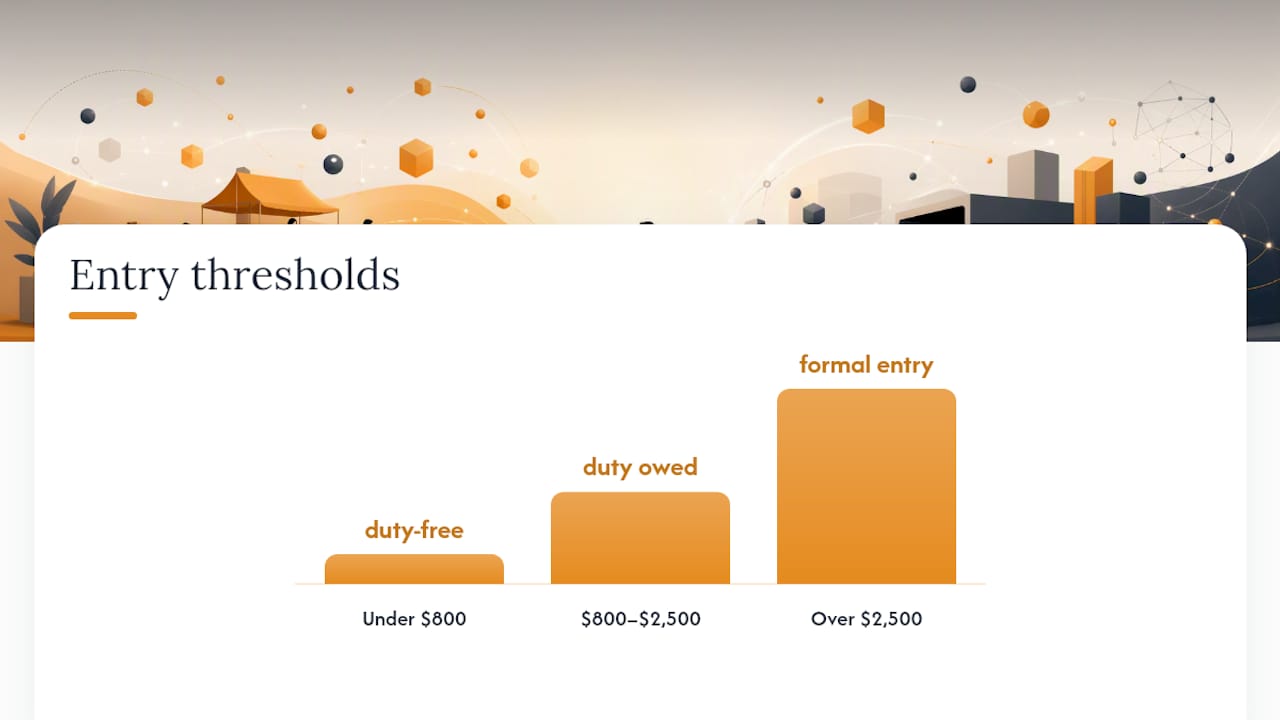
Since CBP’s de minimis suspension, commercial goods do not receive duty-free treatment solely because their value is $800 or less. Instead, the filer chooses an eligible formal or informal procedure based on value, mode, product rules, and agency requirements.
- At $2,500 or less: eligible commercial merchandise generally uses informal entry and pays applicable duties, taxes, and fees.
- International mail: eligible low-value mail uses CBP’s current mail informal process or another appropriate entry type, with the data required for that shipment.
- Above $2,500 or under a mandatory trigger: use formal entry. Quota and AD/CVD merchandise require formal procedures regardless of value.
- At release: accurate descriptions, valuation, origin, HTS classification, and any required agency data must support the filing.
The operational advantage of informal entry is simpler processing, not exemption from duty or compliance. Vague invoices such as “assorted goods” can still lead to document requests, reclassification, or a formal-entry requirement.
When Value Alone Does Not Decide the Entry Path
Value is only the first screen. CBP may require formal entry when necessary for admissibility, revenue protection, or efficient customs administration, and product-specific rules can require more data or a different entry type.
- FDA regulated goods such as cosmetics, supplements, and food ingredients may require prior notice or other agency data.
- USDA requirements can apply to agricultural products, plants, wood, and some food items.
- EPA and FCC rules may apply to regulated chemicals, engines, electronics, and radio-frequency devices.
- Quota and AD/CVD merchandise require formal entry regardless of value.
Consolidation matters too. Under 19 C.F.R. Part 141, shipments arriving together for one consignee may need to be treated as a single entry. Splitting invoices does not reliably change the underlying customs treatment.
When the filing path is unclear, plan for the stricter documentation set and have a broker confirm the entry type before departure.
A Step-by-Step Checklist Before You Ship
Choose the entry path before cargo leaves the supplier:
- Confirm customs value. Use $2,500 as the initial informal-versus-formal screen.
- Do not assume sub-$800 means duty-free. The de minimis exemption is suspended for commercial shipments.
- Check mandatory formal-entry triggers. Flag quota and AD/CVD exposure immediately.
- Check agency requirements. Identify FDA, USDA, EPA, FCC, or other Partner Government Agency data before booking.
- Verify consolidation. Multiple purchase orders on one arrival for one consignee may be treated together.
- Prepare detailed invoices and HTS codes. Follow the commercial invoice requirements CBP expects.
- Budget for duties, bond, and broker costs. Low value does not eliminate applicable duties or fees.
Pro Tip: If the shipment is close to $2,500 or has an agency or trade-remedy trigger, prepare the formal-entry document set before pickup. Extra preparation is cheaper than a port hold.
How a DDP Partner Handles Entry Selection for You
Most small sellers don’t want to become customs experts; understanding the USPS rules for shipping perfume is one example where product-specific shipping restrictions can complicate import requirements. They want their inventory to show up at the fulfillment center on schedule. That’s the practical case for a Delivered Duty Paid (DDP) partner: it centralizes duty calculation, documentation, and clearance into one workflow instead of leaving each shipment’s entry classification up to guesswork.
A logistics partner handling DDP shipments typically manages:
- Eligible informal-entry filing for low-value commercial shipments
- Importer Security Filing (ISF 10+2) submission ahead of ocean shipments
- Bond administration for shipments that require formal entry
- HTS classification review to catch errors before CBP does
The DDP model shifts that compliance burden off the seller’s plate entirely.
What Most Importers Get Wrong
Importers tend to treat the $2,500 threshold like a hard rule instead of a screening tool. It isn’t. Classification, product category, documentation quality, and CBP’s admissibility review can change the required filing path even when the invoice total is below the formal-entry threshold.
The rule worth remembering: document first, classify early, and budget for formal entry whenever there’s real doubt. Guessing wrong costs more than preparing for the stricter path.
How ForwarderOne Takes Entry Decisions Off Your Plate
Getting entry classification wrong doesn’t just delay a shipment. It can mean unexpected bond costs, storage fees while cargo sits at the port, or a compliance flag that follows your business into future imports. ForwarderOne’s DDP service manages customs, duties, and delivery in one workflow, so you’re not the one deciding whether your shipment needs an informal filing or a full formal entry with a bond attached.
Every account gets a dedicated account manager who tracks classification, documentation, and clearance status shipment by shipment, backed by ForwarderOne’s over 99% on-time delivery track record. That matters most during peak season, when a misclassified entry sitting in CBP review can wreck your restock timeline right when demand peaks. If you’re moving inventory from China to a U.S. fulfillment center, the DDP shipping service handles the entry decision for you. Amazon sellers specifically can check the FBA freight forwarding page to see how pickup, customs clearance, and delivery to fulfillment centers connect into a single booking.
Sources
- CBP — Low-value shipment processing and indefinite de minimis suspension
- CBP — E-Commerce Frequently Asked Questions
- CBP Customs Bulletin, Vol. 60, No. 18
FAQ
What Is the Difference Between a Formal Entry and an Informal Entry?
Formal entry generally applies above $2,500 and normally requires a customs bond plus CBP Form 7501. Eligible merchandise valued at $2,500 or less generally uses an informal procedure and still owes applicable duties, taxes, and fees.
What Are the Different Types of U.S. Customs Entries?
Eligible commercial shipments valued at $2,500 or less generally use an informal procedure and pay applicable duties, taxes, and fees. Formal entry generally applies above $2,500 and is mandatory for quota and AD/CVD merchandise. CBP may also require formal entry when necessary.
What Is Considered a Formal Entry?
Formal entry generally applies to shipments valued over $2,500 and is mandatory for quota and antidumping/countervailing duty merchandise. CBP may also require it for admissibility or revenue protection. It normally requires a customs bond and detailed documentation.
What Is an Informal Entry in Customs?
An informal entry is a simplified customs process generally available to eligible merchandise valued at $2,500 or less. The de minimis suspension means applicable duties, taxes, and fees still apply; accurate invoices and classification remain required.
Does ForwarderOne Handle Entry Type Decisions for Me?
Yes. ForwarderOne’s DDP shipping service manages classification, documentation, and clearance as part of one workflow, so you don’t have to determine whether your shipment needs formal or informal treatment. Current service details are available on the DDP shipping page.
Want customs entry handled before cargo moves?
ForwarderOne coordinates classification, documents, bonds, duties, and delivery in one DDP workflow for U.S. ecommerce and Amazon FBA shipments.