
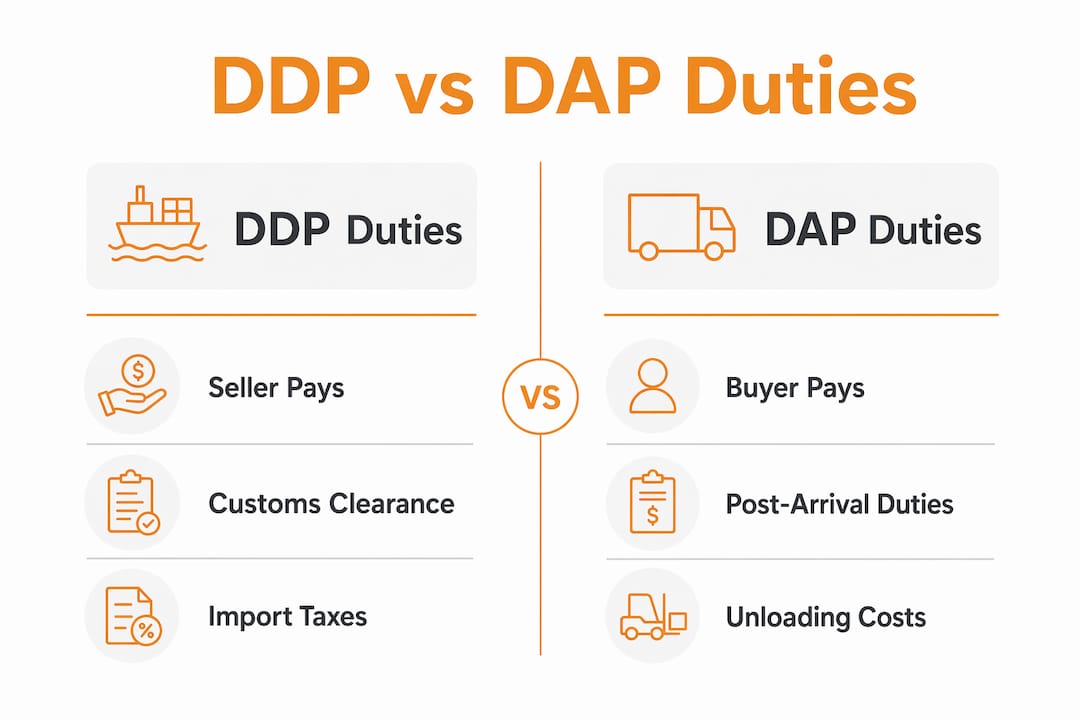
Under DDP (Delivered Duty Paid), the seller pays all import duties and taxes and handles customs clearance before the goods reach the buyer. Under DAP (Delivered At Place), the buyer pays import duties and arranges clearance once the shipment arrives in the U.S. That single sentence is the whole answer — everything else is about who bears the compliance risk, the cash flow burden, and the operational headache when something goes wrong.

The total landed cost is roughly the same under both terms. What changes is who writes the check and who scrambles when CBP flags a misclassification.
Immediate consequences at a glance:
- Under DDP: The seller invoices an all-in price, advances duty payments to CBP, arranges an Importer of Record (IOR), and absorbs any reassessment costs. The buyer receives goods cleared and ready to unload.
- Under DAP: The buyer appoints a customs broker, files the import entry, pays duties and taxes before the carrier releases the freight, and may face demurrage if they are not ready.
- Surprise fees under DAP: Carrier brokerage fees, customs bond costs, and ISF filing charges land on the buyer's invoice — often unexpected for first-time importers.
- Surprise costs under DDP: If the seller's duty estimate is wrong, the seller eats the difference. Misclassification penalties under DDP fall entirely on the seller.
Pro Tip: If you are selling direct-to-consumer or shipping into Amazon FBA, insist on DDP. The buyer's inability to clear customs quickly can cause stockouts. If you are a B2B buyer with an established customs program and a licensed broker on retainer, DAP gives you more control over classification and any applicable tax recovery.
What are Incoterms 2020 and why do they govern DDP vs DAP?
Incoterms — short for International Commercial Terms — are a set of standardized trade rules published by the International Chamber of Commerce (ICC). The current edition, Incoterms 2020, defines eleven terms that allocate costs, risk, and obligations between seller and buyer in international contracts. DDP and DAP are both "D-group" terms, meaning the seller is responsible for delivering goods to a named destination in the buyer's country. The critical difference is one obligation: under DDP, the seller also clears import customs and pays duties; under DAP, that responsibility shifts entirely to the buyer.
For U.S. imports, this distinction has real operational weight. U.S. Customs and Border Protection (CBP) requires a formal entry filing, a customs bond, accurate Harmonized Tariff Schedule (HTS) codes, and in many cases an Importer Security Filing (ISF) submitted 24 hours before vessel loading. Someone has to own all of that. The Incoterm in your contract determines who.
The ICC's Incoterms 2020 rules define DDP as the maximum obligation for the seller — the only term where the seller pays import duties, taxes, and performs import customs clearance in the buyer's country. Choosing DDP without the operational infrastructure to support it is one of the most common and costly mistakes in cross-border trade.
What does the seller actually do under DDP for U.S. shipments?
DDP places the full compliance burden on the seller. Here is what that means in practice for a shipment arriving in the U.S.:
- Export clearance: The seller files export documentation in the country of origin.
- International freight: The seller arranges and pays for ocean or air transport to the U.S.
- Import customs clearance: The seller (or their IOR/broker) files the CBP entry, submits the ISF, and presents the commercial invoice with accurate HTS codes.
- Duty and tax payment: The seller pays all applicable tariffs, including any Section 301 or antidumping duties, before CBP releases the goods.
- Delivery to named place: The seller delivers the goods ready for unloading at the agreed destination — a warehouse, Amazon FBA fulfillment center, or retail location.
Because most foreign sellers do not have a U.S. legal entity, they typically use a carrier or specialist freight forwarder who acts as the Importer of Record (IOR). The IOR assumes legal responsibility for the import entry and advances duty payments to CBP, then invoices the seller. Timing matters: duties are generally due at the time of CBP entry, which happens before or at the moment of cargo release — not after delivery.
The financial exposure for sellers is real. If an HTS code is misclassified at a higher duty rate, the seller absorbs the extra duties, penalties, and any demurrage while the shipment sits waiting for correction. Sellers without local VAT registration in other markets may also pay import VAT they cannot reclaim, which becomes a permanent embedded cost. To hedge against tariff volatility, many sellers pad their DDP duty estimates with a protective buffer when quoting all-in prices.

How does DAP work and what does the buyer owe at the U.S. border?
Under DAP, the seller's job ends when the goods arrive at the named place, ready for unloading. Everything that happens at the U.S. border is the buyer's problem.
Pro Tip: Before your first DAP shipment arrives, have three things in place: a licensed customs broker, a continuous customs bond (or single-entry bond for one-off shipments), and confirmed HTS codes for your products. Without all three, your freight can sit at the port while demurrage charges accumulate.
The typical sequence for a DAP import into the U.S.:
- The carrier notifies the buyer of arrival and requests clearance instructions.
- The buyer's customs broker files the CBP entry and ISF (if not already filed).
- CBP reviews the entry and may request additional documentation or a physical exam.
- The buyer pays duties and taxes — either directly or through the broker who advances payment.
- CBP releases the goods; the carrier delivers to the named place.
- The buyer unloads at their own expense.
Carriers like UPS, FedEx, and DHL will sometimes clear goods on the buyer's behalf under DAP and invoice brokerage and advance fees afterward. That convenience comes at a cost: carrier brokerage rates are often higher than those of a dedicated customs broker, and buyers who are not watching their invoices carefully can be surprised by the total.
DAP is the pragmatic choice for experienced B2B importers. If you have an established customs program, a licensed broker who knows your product classifications, and the ability to recover import VAT or GST in your market, DAP gives you control that DDP takes away. You set the classification strategy; you manage the bond; you handle any disputes with CBP directly.
How do UPS, FedEx, DHL, and USPS handle DDP and DAP shipments?
Carrier behavior varies more than most shippers expect. Here is how the major U.S. carriers typically handle each term:
| Carrier | DDP / IOR Service | DAP Brokerage Option | Typical Advance/Processing Fees | Speed of Release |
|---|---|---|---|---|
| UPS | Yes — UPS Trade Direct and brokerage services support DDP; IOR available via UPS customs brokerage | Yes — UPS clears on buyer's behalf and invoices fees | Entry fee + disbursement fee + bond prorate | Fast for express; standard for freight |
| FedEx | Yes — FedEx International Priority supports DDP; FedEx Trade Networks provides IOR | Yes — FedEx clears and invoices buyer for duties + brokerage | Entry fee + advancement fee (typically a percentage of duties advanced) | Fast for express shipments |
| DHL | Yes — DHL international parcel services include DDP options with IOR support | Yes — DHL Express clears and bills receiver for duties + handling fee | Disbursement fee + entry fee; handling surcharge on duty advances | Generally fast; DHL Express is among the quickest for small parcels |
| USPS | No — USPS does not offer IOR services or formal DDP programs | Limited — USPS notifies recipient; CBP handles clearance separately | Minimal processing fee; buyer pays duties at delivery or via CBP | Slower; customs holds are common |
USPS is the outlier. It has no IOR capability and no formal DDP program, which makes it unsuitable for any seller who needs guaranteed DDP delivery into the U.S. For high-volume or high-value shipments, a dedicated IOR or third-party logistics provider is almost always preferable to relying on carrier brokerage alone — the fees are lower and the classification expertise is deeper.
What does landed cost actually look like under DDP vs DAP?
Cost components are the same under both terms. The assignment of who pays each line is what changes.
Cost components in a U.S. import:
- Product value (CIF basis): The customs value CBP uses to calculate duties.
- Tariff/duty: The applicable HTS rate on the dutiable value.
- Section 301 / antidumping duties: Additional tariffs on goods from specific countries (notably China), which can dwarf the base duty rate.
- Customs brokerage fee: Charged by the broker or carrier for filing the entry.
- Customs bond: Required for formal entries; either a single-entry bond or a prorate of an annual continuous bond.
- ISF filing fee: For ocean shipments, typically $25–$50 per filing.
- Carrier advance/disbursement fee: Charged when a carrier advances duty payments on behalf of the importer.
- Demurrage/storage: Accrues if goods are not cleared promptly.
Simple example — an example shipment of consumer electronics from China:
| Cost Line | Amount | Pays Under DDP | Pays Under DAP |
|---|---|---|---|
| Product value (CIF) | — | Seller | Seller |
| Base tariff (e.g., 7.5%) | the base tariff paid by seller or buyer | ||
| Section 301 tariff (e.g., 25%) | the Section 301 tariff paid by seller or buyer | ||
| Customs brokerage fee | the customs brokerage fee paid by seller or buyer | ||
| Customs bond (prorate) | the customs bond cost paid by seller or buyer | ||
| ISF filing fee | the ISF filing fee paid by seller or buyer | ||
| Carrier advance fee | the carrier advance fee paid by seller or buyer | ||
| Total duties + fees | $3,560 | Seller | Buyer |
Under DDP, the seller builds that $3,560 into the quoted price. Under DAP, the buyer pays it separately on arrival. Neither term is cheaper in aggregate — but under DDP, the buyer's experience is frictionless, and under DAP, the buyer controls the process.
Pro Tip: When quoting DDP, add a 10–25% buffer on your estimated duty line to protect against tariff changes or HTS reassessments. A quote that assumed 7.5% duty on a product that CBP reclassifies at 25% will cost you the difference.
State-level sales tax is a separate matter. For B2C shipments, some states require the seller to collect and remit sales tax on imported goods. DDP does not automatically include state sales tax; that obligation depends on the seller's nexus in the destination state and is governed by U.S. state law, not Incoterms.
What are the real risks for sellers and buyers under each term?
| Dimension | DDP | DAP |
|---|---|---|
| Who pays duties and taxes | Seller | Buyer |
| Who arranges customs clearance | Seller (via IOR/broker) | Buyer (via their broker) |
| When risk transfers | At named delivery place, ready for unloading | At named delivery place, ready for unloading |
| Who pays advance/processing fees | Seller | Buyer |
| Best use case | B2C e-commerce, Amazon FBA, frictionless delivery | B2B with established import programs |
Seller risks under DDP:
- Duty misclassification: If the HTS code is wrong, the seller pays the corrected duty rate plus any penalties. Robust pre-shipment HTS auditing is the primary mitigation.
- Margin erosion: Section 301 tariffs on Chinese goods can push total duty exposure above 30%, which can eliminate profit on a DDP quote that did not account for them.
- VAT reclaim limitations: In markets outside the U.S., sellers without local VAT registration may pay import VAT they cannot recover.
Buyer risks under DAP:
- Surprise fees: Carrier brokerage, bond costs, and ISF fees arrive on a separate invoice after delivery — often larger than expected.
- Clearance delays and stockouts: A buyer who is not ready with a broker and bond when the shipment arrives faces demurrage and, for Amazon FBA sellers, potential stockouts during peak periods.
- Classification disputes: The buyer owns any CBP reassessment under DAP, including back-duties and interest.
Risk mitigation that applies to both terms: accurate HS code classification before shipment, clear contract language specifying who acts as IOR, audit-ready commercial invoices, and cargo insurance that explicitly covers customs penalties where available.
How do you choose between DDP and DAP for your U.S. imports?
Work through this checklist before you finalize contract terms:
- Does the buyer have an established customs program? If yes, DAP gives them control. If no, DDP removes a process they are not equipped to manage.
- Is this B2C or Amazon FBA? DDP is strongly preferred. Delayed clearance directly causes stockouts and customer complaints.
- Can the seller obtain or arrange IOR in the U.S.? DDP is only viable if the seller has a carrier, forwarder, or specialist IOR provider who can file CBP entries and advance duties.
- What is the duty exposure? High Section 301 tariffs (25%+) make DDP quotes expensive and margin-sensitive. Sellers need accurate HTS codes and a duty buffer before committing.
- Does the buyer need to recover import VAT or GST? In markets where VAT recovery is possible, DAP lets the buyer register as importer and claim it back. Under DDP, the seller may not be able to recover it.
- What is the shipment frequency and volume? High-volume, recurring shipments justify the operational investment in DDP infrastructure. One-off or low-volume B2B shipments often default to DAP.
Contract clauses to include:
- Specify the named place precisely (e.g., "DAP — [Buyer's warehouse address], Incoterms 2020").
- State who acts as Importer of Record and who bears reassessment costs.
- Define payment terms for duty advances and how overruns are handled.
- Clarify whether the DDP quote includes or excludes state sales tax.
Red flags in a DDP quote: vague duty estimates with no HTS code reference, no named IOR solution, unclear brokerage fees, or "DDP VAT unpaid" language without documentation of how VAT will be handled. Any of these signals that the seller has not fully priced the obligation they are taking on.
How ForwarderOne handles DDP duties for U.S. imports
ForwarderOne's DDP workflow is built specifically for small and mid-sized Amazon sellers shipping from China to U.S. fulfillment centers — a route where clearance delays directly translate to lost sales.
The ForwarderOne DDP process, step by step:
- Pre-shipment classification: ForwarderOne reviews HTS codes before the shipment leaves China, flagging misclassification risk and estimating duties with a protective buffer.
- IOR arrangement: ForwarderOne acts as or arranges the Importer of Record for the U.S. entry, so the seller does not need a U.S. legal entity.
- Duty calculation and client approval: The estimated duty amount is presented to the client before shipment, with the 10–25% buffer built in. No surprises at clearance.
- CBP entry filing: ForwarderOne's customs team files the formal entry, ISF, and any required bond with CBP.
- Duty payment and release: Duties are advanced and paid to CBP; goods are released and routed directly to the FBA fulfillment center.
- Post-entry support: If CBP issues a reassessment or requests additional documentation, ForwarderOne manages the dispute and post-entry correction process.
The practical risk ForwarderOne mitigates most often is HTS misclassification — the scenario where a carrier or 3PL assigns the wrong code and the seller absorbs extra duties and penalties. Pre-shipment auditing catches most of these before they become a CBP problem.
ForwarderOne reports over 99% on-time delivery and assigns a dedicated account manager to each client, which matters most during Q4 when FBA inventory deadlines are tight. For sellers who want a deeper look at the DDP shipping process for Amazon FBA, ForwarderOne's published guides walk through the full workflow with route-specific detail.
Key Takeaways
Under DDP, the seller pays all import duties and handles customs clearance; under DAP, the buyer pays duties and manages clearance, with the total landed cost being roughly equal under both terms.
| Point | Details |
|---|---|
| DDP vs DAP duty responsibility | Under DDP the seller pays all duties and clears customs; under DAP the buyer pays and arranges clearance. |
| Landed cost is the same | Total cost does not change between terms — only which party advances and manages duty payments. |
| Carrier behavior varies | UPS, FedEx, and DHL offer IOR and DDP services; USPS has no IOR capability and is unsuitable for DDP. |
| Seller DDP risk: misclassification | HTS errors under DDP cost the seller the corrected duty rate plus penalties; pre-shipment auditing is the main defense. |
| ForwarderOne for Amazon FBA | ForwarderOne handles IOR, CBP entry, duty payment, and post-entry disputes for China-to-USA DDP shipments. |
The term that actually matters is the one you can execute
Most of the DDP vs DAP debate focuses on who pays. The more useful question is who is capable of paying correctly and on time.
Sellers who commit to DDP without a reliable IOR, accurate HTS codes, and a duty buffer are not offering a premium service — they are taking on a liability they have not priced. The margin erosion from a single misclassification on a high-tariff product can wipe out the profit on an entire shipment. Section 301 tariffs on Chinese goods make this especially acute: a 25% additional duty on a $50,000 shipment is $12,500 that the seller did not budget for.
On the buyer side, DAP is not the "easy" option it appears to be. Buyers who have never managed a formal CBP entry are often blindsided by the combination of brokerage fees, bond costs, and the speed at which demurrage accumulates at busy U.S. ports. The shipment does not wait while you find a broker.
The right term is the one where the party taking on the obligation actually has the infrastructure to execute it. For most small and mid-sized sellers shipping into Amazon FBA, that means DDP with a specialist forwarder who has done it hundreds of times. For experienced B2B importers with their own customs programs, DAP keeps control where the expertise is.
ForwarderOne takes the duty burden off your plate
Paying duties under DDP shipping is straightforward when you have the right partner. ForwarderOne's all-inclusive DDP service covers IOR arrangement, CBP entry filing, duty payment, and direct delivery to Amazon FBA fulfillment centers — all in a single workflow with no hidden brokerage surprises.
Every shipment comes with a dedicated account manager who monitors your entry status and handles CBP queries before they become delays. With over 99% on-time delivery, ForwarderOne is built for sellers who cannot afford a stockout during peak season. Whether you are a first-time importer or scaling an established FBA operation, the DDP freight forwarding service from ForwarderOne removes the compliance complexity so you can focus on selling. Get a quote for your next China-to-USA shipment on the China-to-USA freight forwarding page.
Need DDP duties handled before cargo ships?
ForwarderOne combines duty planning, customs entry, and final FBA delivery so sellers can quote landed cost without border surprises.