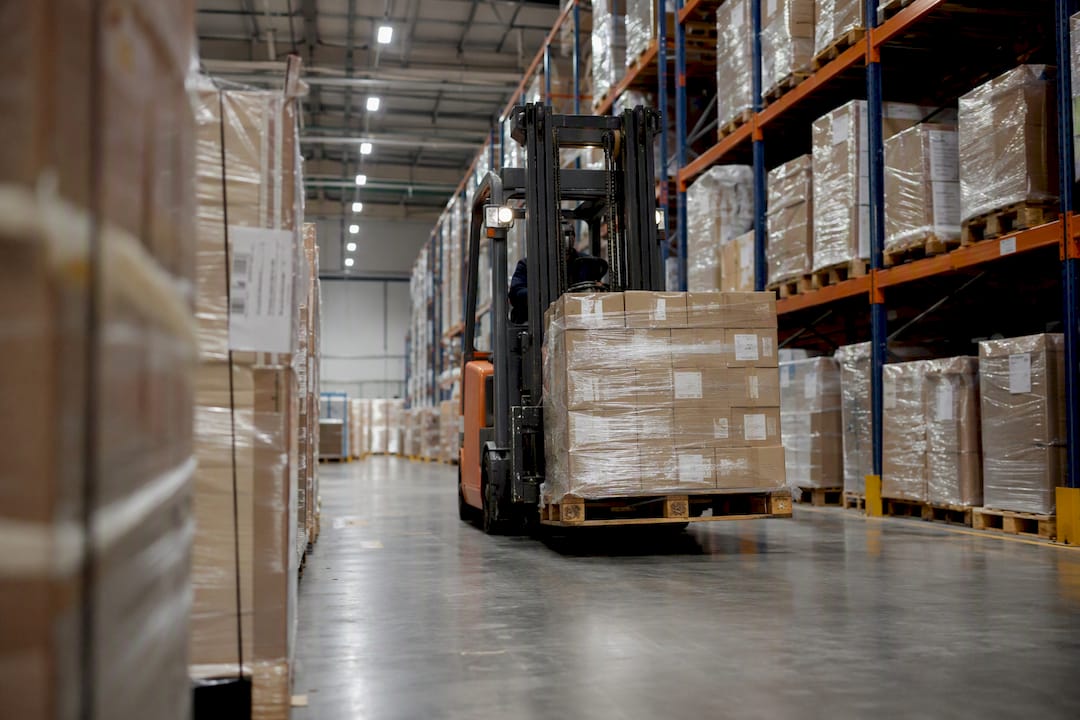
A bonded warehouse is a customs-supervised facility where you can store imported, dutiable goods without paying import duties up front. Duties generally come due when goods are withdrawn for U.S. consumption; merchandise exported directly from bond is not entered for U.S. consumption, although storage, handling, and bond costs still apply. The framework is set out in 19 U.S.C. §1555, and U.S. Customs and Border Protection (CBP) supervises bonded warehouse operations.
Three things matter most:
- Cash-flow relief: your capital stays in your business instead of sitting in a duty payment.
- Duty timing: U.S. import duty is generally deferred until you formally withdraw goods for consumption.
- Export flexibility: merchandise exported directly from bond is generally not subject to U.S. import duty.
Key Takeaways
A bonded warehouse generally defers U.S. import duty until goods are withdrawn for consumption, with a five-year statutory storage limit and no U.S. import duty on merchandise exported directly from bond.
| Point | Details |
|---|---|
| Duty timing | U.S. import duty is generally deferred until goods are formally withdrawn for consumption. |
| Storage limit | U.S. bonded warehouses allow storage for up to five years from importation. |
| Manipulation vs. manufacturing | Authorized manipulation may include cleaning, sorting, relabeling, or repacking; manufacturing requires the appropriate warehouse class or other CBP authorization. |
| Bond liability | Required customs bonds secure the obligations of the parties named in the warehouse entry and facility operations. |
| Simpler alternative | ForwarderOne’s DDP shipping handles duties and delivery in one workflow for sellers who want to skip bonded storage entirely. |
Where to verify the details
- CBP’s bonded warehouse guidance for official procedures.
- Export.gov’s bonded warehouse summary for legal framework.
- CBP’s customer service page for facility-specific questions.
- FreightFigures’ industry explainer for practical duty-deferral context.
What Is a Bonded Warehouse, Legally Speaking?
Under Title 19 U.S.C., §1555, and the bonded manufacturing provisions in §§1311 and 1312, CBP has the legal authority to designate secure facilities where dutiable goods sit under its custody. Customs bonds secure the government’s revenue and compliance interests until the merchandise is properly withdrawn for consumption, exported, destroyed under CBP supervision, or otherwise disposed of under an authorized procedure.
Not every bonded warehouse looks the same. A public bonded warehouse is open to any importer who wants to rent space, usually run by a licensed third party. A private bonded warehouse belongs to a single company that stores its own imported inventory, often because volume justifies the overhead. Bonded manufacturing, smelting, or refining warehouses go a step further, letting companies process raw materials under bond before duty ever applies.
The bond is not a formality. It protects the government if merchandise is removed or handled outside the authorized warehouse procedures.
How Does a Bonded Warehouse Work?
Getting goods into and out of bond follows a fairly predictable sequence:
- Entry into bond — the shipment arrives, and instead of formal consumption entry, it’s entered for warehousing.
- Bond coverage — a bond guarantees the government will eventually get its duty, or the goods will leave the country.
- Storage under CBP custody — the goods sit in the facility, tracked and periodically inspected.
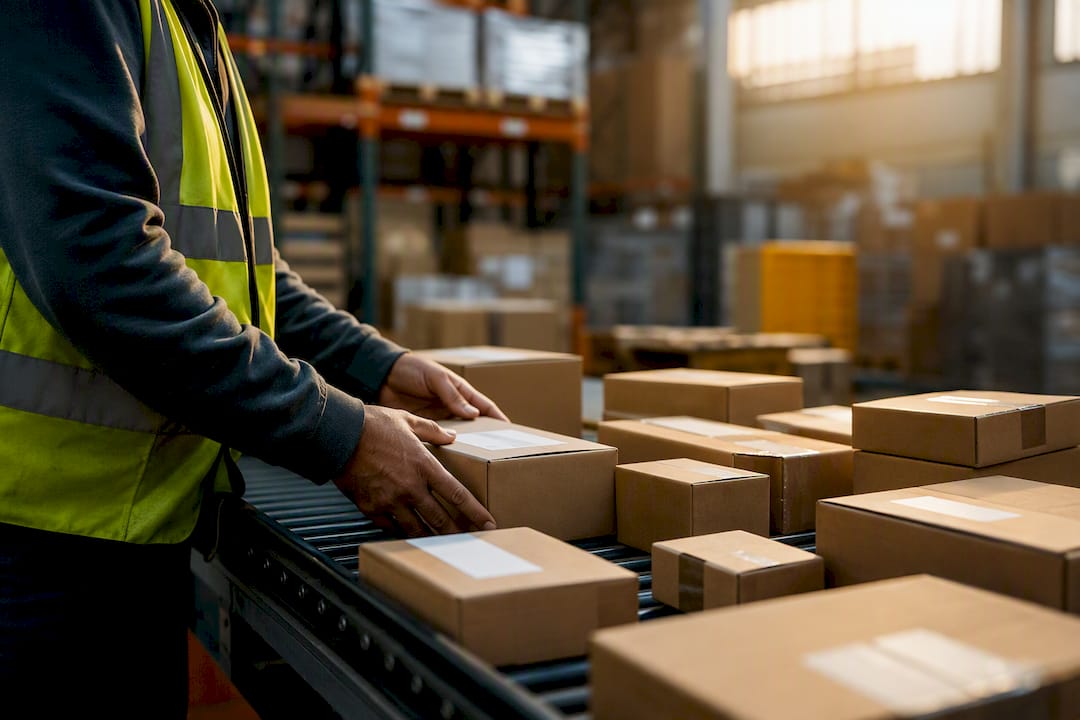
- Permitted handling — limited manipulation happens under supervision (more on that below).
- Withdrawal — you choose to enter the goods for consumption, export them, supply them to a vessel or aircraft, or destroy them under CBP oversight.
While goods sit in bond, facilities can perform:
- Cleaning
- Sorting
- Repacking
- Relabeling
What they generally cannot do without special authorization is manufacture. Assembling components into a finished product, or any process that changes the article’s essential character, crosses into manufacturing territory, and that requires separate approval under different rules.
What Counts as Manipulation vs. Manufacturing?
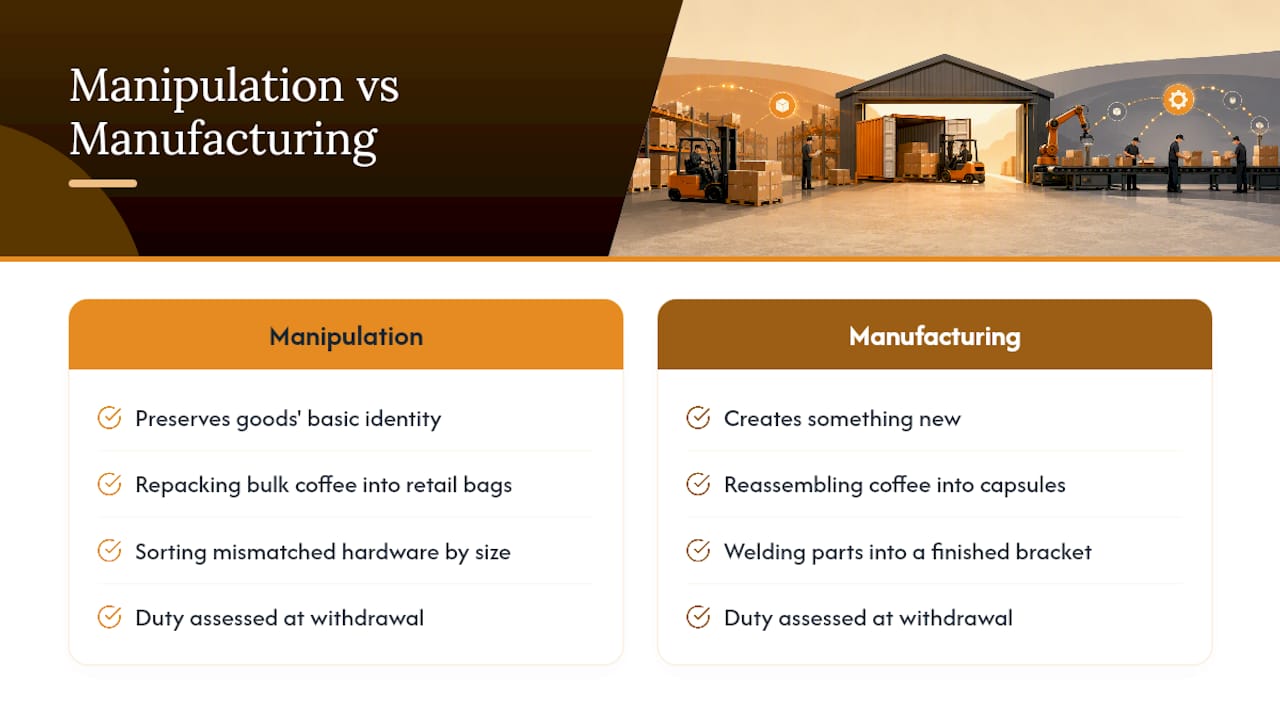
CBP draws a hard line here because the answer changes your duty bill. Manipulation preserves the goods’ basic identity. Manufacturing creates something new.
Repacking bulk coffee into retail bags is manipulation. Reassembling raw coffee grounds into flavored capsules with added ingredients starts to look like manufacturing. Sorting mismatched hardware by size is manipulation. Welding separate parts into a finished bracket is manufacturing.
The duty consequence is the part importers miss: CBP assesses duty based on the condition of the goods at the moment of withdrawal, not their condition at entry. If manipulation changes the tariff classification, you could owe a different duty rate than you expected when the shipment first arrived.
Why Businesses Use Bonded Warehouses
Duty deferral is the headline benefit, but it’s not the only one:
- Cash-flow control: you don’t pay duty until you actually sell or move the goods domestically.
- Re-export option: merchandise exported directly from bond is generally not entered for U.S. consumption, so U.S. import duty is ordinarily not assessed on that inventory.
- Quota management: items subject to import quotas can sit in bond until quota space opens up.
- Specialized storage: some bonded facilities handle cold chain or bulk liquid storage that ordinary warehouses can’t, a point Maersk’s logistics guide covers well.
- Market timing: hold goods until pricing or demand conditions improve, without duty eating into your margin while you wait.
Picture an importer bringing in $200,000 worth of seasonal goods in September for a spring release. Storing that inventory in bond means the duty payment doesn’t hit until the goods actually move toward sale, months later. Fees and lease terms vary by facility, so get quotes before assuming bonded storage is automatically cheaper than paying duty at entry.
Bonded Warehouse or Free Trade Zone?
Both defer duty, but they solve different problems.
- Duty timing: both frameworks can defer duty and can avoid U.S. consumption duty on qualifying direct re-exports, but their admission, activity, and withdrawal rules differ.
- Allowed activity: activity depends on the bonded warehouse class and CBP authorization; FTZ procedures follow a different regulatory framework and may support broader production activity.
- Admin overhead: FTZs typically involve more setup and reporting than a standard bonded facility.
- Typical user: bonded warehouses suit storage-heavy importers; FTZs suit companies doing production or heavy processing on U.S. soil.
If you’re mostly storing and reselling, a bonded warehouse is the simpler path. If you’re assembling or manufacturing from imported components, an FTZ usually fits better.
How Do You Place Goods Into Bonded Storage?
The process has a few non-negotiable steps:
- Select a facility — find a CBP-approved public bonded warehouse or set up a private one if your volume justifies it.
- File entry documents — submit warehouse entry paperwork instead of a standard consumption entry.
- Secure bond coverage — the bond amount typically ties to the value of goods and potential duty exposure.
- Handle inventory requirements — labeling, lot tracking, and record-keeping have to meet CBP’s standards, similar to the labeling discipline covered in ForwarderOne’s FNSKU prep guide.
- Sign a storage contract — fee structures vary by facility and by how long goods stay.
- Withdraw correctly — file the right paperwork whether you’re entering goods for consumption or exporting them.
A licensed customs broker or your nearest CBP office can confirm facility-specific requirements before you commit.
What Compliance Risks Should You Watch For?
Bonded storage rewards precision and punishes shortcuts:
- Misclassifying manipulation as manufacturing (or the reverse) creates duty disputes down the line.
- Unauthorized removal of goods from bond, even briefly, can trigger penalties.
- Inadequate bond coverage leaves you exposed if CBP assesses a higher duty than expected.
- Storing restricted or quota-controlled goods without proper approval risks seizure.
- Weak inventory controls make audits painful and slow down withdrawal.
Pro Tip: Document every manipulation performed in bond, down to the date and method. If CBP ever questions whether an activity crossed into manufacturing, your paper trail is what saves you from a reclassification penalty.
Noncompliance can mean fines, forfeiture of the bond, or in serious cases, loss of warehouse privileges altogether.
How Long Can Goods Stay in Bond?
Under 19 U.S.C. §1557, merchandise generally may remain in a bonded warehouse for up to five years from importation. Confirm any special rule that applies to the merchandise or entry.
Duty gets calculated at the moment you withdraw goods for consumption, based on their condition at that point, not their condition when they first arrived. If merchandise turns out to be unsalable, you can request destruction under CBP supervision instead of paying duty on something you’ll never sell.
- Five-year maximum storage period
- Duty assessed at withdrawal, not at entry
- Destruction under CBP supervision as a legitimate exit if goods have no resale value
Should Amazon Sellers Use Bonded Storage?
For most small and mid-sized Amazon sellers, the math comes down to volume and appetite for paperwork. Bonded storage tends to make sense when you’re importing large volumes, deliberately deferring duty for cash-flow reasons, or planning to resell part of a shipment abroad. It tends to be overkill when you’re moving modest quantities straight into FBA.
A few quick markers:
- Bonded storage fits if you need to hold quota-limited goods, want duty deferral on high-value inventory, or plan international resale.
- DDP or forwarder-managed import fits if you want duties handled at entry with no bond paperwork and minimal internal admin.
- Either way, a licensed customs broker or forwarder can walk you through bond requirements specific to your product category, as ForwarderOne’s guide on working with forwarders explains in more depth.
Sellers who lean toward simplicity over duty-deferral strategy usually find a managed import workflow easier to run alongside day-to-day FBA operations.
A pragmatic read on bonded storage
Bonded warehouses are a legitimate lever for duty deferral and re-export strategy, but they add real administrative weight. Weigh the cash-flow gain against storage fees and compliance work before committing.
A Simpler Path: DDP Instead of Managing Bonds
If bonded storage adds more compliance overhead than your operation needs, Delivered Duty Paid shipping is a different operating model: the seller arranges import clearance, duty payment, and delivery instead of deferring duty through bonded storage.
ForwarderOne coordinates DDP shipping for small and mid-sized sellers moving inventory from China or Korea to U.S. fulfillment centers, combining customs clearance, estimated duties, freight, and delivery in one managed workflow. If your volumes do not justify a bonded-storage strategy, request a DDP quote and compare the total landed cost and operating effort.
Frequently Asked Questions
What is a customs bonded warehouse? It is a CBP-authorized facility where imported merchandise can be stored under bond without immediate payment of import duty.
How long can goods remain in a U.S. bonded warehouse? The general statutory maximum is five years from importation, subject to the applicable entry, warehouse class, and CBP requirements.
When is import duty paid? Duty is generally paid when merchandise is withdrawn for U.S. consumption. Merchandise exported directly from bond is not entered for U.S. consumption, although storage and handling costs still apply.
Can goods be repacked or processed in bond? Authorized manipulation such as sorting or repacking may be permitted. Manufacturing requires the appropriate bonded warehouse class or another authorized program.
Is bonded storage the same as DDP shipping? No. Bonded storage defers duty and supports later withdrawal or export; DDP is a delivery term and managed import workflow in which the seller arranges import clearance and duty payment.
Compare bonded storage with a managed import
ForwarderOne coordinates customs clearance, duties, DDP freight, and final delivery for sellers who do not need a bonded-storage strategy.