Delivered Duty Paid (DDP) is defined as the Incoterm under which the seller assumes complete financial and logistical responsibility for delivering goods to the buyer’s named destination, fully cleared for import. Governed by the International Chamber of Commerce (ICC) under Incoterms 2020, DDP places maximum responsibility on the seller, covering freight, export clearance, import duties, taxes, and VAT. The buyer’s only obligation is to unload the goods. For e-commerce sellers shipping cross-border, understanding delivery duty paid meaning is the difference between a profitable international operation and an expensive compliance failure.
What is delivery duty paid and what must the seller cover?
DDP is the only Incoterm where the seller pays both import duties and VAT on the buyer’s behalf. Every other Incoterm transfers at least some customs liability to the buyer. That distinction makes DDP uniquely powerful for consumer-facing e-commerce, and uniquely demanding for the seller.
Under DDP, the seller’s obligations include:
- Export clearance at the country of origin, including all export licenses and documentation
- International freight by sea, air, or road to the destination country
- Import customs clearance at the destination, including filing all required declarations
- Payment of import duties, taxes, and VAT in the destination country
- Inland transport from the port or border to the buyer’s specified address
- Packaging, labeling, and documentation that meet destination country requirements
- Unloading, if the contract specifies it (optional but sometimes included)
The seller also carries all risk of loss or damage until the goods physically arrive at the named destination. If a shipment is delayed at customs, the seller absorbs that cost. If duties are miscalculated, the seller pays the difference.
Pro Tip: Register as an importer of record in your target market before your first DDP shipment. Attempting to handle import clearance without proper legal standing in the destination country can result in shipment holds, fines, or forced return of goods.

Sellers who underestimate these obligations often discover the problem at the worst possible moment: when goods are sitting in a bonded warehouse and a customs bill arrives that exceeds the product’s sale price. Proper preparation, including legal registration and accurate HS code classification, prevents that scenario.
How does DDP differ from DAP and other Incoterms?
The primary difference between DDP and Delivered at Place (DAP) is who pays import duties and handles customs clearance. Under DAP, the buyer takes responsibility for import clearance and pays all duties and taxes. Under DDP, the seller handles everything. That single shift in responsibility changes the entire cost structure and compliance burden of a shipment.
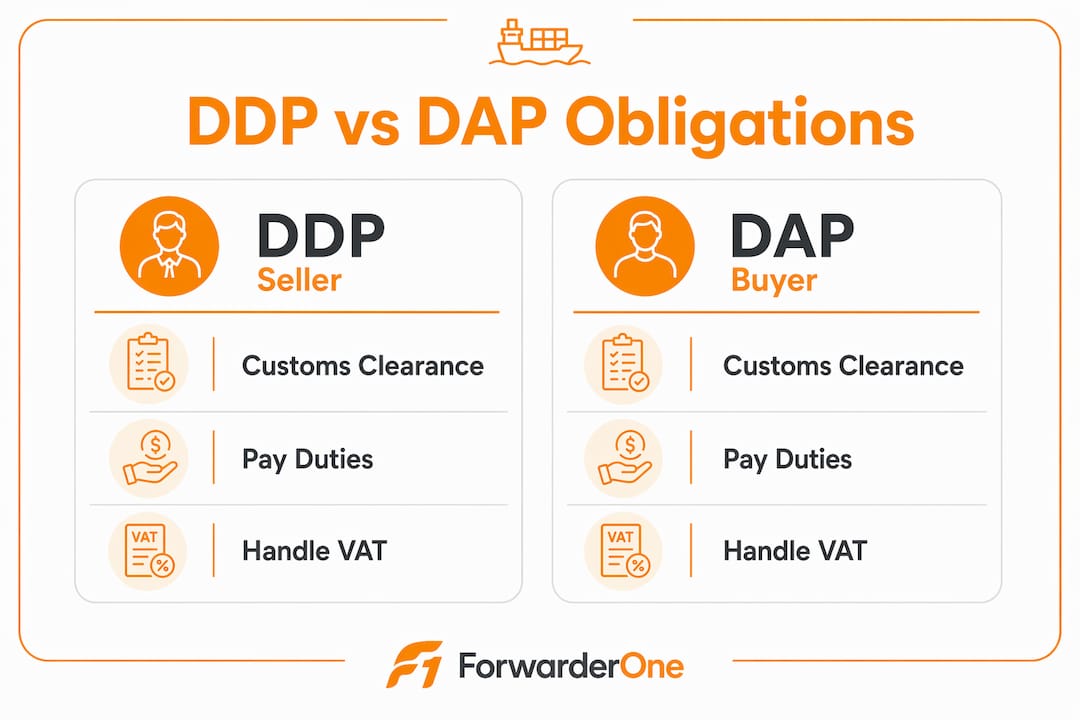
The table below shows the key distinctions across DDP, DAP, and Delivered at Place Unloaded (DPU):
| Obligation | DDP | DAP | DPU |
|---|---|---|---|
| Import customs clearance | Seller | Buyer | Buyer |
| Import duties and taxes | Seller | Buyer | Buyer |
| Unloading at destination | Buyer (unless agreed) | Buyer | Seller |
| Risk transfer point | Named destination | Named destination | After unloading |
| Buyer paperwork burden | None | High | High |
DDP requires the seller to manage export and import customs and pay all duties, while the buyer bears no import customs liability whatsoever. DAP and DPU shift that burden back to the buyer, which simplifies the seller’s compliance load but creates friction for the customer at delivery.
For e-commerce sellers, that friction matters. A buyer who receives an unexpected customs bill at the door often refuses the shipment or files a chargeback. DDP eliminates that problem entirely by making the landed cost visible and prepaid at checkout. Choosing the right Incoterm is not just a logistics decision. It is a customer experience decision.
What operational challenges does DDP present for e-commerce sellers?
DDP introduces real operational complexity that sellers must plan for before committing to it as their standard shipping term. The challenges are manageable, but only with the right systems in place.
-
HS code classification. Every product must be assigned the correct Harmonized System (HS) code for the destination country. An incorrect classification can trigger the wrong duty rate. Tariffs can exceed a product’s value, turning a profitable sale into a loss.
-
EU VAT thresholds. For sellers shipping to the European Union, the €150 threshold is critical. Shipments under €150 qualify for IOSS, the EU’s Import One-Stop Shop, which lets sellers collect VAT at checkout and remit it monthly. Shipments above €150 require full formal customs entries, which are slower and more expensive.
-
IOSS registration and compliance. Failing to register for IOSS causes individual parcel-level customs inspections, creating delays that destroy the frictionless experience DDP is supposed to deliver. Registration is straightforward but must happen before the first EU shipment.
-
Importer of record status. In many countries, the seller must be registered as the importer of record or appoint a fiscal representative. This is a legal requirement, not a formality. Skipping it means the shipment cannot legally clear customs under DDP terms.
-
Cash flow management. The seller pays duties and taxes upfront, often weeks before receiving payment from the buyer. For high-volume sellers, this creates a significant working capital gap that must be budgeted in advance.
-
SLAs with logistics partners. Sellers must maintain strong SLAs with freight forwarders and customs brokers to control compliance risks. Without defined timelines and accountability, a single customs delay can cascade into stockouts and lost sales.
Pro Tip: Use supply chain optimization tools to model your landed costs before committing to DDP pricing. Duty rates, VAT, and freight costs combined can shift your margin by 15–30 percentage points depending on the destination.
The sellers who handle DDP well treat it as a system, not a one-off decision. They build duty calculation into their pricing model, automate VAT collection at checkout, and work with logistics partners who specialize in customs clearance.
What are the benefits and risks of DDP for international shipments?
DDP delivers a genuinely superior buyer experience. The customer pays one price, receives the goods at their door, and never interacts with customs. For consumer-facing e-commerce, that frictionless delivery is a competitive advantage that drives repeat purchases and reduces cart abandonment on international orders.
The benefits are real:
- No customs surprises for buyers. All duties and taxes are prepaid, so buyers never face unexpected charges at delivery.
- Faster delivery perception. Goods pre-cleared for import move through customs faster than shipments where the buyer must respond to customs notices.
- Stronger brand trust. Buyers associate smooth delivery with brand reliability, not logistics complexity.
- Reduced return rates. Refused shipments due to unexpected duty bills drop to near zero under DDP.
The risks are equally real. DDP creates significant B2B risks including duty-drawback complications, product liability exposure in the destination jurisdiction, and transfer-pricing issues that can attract tax authority scrutiny.
“DDP convenience can be deceptive. Seller costs are variable and tied directly to tariffs, HS codes, and destination regulations rather than a fixed fee. A seller who prices DDP without modeling destination-specific duty rates is essentially writing a blank check to the customs authority.”
The most common mistake is treating DDP as a flat-rate service. It is not. Every destination country has its own tariff schedule, VAT rate, and import rules. A seller who prices DDP for the US market and then applies the same logic to the EU or Brazil without recalculating will lose money on every shipment.
How to implement DDP shipping for your e-commerce business
Implementing DDP successfully requires building the right infrastructure before you ship a single parcel. These are the steps that matter most:
- Establish fiscal representation or importer of record status in each target market. Work with a local legal or tax advisor to understand registration requirements before launch.
- Integrate IOSS at checkout for EU-bound shipments under €150. Collect VAT from the buyer at the point of sale and remit it monthly through the IOSS portal. This keeps your EU shipments moving without parcel-level customs inspections.
- Choose freight forwarders and customs brokers with DDP expertise. Not every forwarder handles import clearance in the destination country. Verify their capabilities and references before signing a contract.
- Build duty and tax calculations into your pricing engine. Use HS code-based duty calculators to model landed costs for each product-destination combination. Update these calculations whenever tariff schedules change.
- Negotiate written SLAs that define clearance timelines, escalation procedures, and liability for delays caused by customs holds.
- Monitor shipments at every stage. Use a tracking system that shows customs clearance status, not just carrier scans. Knowing a shipment is held at customs on day two is far better than discovering it on day ten.
The customs clearance process is the most time-sensitive part of DDP. Sellers who treat it as a black box consistently face delays, unexpected costs, and frustrated customers.
Key Takeaways
DDP is the only Incoterm where the seller pays all import duties, taxes, and VAT, making it the highest-responsibility and highest-complexity shipping term available under Incoterms 2020.
| Point | Details |
|---|---|
| Seller bears all costs | Under DDP, the seller covers freight, duties, VAT, and clearance from origin to buyer’s door. |
| Buyer has no customs burden | The buyer’s only obligation is to unload goods at the named destination. |
| IOSS simplifies EU VAT | EU shipments under €150 qualify for IOSS, enabling monthly VAT remittance and faster clearance. |
| Duty miscalculation is costly | Tariffs can exceed product value, so accurate HS classification is non-negotiable before pricing DDP. |
| SLAs protect compliance | Written service-level agreements with forwarders and brokers are the primary tool for managing DDP risk. |
DDP in practice: what sellers get wrong
Most sellers I work with understand DDP in theory before they ship their first international order. The problems start when theory meets a real customs declaration in a country they have never shipped to before.
The biggest misconception is that DDP is a service you buy from a freight forwarder. It is not. DDP is a legal and financial commitment you make to your buyer. The forwarder executes the logistics. You own the liability. If the forwarder misclassifies your goods and the customs authority issues a penalty, that penalty lands on you, not the forwarder, unless your SLA explicitly states otherwise.
The second thing sellers consistently underestimate is the cash flow impact. Paying duties and VAT upfront on a high-volume shipment can tie up tens of thousands of dollars for weeks. I have seen sellers with healthy profit margins run into serious cash flow problems simply because they did not model the timing of duty payments against their payment terms.
My honest advice: start DDP on one market, with one product category, and one trusted logistics partner. Build your systems, test your duty calculations, and verify your compliance setup before scaling. The sellers who try to launch DDP across five markets simultaneously almost always hit a compliance problem in at least one of them.
Regulations are also moving fast. The EU’s IOSS rules, US de minimis thresholds, and destination-country VAT requirements are all in active flux heading into 2026. Sellers who rely on DDP shipping guides from two years ago are working with outdated information. Build a compliance review into your quarterly operations calendar.
— Keven
ForwarderOne’s DDP freight forwarding for Amazon sellers
Shipping inventory from China to the US, Mexico, or other markets under DDP terms requires a logistics partner who handles import clearance, duties, and VAT as a core service, not an add-on.
ForwarderOne specializes in DDP freight forwarding for small and mid-sized Amazon sellers, managing customs clearance, import duties, and delivery in a single workflow. With over 99% on-time delivery and a dedicated account manager for every client, ForwarderOne removes the compliance burden so sellers can focus on growing their business. Routes include China to USA, China to Mexico, and other key e-commerce corridors. Sellers who want a China-to-USA DDP solution built specifically for Amazon FBA can get a quote directly through ForwarderOne.
FAQ
What is delivery duty paid in simple terms?
Delivered Duty Paid (DDP) means the seller pays all shipping costs, import duties, and taxes and delivers goods to the buyer’s door fully cleared for import. The buyer only needs to unload the shipment.
Is delivery duty paid prepaid by the seller?
Yes. Under DDP, all duties and taxes in shipping are prepaid by the seller before or at the time of customs clearance. The buyer pays nothing to customs authorities.
How does delivery duty paid work for EU shipments?
For EU shipments under €150, sellers can use the Import One-Stop Shop (IOSS) to collect VAT at checkout and remit it monthly, avoiding parcel-level customs delays. Shipments above €150 require full formal customs entries.
What is the difference between DDP and DAP?
Under DDP, the seller handles import customs clearance and pays all duties and taxes. Under DAP (Delivered at Place), the buyer handles import clearance and pays all duties, which can result in unexpected charges at delivery.
Can small e-commerce sellers use DDP shipping?
Yes, but small sellers need a reliable freight forwarder experienced in import clearance and a clear understanding of duty costs for each destination market. Services like ForwarderOne’s Amazon FBA DDP shipping are specifically designed to make DDP accessible for smaller operations.
Need a DDP route that protects landed cost?
ForwarderOne manages pickup, customs, duties, delivery appointments and milestone updates for ecommerce sellers shipping inventory to US and Mexico fulfillment channels.