
Door-to-door shipping, formally known as DDP (Delivered Duty Paid), means your forwarder picks up inventory at your Chinese supplier's factory and delivers it directly to your Amazon fulfillment center address, covering freight, customs clearance, import duties, and final-mile delivery in a single contract. You get one quote, one point of contact, and one delivery outcome.
Here is what transfers to the forwarder under DDP, and what stays with you:
- Forwarder handles: factory pickup, export documentation, main carriage (ocean, air, or express), CBP import clearance, duty and tax payment, and final-mile carrier appointment to the Amazon FC
- You remain responsible for: product compliance, accurate HTS codes, FNSKU labeling accuracy, and a valid FBA shipment plan
- Trust signal: ForwarderOne manages the full China to US Amazon FC chain with end-to-end tracking from factory to fulfillment center, coordinating CBP clearance and Amazon FC appointments
Industry commentary describes door-to-door logistics as a "teleportation device" for cargo, replacing the complexity of multiple vendors with a single provider and real-time visibility.
What a DDP quote should actually include for your China to US shipment
A legitimate all-inclusive DDP quote covers these core components:
- Origin inland pickup from your supplier's factory
- Export customs declaration and documentation
- Main carriage (ocean FCL/LCL, air freight, or express courier)
- US import clearance with CBP, including duty and tax payment
- Final-mile delivery to the Amazon FC address
- Proof of delivery and shipment reconciliation
For background on the freight portion of a door-to-door shipment, see AMB Moving Services' guide: What is long-distance freight?
Beyond the core, some forwarders bundle add-ons while others charge separately. Confirm in writing whether these are included:
- Palletization and pallet labeling to Amazon standards
- FNSKU labeling and FBA prep services
- Cargo insurance (and at what declared value)
- Amazon FC carrier appointment scheduling fees
Pro Tip: Ask your forwarder to send you the written SLA language before booking. If appointment scheduling and Amazon FC acceptance checks are not explicitly listed in the quote, assume they are excluded and negotiate them in.

How DDP compares to other Incoterms you will see in quotes
The Incoterm determines who pays duties, who handles import clearance, and who arranges final-mile delivery. For Amazon sellers, that split has real cash and operational consequences.
| Incoterm | Who pays import duties | Who handles US customs | Final-mile to Amazon FC |
|---|---|---|---|
| DDP | Seller/forwarder | Forwarder | Forwarder |
| DAP | Buyer (you, after arrival) | Buyer arranges | Buyer arranges |
| EXW | Buyer | Buyer | Buyer |
| CIF | Buyer | Buyer | Buyer |
Under DAP, EXW, or CIF, you are responsible for US customs clearance and arranging delivery to the FC yourself. That means hiring a separate customs broker, coordinating a drayage carrier, and scheduling the Amazon appointment independently. DDP bundles all of that.
The real advantage of DDP is cost predictability, not just convenience. When duties, brokerage, and final-mile are bundled, your landed cost is fixed at booking. With DAP or EXW, a CBP exam, unexpected tariff classification, or appointment re-scheduling fee can blow your margin after the goods are already in transit.
That said, DDP quotes can hide exclusions. Always verify what is explicitly listed, not just implied by the word "all-inclusive." Learn more about what DDP shipping covers before signing a contract.
Step-by-step: how a China to US DDP shipment actually moves
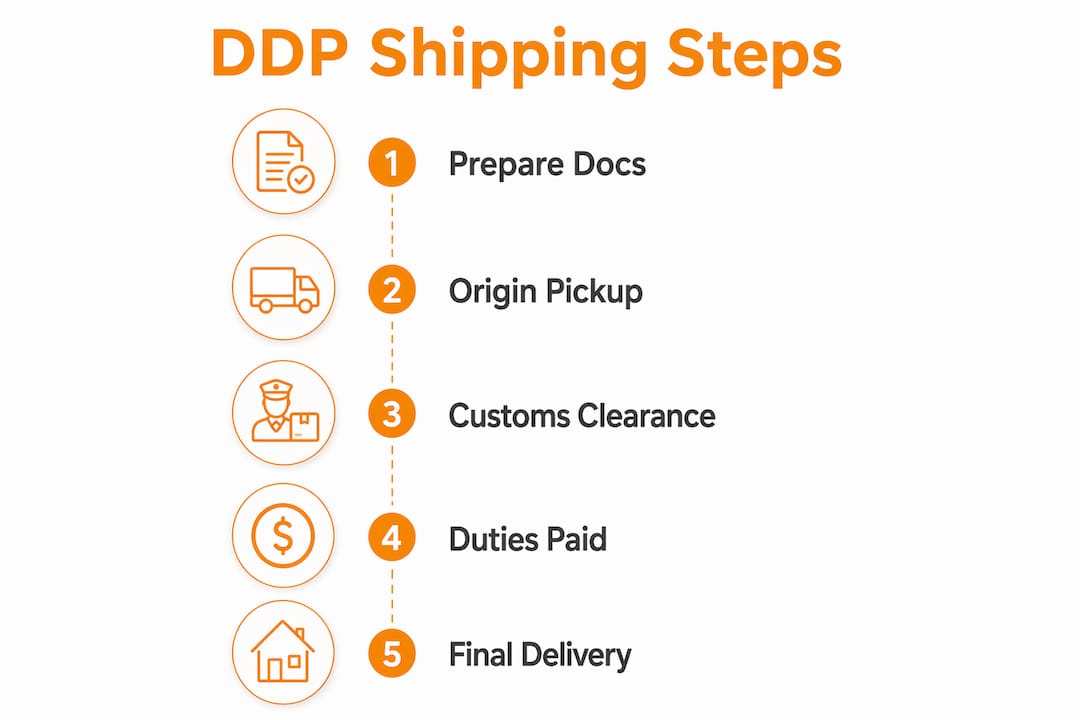
- Factory pickup — Forwarder dispatches a truck to your supplier. Verify carton count, weights, and dimensions against the packing list before the truck leaves.
- Export customs declaration — Forwarder files export documents with Chinese customs. Your commercial invoice, packing list, and HTS codes must be accurate here; errors cause export holds.
- Inland drayage to port or airport — Cargo moves to the origin port (typically Shenzhen, Shanghai, or Ningbo for ocean; Shenzhen or Hong Kong for air).
- Main carriage — Ocean vessel or air freight departs. For LCL ocean, your cargo consolidates with other shipments; for FCL, you have the container.
- US port arrival and CBP clearance — Forwarder's customs broker files the ISF (ocean) and entry documents with CBP. Missing or incorrect HTS codes are the single most common cause of CBP holds here.
- Drayage to Amazon FC region — Cargo moves from the port to a local carrier or cross-dock near the destination FC.
- Amazon FC carrier appointment — Forwarder or final-mile carrier schedules a delivery appointment through Amazon's carrier appointment system. No appointment, no delivery.
- Delivery and proof of delivery — Carrier delivers to the FC dock. You reconcile the delivery against your FBA shipment plan and submit the ASN if required.
Key documents to have ready before step 1: commercial invoice, packing list, Bill of Lading or AWB, FBA shipment plan ID, HTS codes for every SKU, and MSDS for any regulated or battery-containing products.
Documents, labeling, and prep you must supply before pickup
Even with a full-service DDP forwarder, sellers remain responsible for product compliance and labeling accuracy. A forwarder can apply FNSKU labels, but you must supply the correct label file.
Mandatory documents you provide or approve:
- Commercial invoice with accurate declared values and HTS codes
- Packing list matching carton contents exactly
- FBA shipment plan details (shipment ID, destination FC, expected units)
- MSDS or safety data sheet for batteries, liquids, or regulated goods
Amazon FC labeling and prep requirements:
- FNSKU labels on every unit (or poly-bag/bubble-wrap per Amazon category rules)
- Carton labels with FBA shipment ID and carton number
- Pallet labels on all four sides if palletizing
- Pallet height generally not to exceed 72 inches including pallet; weight limits apply per Amazon's current guidelines
Pre-shipment checklist before your forwarder picks up:
- Confirm product compliance for the US market (CPSC, FCC, FDA as applicable)
- Send the correct FNSKU label file and carton label template to your forwarder
- Declare the full insured value of the shipment
- Provide the Amazon FC receiving contact and any special delivery instructions
How DDP costs are calculated and what to watch for
| Cost component | Who pays under DDP | What to confirm in writing |
|---|---|---|
| Origin pickup / inland drayage | Forwarder | Included or charged per km/zone? |
| Export documentation | Forwarder | Flat fee or per-document? |
| Main carriage (ocean/air) | Forwarder | Rate basis (CBM, kg, container) |
| US import duties & tariffs | Forwarder (billed to you) | Duty rate used, tariff classification |
| Customs brokerage fee | Forwarder | Per-entry or per-shipment? |
| Final-mile delivery | Forwarder | Included to FC address? |
| Amazon FC appointment fee | Often excluded | Confirm explicitly |
| FBA prep / labeling | Optional add-on | Per-unit or flat fee? |
| Cargo insurance | Often optional | Declared value basis, coverage scope |
| Detention / demurrage | Risk item | Who absorbs if customs delays clearance? |
Hidden fees are the most common risk in DDP quotes. Sellers must clarify whether quotes include carrier appointment fees, detention and demurrage exposure, and insurance for the shipment's full declared value. A quote that looks $400 cheaper than a competitor's may exclude three of those line items.
Typical timelines and SLA checkpoints by shipping mode
- Ocean freight (LCL or FCL): 25–45 days door-to-door from major Chinese coastal cities to US FCs. Add extra buffer days during Chinese New Year and Q4 peak season.
- Air freight: 5–10 days door-to-door. Faster, but cost per kilogram is significantly higher than ocean.
- Express courier (DHL/FedEx/UPS): 2–5 days. Best for small, high-value restocks or urgent inventory gaps.
SLA checkpoints to require from your forwarder in writing:
- Pickup window (within X days of booking confirmation)
- Export clearance completion date
- Port cut-off receipt confirmation
- Estimated arrival and customs clearance target date
- Amazon FC appointment confirmation date and delivery window
For peak seasons (Q4, Prime Day), add at least 10–14 days to your standard ocean lead time and reorder earlier than your historical cadence. Real-time tracking visibility reduces the safety stock you need to hold, because you know exactly where your inventory is at every checkpoint.
Amazon FC delivery rules and the failure modes that cost you money
Amazon's fulfillment centers have strict delivery requirements. A forwarder without documented Amazon FC experience will get your shipment turned away.
Core Amazon delivery rules:
- All deliveries require a confirmed carrier appointment booked through Amazon's system
- An Advance Shipment Notice (ASN) must be submitted before delivery
- Pallets must be GMA-standard, four-way entry, in good condition, and labeled on all four sides
- Carton contents must match the FBA shipment plan exactly
- Carriers must be on Amazon's approved carrier list for the FC
Common failure modes:
- Missed or incorrectly scheduled appointments (most common cause of re-delivery fees)
- Pallet labeling errors or non-compliant pallet quality
- Shipment contents that do not match the FBA plan (triggers a discrepancy hold)
- Late delivery outside the appointment window
Red flags in a forwarder's Amazon experience:
- Cannot describe their appointment scheduling process in detail
- No documented history of delivering to Amazon FCs
- Unclear or absent re-delivery fee policy in the contract
- No proof-of-delivery process tied back to your FBA shipment plan
For Amazon-focused deliveries, the "door" is a defined Amazon FC address, and forwarders that document appointment scheduling and acceptance processes reduce costly delivery failures significantly.
How to choose a DDP forwarder for your Amazon inventory
- Verify Amazon FC experience directly. Ask for examples of FCs they have delivered to, not just general freight experience.
- Request written SLA metrics. On-time delivery percentage, pickup window, and customs clearance target should all be in writing.
- Confirm dedicated account management. A single point of contact who knows your SKUs and shipment history prevents miscommunication during peak periods.
- Check end-to-end tracking capability. You should be able to see status from factory pickup through FC delivery, not just main carriage.
- Clarify insurance terms. Confirm coverage scope, declared value basis, and average claim resolution time before you need it.
- Get line-item DDP invoicing. A forwarder who cannot break down duties, brokerage, freight, and final-mile separately is hiding something.
Questions to ask every forwarder before booking:
- Who schedules the Amazon FC appointment, and what is your re-delivery fee policy?
- What is explicitly included and excluded in this DDP quote?
- What is your average customs clearance time at the destination port?
- How do you handle a CBP exam or customs hold?
Red flags to walk away from:
- Flat fees with no line-item breakdown
- No tracking portal or only carrier-level tracking (not origin-to-FC)
- Vague answers about Amazon appointment scheduling
- No references from other Amazon sellers
Choosing the right freight forwarder as an Amazon seller is one of the highest-leverage decisions you make for inventory reliability. Industry sources confirm that SLA metrics, dedicated account management, and end-to-end tracking are the top trust signals to verify.
How ForwarderOne delivers DDP for Amazon sellers
ForwarderOne handles the full China to US Amazon FC chain: factory pickup, export clearance, ocean or air main carriage, CBP import clearance, duty payment, FBA labeling, and carrier appointment scheduling to the FC dock.
Service features relevant to Amazon sellers:
- High on-time delivery rate across China to US FBA shipments
- Dedicated account manager assigned to your account from day one
- End-to-end tracking from factory pickup through FC delivery
- Transparent DDP invoicing with line-item duty and fee breakdown
- FBA labeling and prep services available at origin
- Cargo insurance support with declared value coverage
- Amazon FC appointment coordination and re-delivery policy in writing
ForwarderOne's DDP service is built specifically for small and mid-sized Amazon sellers who need predictable landed costs and zero surprises at the FC dock. The combination of a dedicated account manager, 99% on-time delivery, and documented Amazon FC appointment experience means your inventory arrives on schedule, labeled correctly, and accepted on the first attempt.
For sellers also shipping to Walmart WFS or TikTok Shop FBT, ForwarderOne's fulfillment network delivery experience extends beyond Amazon FCs.
Key Takeaways
Door-to-door DDP shipping covers the full China to US Amazon FC journey under one contract, but sellers must still supply accurate documentation, correct labeling files, and a valid FBA shipment plan.
| Point | Details |
|---|---|
| DDP scope | Forwarder handles pickup, customs, duties, and final-mile; you supply accurate docs and labels. |
| Hidden fees risk | Always confirm appointment fees, detention exposure, and insurance are explicitly included in the quote. |
| Amazon FC requirements | Confirmed appointments, ASN submission, and pallet compliance are non-negotiable for FC acceptance. |
| Mode timelines | Ocean runs 25–45 days; air runs 5–10 days; express runs 2–5 days door-to-door from China. |
| ForwarderOne | Delivers China to US FBA DDP with 99% on-time delivery, dedicated account management, and FC appointment coordination. |
When door-to-door DDP is the right call for your Amazon business
Most small and mid-sized Amazon sellers benefit from DDP precisely because they do not have an in-house customs team or a carrier network at US ports. The predictable landed cost is not just a convenience feature; it is a margin protection tool. When you know your total cost at booking, you can price accurately and reorder confidently.
That said, DDP is not always the cheapest option per unit. High-volume sellers moving full container loads regularly sometimes find it worth building direct relationships with a customs broker and a drayage carrier, shaving cost on the brokerage and final-mile legs. The trade-off is operational complexity and the risk of a single missed appointment costing more than the savings.
The sellers who get the most from DDP are those restocking during peak seasons, launching new SKUs where cash flow predictability matters, or scaling past the point where managing multiple logistics vendors becomes a distraction. For those sellers, the premium over a self-assembled logistics chain is almost always worth it. The sellers who should think twice are those with enough volume to negotiate direct carrier contracts and enough staff to manage the coordination. Even then, most keep DDP for their most time-sensitive restocks.
One thing the industry undersells: door-to-door shipping is not just about who pays the duties. It is about who owns the problem when something goes wrong. Under DDP, that is your forwarder. Under EXW or DAP, it is you, at the worst possible moment.
ForwarderOne: DDP shipping from China to your Amazon FC
ForwarderOne is built for Amazon sellers who need their inventory to arrive at the FC on time, labeled correctly, and without a surprise invoice at the end. From supplier pickup in China through CBP clearance, duty payment, and Amazon FC appointment scheduling, every step is covered under one DDP contract with a dedicated account manager who knows your shipments by name.
With 99% on-time delivery and transparent line-item invoicing, ForwarderOne gives you the cost predictability and operational reliability that Amazon's restocking cadence demands. Whether you are shipping ocean LCL, air freight, or express, the process is the same: one quote, one contact, one delivery. Get a DDP quote or explore the full FBA forwarding service catalog to see what is included for your next shipment.
Need door-to-door DDP into Amazon FBA?
ForwarderOne coordinates pickup, customs clearance, duty payment, FBA prep details, and final delivery under one shipment plan.