
Planning for peak season converts cost and service risk into predictable, controllable outcomes. If you’re still treating peak as a once-a-year scramble, you’re leaving margin on the table and handing service failures to your customers.
Three reasons to commit resources to peak planning now:
- Avoid exponential expedited costs. Last-minute air freight and spot-rate trucking can run three to five times the cost of pre-booked capacity.
- Protect on-time delivery and customer trust. A single missed peak window can cost you reviews, rankings, and repeat buyers that take months to recover.
- Preserve margin through capacity and inventory alignment. Pre-positioned inventory and locked carrier capacity mean you’re not paying premium rates for the same service you could have secured at contract rates.
Run a 30-minute readiness check right now across three areas: your demand forecast inputs, your carrier commitments, and your staffing plan. If any of those three has a gap, this guide tells you exactly how to close it.
Key Takeaways
Peak-season logistics planning converts unpredictable cost and service risk into a managed, measurable operation that protects margin and customer trust.
| Point | Details |
|---|---|
| Start planning earlier than you think | Ocean bookings for holiday peak should be confirmed by August; FBA inbound cutoffs typically close in mid-October. |
| Build flexibility, not just forecasts | Multi-carrier fallback, overflow warehousing, and exception automation matter more than forecast precision during peak. |
| Track six KPIs daily during peak | OTD, fill rate, cost per order, expedited spend %, inventory turns, and exception rate are the metrics that trigger decisions. |
| Assign one owner per action | Collective ownership of peak tasks means no one escalates in time; every checklist item needs a named individual and a due date. |
| ForwarderOne for international inbound | ForwarderOne’s DDP service and dedicated account manager handle customs, labeling, and FBA routing so your international leg stays on schedule. |
What does “peak season” actually mean for U.S. logistics teams?
Peak season in logistics isn’t a single date on a calendar. Operationally, it means a demand surge collides with constrained capacity and shorter decision windows, all at the same time. Carriers fill their lanes. Warehouses hit throughput ceilings. Labor markets tighten. The margin for error compresses precisely when the volume is highest.
For U.S. logistics teams, the major recurring peak events and their typical planning windows look like this:
- Holiday surge (November–December): The biggest and most predictable. Ocean freight bookings from Asia should be confirmed by August; FBA inbound cutoffs for peak typically fall in early-to-mid October.
- Prime Day (July): Amazon’s mid-year spike. Inventory needs to land at fulfillment centers by late June; factory production cutoffs often fall in May.
- Back-to-school (July–August): Overlaps with Prime Day prep and creates a double-pressure window for apparel, electronics, and school supplies.
- Black Friday / Cyber Monday (late November): Sits inside the holiday surge but has its own promotional flash dynamic; carrier surcharges typically activate in early November.
- Promotional flashes (varies): Flash sales, brand events, and platform-specific promotions can spike demand with as little as two weeks’ notice.
Peak season timing has shifted earlier and lengthened, and teams that build predictive dashboards using historical data and real-time signals reduce the risk of missing capacity windows and incur lower expedited costs. The practical implication: if you’re starting your holiday planning in September, you’re already behind.
Booking lead time benchmarks to keep in mind:
- Ocean freight from China: 6–10 weeks transit plus 2–4 weeks booking lead time
- Air freight from Asia: 1–2 weeks transit, but capacity fills fast in October
- Domestic truckload: Spot rates spike in November; contract capacity should be locked by September
- FBA inbound receiving: Amazon’s cutoff windows for guaranteed pre-holiday processing typically close in mid-October
Why peak-season logistics planning matters: the measurable business case
The business case for planning isn’t abstract. It shows up in your P&L, your fill rate, and your customer satisfaction scores.
Cost control is the most immediate lever. When you plan, you book capacity at contract rates instead of spot rates. You avoid accessorial charges that stack up when shipments miss appointment windows. You don’t pay $8 per unit in air freight for inventory that could have moved by ocean at $1.50 if it had left the factory six weeks earlier. Logistics planning reduces costs, improves visibility, and increases resilience through better inventory turns and reduced expedited spend.
Service and revenue protection follow directly. Stockouts during peak don’t just lose a sale. On Amazon, a stockout drops your organic ranking, and recovering that position takes weeks of advertising spend after the peak is over. Protecting your on-time delivery (OTD) rate and fill rate during November and December is worth more than any promotional discount you could run.
Operational leverage compounds the benefit. When your warehouse knows volume is coming, it can schedule labor efficiently. When your carriers know your lanes, they hold capacity. When your suppliers know your cutoffs, they prioritize your production runs. Cross-functional coordination, planned in advance, turns peak from a reactive fire drill into a managed operation.
A Shopify logistics planning analysis identifies planning tools and disciplines that directly improve visibility and reduce costs, including demand forecasting, inventory positioning, and carrier management. The ROI of planning isn’t theoretical. It’s the difference between a peak season that grows your business and one that erodes it.
What challenges does peak season expose in your operations?
Peak season doesn’t create new problems. It amplifies the ones already hiding in your operation. Here are the most common failure modes, mapped to their business consequences:
-
Capacity crunch. Carrier lanes fill, warehouse dock appointments become scarce, and port congestion spikes. Symptom: shipments sit waiting for pickup or receiving appointments. Consequence: delayed inbound, missed FBA cutoffs, stockouts.
-
Labor shortages. Warehouse labor markets tighten in October and November. If you haven’t pre-arranged temp staffing or surge agreements, you’re competing for workers at peak rates with two weeks’ notice. Symptom: throughput drops below plan. Consequence: orders ship late, error rates climb.
-
Carrier cutoffs and surcharges. Major carriers activate peak surcharges as early as October 1. Single-carrier dependency means you absorb every surcharge with no leverage. Relying on a single carrier, underestimating labor, and automating too little of exception handling are the most repeated peak-season mistakes. Consequence: cost per shipment rises faster than revenue.
-
Returns spikes. Post-holiday returns can run 20–30% of peak volume in some categories. If your reverse logistics process isn’t pre-planned, returns processing creates a secondary bottleneck in January that ties up warehouse space and labor. Consequence: delayed restocking, cash tied up in unprocessed inventory.
-
Throughput bottlenecks. Pack stations, label printers, and dock doors all have physical limits. A volume surge that exceeds any one of those limits creates a queue that backs up the entire operation. Consequence: orders age, SLA compliance drops.
-
Inaccurate delivery promises. When systems don’t reflect real carrier capacity or transit times, customer-facing delivery estimates are wrong. Consequence: customer complaints, chargebacks, and negative reviews arrive before the peak is even over.
Challenges 1, 3, and 6 are largely predictable and can be addressed in your planning cycle. Challenges 2, 4, and 5 require contingency playbooks because their magnitude is harder to forecast precisely.
How do you build a time-phased peak-prep plan?
The Peak Season Planning Playbook frames peak planning as a preparation-led operating discipline that connects forecasting, inventory planning, logistics readiness, scenario planning, and decision ownership. That framing matters because it shifts the question from “what do we forecast?” to “what are we ready for?”
Here’s how to structure the work by phase:
-
T-minus 16+ weeks (strategic setup): Pull two to three years of demand data by SKU and channel. Identify your top 20% of SKUs by peak revenue contribution. Assign decision owners for forecasting, carrier relations, warehouse ops, and customer service. Lock your peak budget, including contingency reserves for expedited freight.
-
T-minus 12 weeks (inventory and supplier alignment): Share peak forecasts with suppliers and confirm production capacity. Book ocean freight for holiday inventory. Confirm FBA inbound cutoff dates and build your shipment calendar backward from those dates. Identify SKUs at risk of stockout and pre-position safety stock.
-
T-minus 8 weeks (carrier and warehouse commitments): Finalize carrier contracts and confirm surge capacity agreements. Negotiate contingency lanes with at least one backup carrier per major lane. Confirm warehouse labor plans, including temp agency agreements. Run a throughput simulation: can your current dock, pack, and label capacity handle 150% of normal daily volume?
-
T-minus 4 weeks (pressure testing): Run scenario tests for demand arriving early, a constrained carrier lane, and returns surging beyond plan. Validate label formats and ASN processes end-to-end. Test exception automation: does your system flag a late shipment automatically, or does someone have to notice it manually?
-
T-minus 2 weeks (final confirmation): Confirm all inbound shipments are on track. Brief customer service on expected delivery windows and exception scripts. Activate real-time tracking dashboards. Confirm contingency triggers: at what point do you escalate to air freight or a backup carrier?
-
Peak week (execution and monitoring): Track OTD, fill rate, and cost per order daily. Hold a 15-minute cross-functional standup every morning. Escalate exceptions within four hours, not four days.
Pro Tip: When sizing your buffer inventory, use your worst peak year as the baseline, not your average. Average-based buffers run out in the years that matter most.
| Phase | Owner | Key Output |
|---|---|---|
| T-16+ weeks | Supply Planning | Demand forecast, budget approved |
| T-12 weeks | Procurement / Ops | Supplier confirmed, ocean booked |
| T-8 weeks | Carrier Relations / Warehouse | Contracts signed, labor plan confirmed |
| T-4 weeks | All functions | Scenario tests complete, automation validated |
| T-2 weeks | Ops / CS | Dashboards live, contingency triggers set |
| Peak week | Ops lead | Daily KPI review, exception escalation |
Inventory, warehousing, and distribution tactics that reduce peak friction
The best carrier strategy in the world doesn’t help if your inventory is in the wrong place when demand hits. These tactics address the physical distribution problem directly.
- Distributed inventory across regional nodes. Splitting inventory across two or three fulfillment locations reduces average transit time to the customer and insulates you from a single-node capacity constraint. For FBA sellers, this means understanding Amazon’s FBA warehouse locations and routing inbound shipments to nodes that serve your highest-demand zip codes.
- Regional preloads. Pre-positioning inventory in regional distribution centers before peak begins cuts last-mile cost and transit time. A seller who moves 60% of their holiday inventory to a Midwest DC in October pays ground rates instead of expedited rates in December.
- Cross-docking for fast-moving SKUs. For high-velocity items, cross-docking at a regional hub eliminates a storage step and accelerates throughput. This works best when your demand signal is reliable enough to justify the reduced buffer.
- Zone skipping. Injecting parcels directly into a regional carrier hub bypasses upstream sortation and cuts one to two transit days. The tradeoff is higher minimum volume requirements per injection point.
- Pack cadence changes. Shifting to pre-kitted or pre-packed configurations before peak reduces pick-and-pack time per order during the surge. This requires coordination with your supplier or 3PL on packaging specifications.
- Surge labor plans. Pre-arrange temp staffing through agencies with warehouse experience, not general labor pools. Brief them on your label and pack standards before peak begins, not during it.
Pro Tip: Temporary overflow warehousing is a peak tool, not a permanent fix. Use it for predictable overflow on a specific SKU category, with a clear plan for when that inventory moves to its final destination. Signing a long-term lease because peak felt overwhelming is a cost you’ll carry all year.
Freight consolidation is another tactic worth building into your pre-peak inbound plan. Consolidating smaller shipments into full container loads before peak reduces per-unit freight cost and simplifies customs clearance.

How do you structure your carrier mix to survive a capacity crunch?
Single-carrier dependency is the most predictable peak failure mode, and it’s entirely avoidable. Here’s how to think about your carrier mix:
- Ocean freight offers the lowest cost per unit for non-urgent inbound from Asia, but requires 6–10 weeks of lead time. It’s the right mode for base inventory that needs to land before peak begins. Early booking and multi-mode routing are core tactics for peak shipping optimization.
- Air freight costs significantly more per kilogram but cuts transit time to one to two weeks. Reserve it for fast-moving SKUs that are running low mid-peak, not for base inventory you could have moved by ocean. See the ocean vs. air freight tradeoffs for a detailed cost and lead-time comparison.
- Domestic truckload and LTL are the last-mile levers. Lock contract capacity with your primary carrier by September. Negotiate a surge clause that gives you access to additional capacity at a pre-agreed rate, not spot rates, if volume exceeds your base commitment.
Multi-carrier strategy means more than having two carriers on your approved vendor list. It means having tested integrations, confirmed rate cards, and at least one completed test shipment with each backup carrier before peak begins. Switching carriers mid-peak when you’ve never run a shipment through their system is operationally risky.
Pro Tip: During the off-season, run one real shipment through each of your backup carriers. Confirm their label formats, API reliability, and exception notification speed. A carrier that takes 48 hours to notify you of a delay is not a functional backup during peak.
Building flexibility through multi-carrier options, overflow warehousing, and automation is more effective than chasing a perfect forecast. The goal isn’t to predict peak perfectly. It’s to be ready for the version of peak that doesn’t match your forecast.
Which tech tools should your stack include for peak visibility?
Your technology stack during peak needs to do three things well: predict demand before it arrives, track inventory and shipments in real time, and automate exception handling so your team isn’t manually chasing problems at 11 PM on Black Friday.
Commonly referenced planning tools for demand and logistics management include:
- SAP Integrated Business Planning (SAP IBP): Enterprise-grade demand sensing and supply planning with multi-signal forecasting. Strong for teams managing complex multi-node inventory networks.
- Kinaxis RapidResponse: Scenario modeling and supply chain concurrency. Particularly useful for pressure-testing peak scenarios before they happen.
- Oracle Demand Management: Demand forecasting with statistical and machine-learning models. Integrates with Oracle’s broader supply chain suite.
- Magaya: Freight management and customs documentation platform used by freight forwarders and logistics teams managing international inbound. Useful for tracking shipment status across ocean and air legs.
- ShipHero: Warehouse management system built for ecommerce fulfillment. Handles multi-carrier rate shopping, pick-and-pack workflows, and returns processing.
- Shopify order management: For merchants on Shopify, the native order management layer connects sales channels, inventory, and fulfillment routing. Relevant for teams managing peak across multiple storefronts.
Beyond specific platforms, the capabilities your stack must cover during peak are: multi-signal demand forecasting, real-time inventory location by node, shipment-level cost tracking, exception automation with configurable alert thresholds, and carrier API reliability monitoring.
Cargo tracking technologies and freight tracking systems are the operational backbone of peak visibility. Without them, you’re managing by email and spreadsheet during the highest-stakes weeks of the year.
Pro Tip: When evaluating any new tool for peak, ask the vendor for their uptime record during the last two November–December periods specifically. A platform that degrades under high-volume spikes is worse than a simpler tool that stays stable.
How do you measure peak-season performance in real time?
Tracking the right KPIs during peak isn’t about reporting. It’s about triggering decisions before a problem becomes a crisis.
Review these daily during peak weeks, not weekly. The same drop noticed at the weekly review is already a customer problem.
Use shipment-level cost tracking to catch accessorial charges before they stack. Residential delivery fees, address correction charges, and fuel surcharge adjustments can add $2–$4 per parcel without triggering any alert if your system only tracks total freight spend.
How does a DDP forwarder fit into FBA peak planning?
Here’s how the workflow plays out for an Amazon seller shipping from China to U.S. FBA during holiday peak. This example uses a DDP forwarder managing the full international leg.
Step-by-step flow:
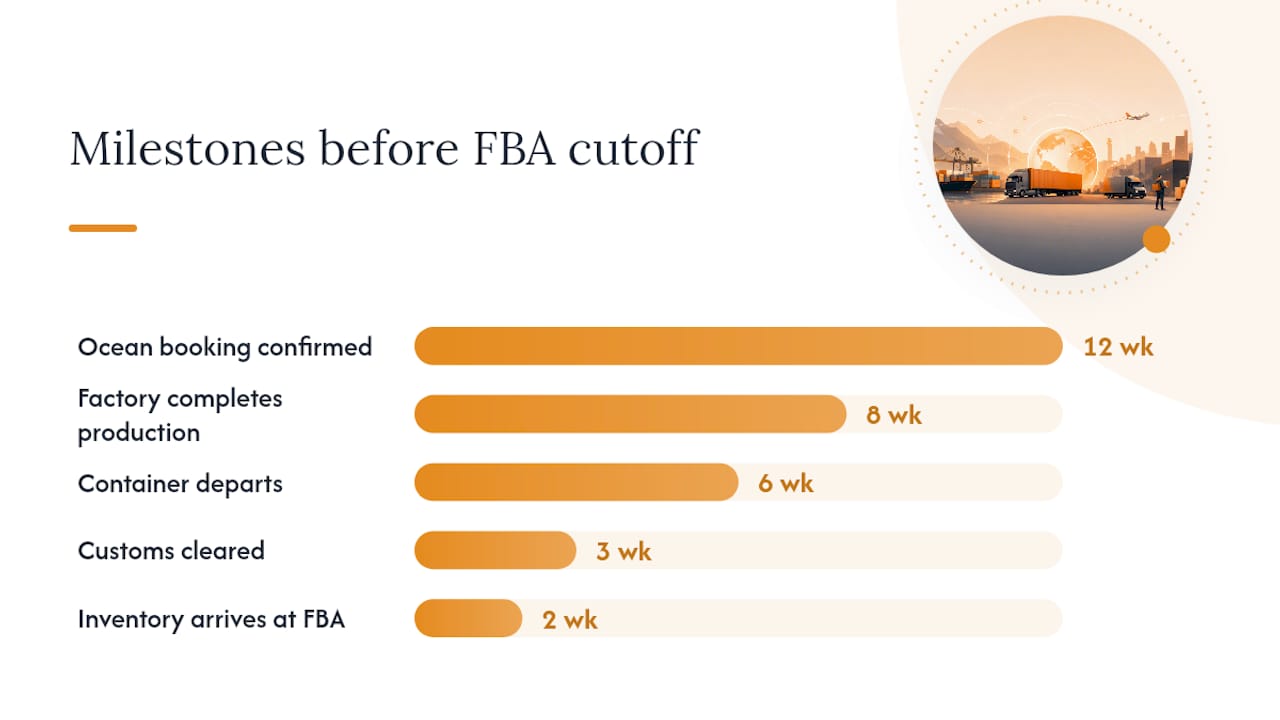
- T-12 weeks: Confirm production quantities with the factory. Share your FBA shipment plan with your forwarder. Book ocean freight for the base inventory volume.
- T-10 weeks: Factory begins production. Forwarder confirms pickup date and provides carton-level packing list template. Seller creates FBA shipment in Seller Central and generates FNSKU labels.
- T-8 weeks: Factory completes production. Forwarder picks up cargo, applies FBA labels at origin (or confirms labeling at a prep center), and loads the container.
- T-6 weeks: Container departs. Forwarder manages customs clearance under DDP terms. Seller receives shipment tracking and estimated arrival date.
- T-3 weeks: Container arrives at U.S. port. Customs cleared under DDP. Inland drayage to FBA inbound destination confirmed.
- T-2 weeks: Inventory arrives at FBA receiving. Seller submits ASN (Advance Shipment Notification) in Seller Central. Forwarder confirms delivery receipt.
- T-0 (FBA cutoff): Inventory checked in and available for sale before Amazon’s peak receiving cutoff.
What to send your forwarder and when:
- FBA shipment ID and box content information: at booking confirmation
- Carton-level packing list with dimensions and weights: at factory pickup
- FNSKU labels (pre-applied at factory or at prep center): confirmed before container loading
- Commercial invoice and packing list for customs: at departure
Document checklists for FBA inbound, including ASNs, carton-level packing lists, and FNSKU labeling, must be confirmed before departure to avoid return-to-origin or port holds during peak.
ForwarderOne publishes a Factory Holiday & Cargo Cutoff Calendar that maps factory closures, cargo cutoff dates, and FBA inbound windows so sellers can build their shipment calendar without manually tracking every deadline.
| Milestone | Deadline (Holiday Peak) | Owner |
|---|---|---|
| Ocean booking confirmed | 12 weeks before FBA cutoff | Seller / Forwarder |
| Labels and packing list sent | 8 weeks before FBA cutoff | Seller |
| Container departed | 8–10 weeks before FBA cutoff | Forwarder |
| Customs cleared | 3 weeks before FBA cutoff | Forwarder (DDP) |
| ASN submitted | At delivery | Seller |
Pro Tip: If your ocean shipment is running late, trigger your air freight contingency at T-minus 5 weeks, not T-minus 2. At T-minus 2, air capacity is gone and you’re paying spot rates for whatever is left.
Two-minute peak-prep checklist: 60 to 0 days out
Run through this before your next peak. Assign an owner and a due date to every open item.
- 60 days out: Demand forecast finalized by SKU. Ocean freight booked. Supplier production confirmed. FBA shipment plan created in Seller Central.
- 30 days out: Carrier contracts signed. Surge capacity agreements confirmed with backup carrier. Warehouse labor plan approved. Temp agency agreements in place.
- 14 days out: All inbound shipments on track (confirmed with forwarder). Label formats validated end-to-end. Exception automation tested. Customer service briefed on delivery windows.
- 7 days out: Real-time tracking dashboards live. Contingency triggers defined in writing (e.g., “if OTD drops below 93%, escalate to backup carrier within 4 hours”). Daily standup cadence confirmed.
- Day 0 (peak cutoff): All FBA inbound received and checked in. Contingency carrier on standby. Post-peak analysis date scheduled.
The plan is green when your operations lead has signed off on every item above and a named individual owns each open action. No collective ownership. One name per line.
After peak ends, schedule your post-peak review within two weeks while the data is fresh. Carrier performance by lane, cost per shipment by zone, and exception rates are the three inputs that matter most for next year’s plan.
What a logistics manager actually focuses on in week zero of peak planning
Most peak-season guides spend a lot of time on forecasting models and not enough on the two decisions that actually determine whether peak goes well: who owns what, and what triggers escalation.
The forecast is an input. The operating model is the output. A team with a mediocre forecast and clear decision rights will outperform a team with a sophisticated demand model and no one empowered to act on it.
The other thing most guides underweight is the off-season work. Testing your backup carrier in July, validating your label automation in August, and running a throughput simulation in September are the actions that make November manageable. By the time peak arrives, the decisions should already be made. Execution is what’s left.
If you take one action from this guide, build your multi-carrier fallback and test your label automation before September. Everything else in your peak plan depends on those two things working when volume spikes.
ForwarderOne handles the international leg so your peak plan doesn’t fall apart at customs
For Amazon sellers shipping inventory from China or Korea to U.S. FBA centers, the international leg is where peak plans most often break down. Factory delays, customs holds, and missed FBA cutoffs are all concentrated in that one segment of the supply chain.
ForwarderOne manages that entire leg under DDP terms, meaning customs, duties, and delivery are handled in a single workflow. You don’t coordinate between a customs broker, a drayage company, and a freight forwarder separately. One account manager handles it, and ForwarderOne’s FBA shipping agent services include FBA labeling, ASN support, and inbound routing to the right fulfillment center.
Key proof points:
- Over 99% on-time delivery on international inbound shipments
- Dedicated account manager for every client, not a ticket queue
- Factory Holiday & Cargo Cutoff Calendar published annually so you can build your shipment calendar without guessing at deadlines
If your peak inventory is moving from Asia to FBA this year, request a quote from ForwarderOne and confirm your cutoff dates before your competitors book the capacity you need.
Keep your peak inbound plan on schedule
ForwarderOne coordinates factory pickup, DDP customs clearance, FBA labeling, ASN support, and delivery windows so your peak plan survives the international leg.