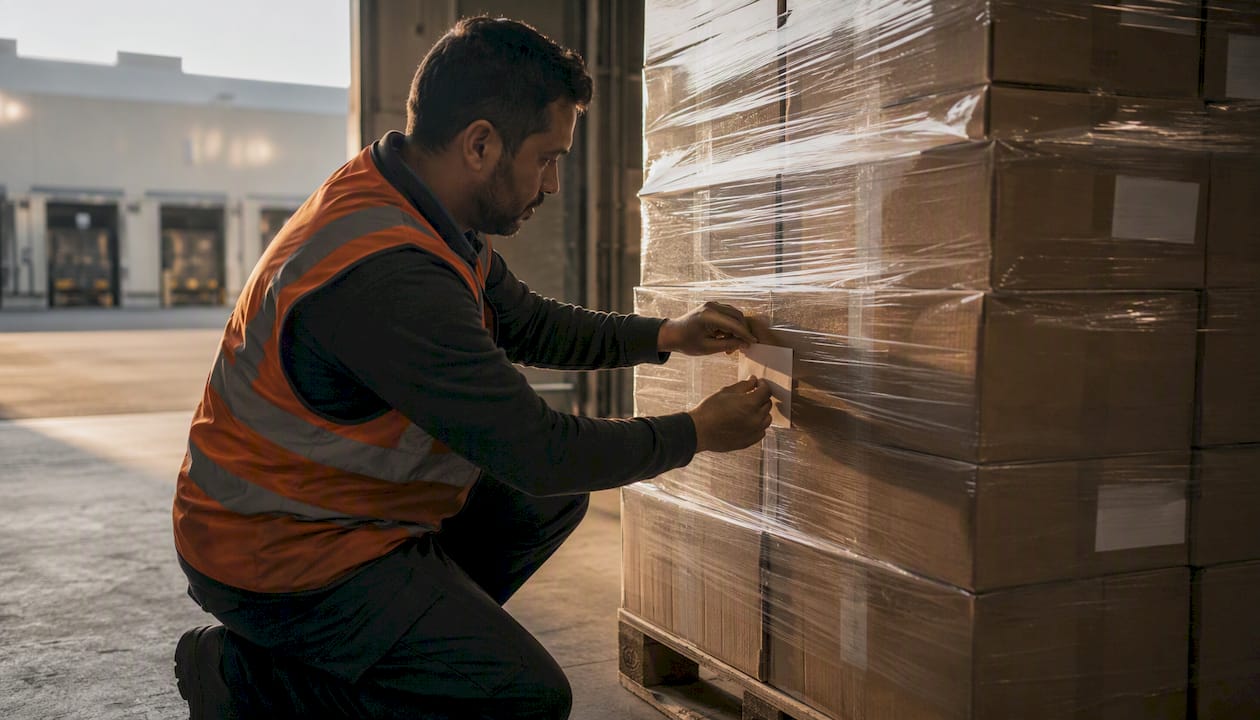
The fastest, lowest-risk way to get inventory into Amazon’s Indianapolis fulfillment center is to book an all-in DDP freight forwarder who handles customs clearance, FBA labeling, palletization, and appointment delivery straight to the assigned FC. That single decision removes most of the failure points sellers hit: mislabeled cartons, missing customs paperwork, and blown delivery windows that trigger receiving fines.
Three things need to happen before your inventory moves an inch:
- Create the shipment in Seller Central using the Send to Amazon workflow, which tells Amazon what’s coming and where it’s going.
- Confirm your FBA labeling and pallet requirements match what your assigned fulfillment center expects.
- Book DDP freight with a forwarder who delivers an FBA-ready shipment, not just a container dropped at a port.
If you’re ready to move on this, request an all-in DDP quote that includes pickup-to-FC ETA and full handling of your Amazon shipment ID. That’s the one conversation that eliminates most of the guesswork below.
Pre-Booking Checklist: What To Prepare Before You Contact A Forwarder
Forwarders quote faster and more accurately when you show up with real numbers instead of estimates. Before you request pricing, gather these details:
- SKU and ASIN list for every product in the shipment.
- Box counts, weights, and dimensions per carton.
- Declared value for customs purposes.
- Commercial invoice and packing list, even in draft form.
- Your labeling preference: Amazon-barcoded labels or stickerless, commingled inventory.
Lead time matters as much as documentation. Sea freight needs the longest runway, typically requiring you to start the process six to eight weeks before you need stock live. Air freight compresses that to roughly two to three weeks. Express courier options can move in under two weeks but cost considerably more per unit.
On the Seller Central side, three things need to be locked in before pickup: the shipment itself needs to be created, box content information needs to be entered accurately, and you need to decide between Amazon-applied labels or your own pre-printed FNSKU stickers. Getting this wrong doesn’t just delay your shipment. It can get cartons flagged or rejected at receiving.
Pro Tip: Build your packing list in the exact format your forwarder requests before you ship, not after. Reformatting a packing list mid-transit is one of the most common causes of customs delays on DDP shipments.
Step-By-Step Inbound Workflow: Factory To The Indianapolis FC
Getting a shipment from a factory floor to an Amazon shelf involves more handoffs than most sellers expect. Here’s the sequence, end to end:
- Create the shipment in Seller Central. Using the Send to Amazon workflow, you tell Amazon what you’re sending, choose between small parcel delivery (SPD) and less-than-truckload (LTL) or full-truckload freight, and get your shipment ID and destination FC assignment. Amazon’s Send to Amazon workflow walks through printing pallet labels and confirming carrier details at this stage.
- Factory pickup and documentation. Your forwarder arranges collection from the vendor, prepares the commercial invoice and packing list, and confirms palletization rules so the load matches what Amazon’s receiving dock expects.
- Export and origin transport. This is where air, sea, or express gets booked and the airwaybill or bill of lading gets generated. Under a DDP arrangement, the forwarder manages export customs clearance; you’re only responsible for supplying accurate product and value data.
- Import and US customs. DDP means the forwarder pays duties and taxes on your behalf and files the customs entry. You still need to supply correct HTS codes, declared value, and consignee information, since bad data here is the single biggest cause of customs holds.
- Final mile to the Indianapolis FC. The forwarder schedules a delivery appointment, applies pallet ID labels per Amazon’s requirements, and secures proof of delivery. Seller Central’s shipping guidance specifies four pallet labels per pallet and requires a BOL or PRO number for non-partnered carriers.
- Inventory reconciliation. Once the FC checks in the shipment, Amazon updates the shipment status in Seller Central. There’s a difference between “received” and “available for sale,” and that gap can run a few days during high-volume periods.
Documentation is where most delays actually happen, not transit. Here’s what needs to accompany every cross-border shipment:
| Document | Purpose |
|---|---|
| Commercial invoice | States value and product description for customs assessment |
| Packing list | Details carton contents, weights, and dimensions for both customs and FC receiving |
| AWB or BOL | Serves as the transport contract and tracking reference for the carrier |
| Customs entry filing | Formal declaration submitted to US Customs and Border Protection under DDP |
| Pallet ID labels | Identify pallet contents and destination FC for warehouse staff |
Pro Tip: Most receiving rejections at FBA fulfillment centers trace back to three things: labels placed on the wrong side of the carton, mixed SKUs stacked on a single pallet without separation, or cartons that exceed Amazon’s overhang tolerance. Catch these before the pallet leaves the origin warehouse, not after it arrives in Indianapolis.
Shipping Modes, Transit Times, And Cost Drivers For Inbound FBA
Choosing a shipping mode is really a bet on how confident you are in your sales forecast. Sea freight is cheap per unit but slow and unforgiving of mistakes. Air freight splits the difference. Express courier service is the release valve for when you got the forecast wrong.
| Mode | Typical Transit Time (Origin To FC Delivery) | Best For |
|---|---|---|
| Sea (FCL/LCL) | 30–45 days | High-volume, low-urgency restocks |
| Air freight | 8–15 days | Balancing cost and speed for steady sellers |
| Express courier | 3–7 days | Emergency replenishment, new launches |
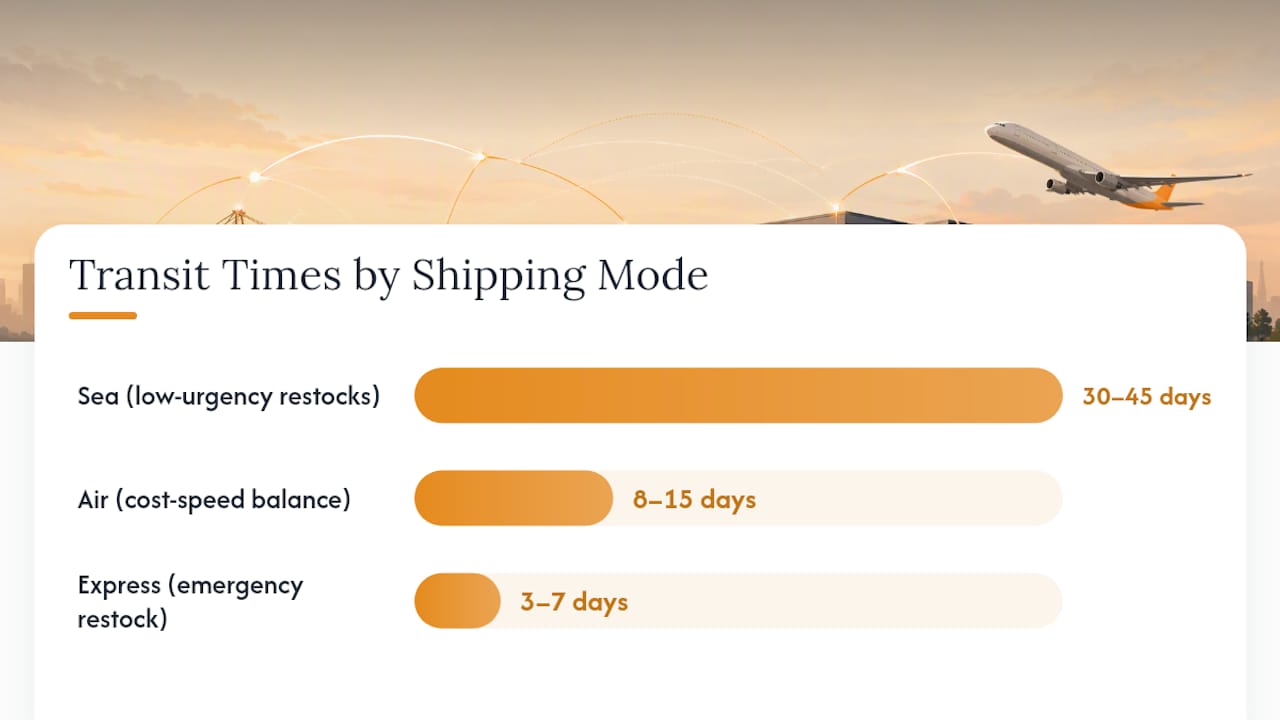
Build in a planning buffer beyond the transit window itself. Customs clearance, FC appointment scheduling, and receiving backlogs during peak season can each add several days on top of the transit estimate.
The freight rate on a quote is rarely the whole cost. Watch for these line items:
- Base freight charges (air, sea, or express)
- Customs duties and tariffs, calculated against declared value
- Customs broker fees, often bundled into DDP pricing
- Amazon receiving appointment fees and potential non-compliance fines
- FBA prep and labeling charges if you’re not pre-labeling at origin
- Cargo insurance, which is worth paying for on any shipment carrying meaningful inventory value
Expedited air or express freight earns its premium in specific situations: a sales spike you didn’t forecast, a product launch with a hard date, or thin-margin SKUs where a stockout costs more in lost Buy Box position than the shipping premium costs in cash. Outside those scenarios, sea freight combined with solid lead-time planning usually wins on unit economics. For a deeper breakdown of what drives freight quotes, see this guide to Amazon seller freight cost factors.
How To Choose A Freight Forwarder For FBA Shipments
Not every freight forwarder understands Amazon’s receiving requirements, and the gap shows up as fines, rejected pallets, or shipments stuck at customs while you scramble for missing paperwork. Ask any forwarder you’re evaluating:
- Do you offer true DDP, or just customs brokerage with duties billed separately later?
- Do you handle Amazon FC appointment scheduling directly, or does that fall back on me?
- Do you print and apply FBA pallet and box labels before delivery?
- What’s actually included in the all-in quote, and what gets billed as an extra?
- Who is my single point of contact if something goes wrong mid-shipment?
Red flags worth walking away from:
- No demonstrated experience routing freight specifically into Amazon FCs.
- Vague or evasive answers about who handles BOL and appointment reference numbers.
- No clear penalty structure or accountability if a delivery misses its scheduled window.
- Pricing that looks like one number upfront and five more line items later.
When comparing proposals side by side, judge them on the same dimensions every time: included services, transit time, pricing transparency, communication and tracking, on-time delivery track record, and origin coverage. Ask for documented service-level numbers, not adjectives. A forwarder who can’t tell you their on-time delivery rate probably isn’t tracking it. For more on vetting criteria, this guide to choosing a freight forwarder as an Amazon seller covers additional screening questions.
Why ForwarderOne Fits Small And Mid-Sized Amazon Sellers
ForwarderOne’s DDP offering was built around the exact checklist above. The service covers customs clearance, duties paid upfront, FBA-compliant labeling, palletization to Amazon’s specifications, appointment scheduling, and delivery to your assigned fulfillment center, all under one quote.
A few specifics worth knowing:
- Every account gets a dedicated account manager, so you’re not routed through a call center every time a shipment status changes.
- ForwarderOne reports a high on-time delivery rate, which matters most during Q4 when a missed appointment window can mean missing the holiday selling season entirely.
- Pricing is quoted as a single all-in DDP number rather than a base rate followed by surprise duty and clearance invoices later.
Getting started follows a short sequence: you submit shipment details (origin, SKU count, weights, dimensions, and your Amazon shipment ID if you already have one), ForwarderOne returns a quote with a pickup-to-FC estimated delivery date, and once you approve, pickup gets scheduled at origin. Most sellers move from quote to pickup within a few business days, depending on origin location and mode selected.
For sellers who’ve been burned by hidden fees on previous shipments, the appeal is straightforward: one point of contact, one itemized quote, and shipment visibility that doesn’t require chasing three different vendors for status updates. You can review the full scope of services on ForwarderOne’s DDP shipping page.
When To DIY Versus Hire A DDP Forwarder For FBA Inbound
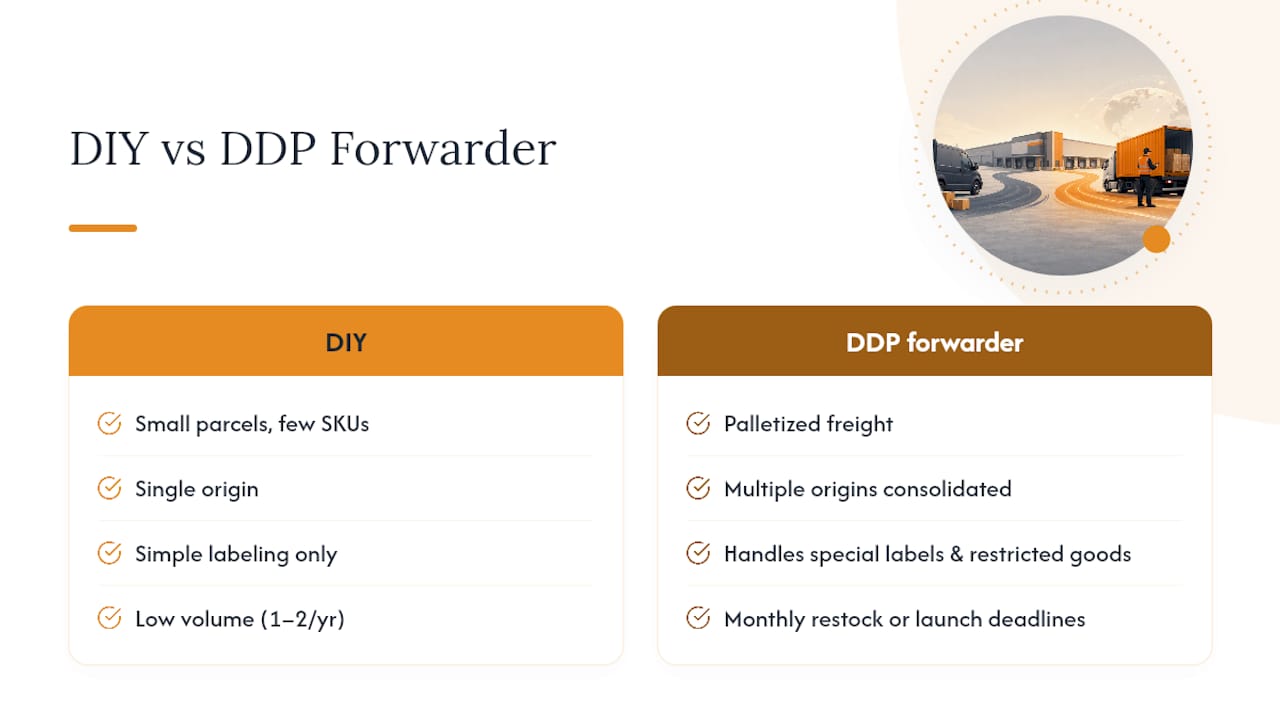
Not every shipment needs a forwarder. If you’re sending a single small parcel delivery with a handful of SKUs and no cross-border complexity, doing it yourself through a domestic carrier is perfectly reasonable. The math changes fast once you add international sourcing, multiple SKUs, or palletized freight.
A few thresholds worth applying to your own operation: once you’re regularly shipping palletized freight rather than small parcels, once you’re consolidating from more than one origin factory into a single shipment, or once you’re dealing with specialized labeling or restricted goods, the operational risk of DIY logistics starts outweighing the cost savings. A single rejected pallet at an Amazon FC can cost more in delayed sales and rework than a season’s worth of forwarder fees.
Volume matters too. Sellers moving inventory once or twice a year can often manage without help. Sellers restocking monthly or facing a hard launch deadline are the ones who benefit most from having a forwarder who already knows Amazon’s receiving quirks.
If you’re on the fence, don’t commit your entire season’s inventory to a new forwarder relationship on faith. Run one SKU through as a pilot DDP shipment first. Watch how they handle documentation, labeling accuracy, and appointment scheduling before you hand over a container’s worth of product.
How ForwarderOne Can Help: Request An All-In DDP Quote
ForwarderOne is built specifically for sellers who don’t want to manage five separate vendors just to get a pallet from a factory in Shenzhen to a fulfillment center in Indianapolis. Instead of piecing together a freight broker, a customs agent, an FBA prep service, and a delivery carrier, you get one quote that covers pickup, export clearance, duties, import clearance, pallet labeling, and appointment delivery.
To get an accurate quote fast, have these ready when you reach out: your origin location, preferred incoterm (DDP), a list of SKUs with weights and dimensions, your Amazon shipment ID or ARN if one exists yet, and your target delivery window. Quotes typically come back within one to two business days once that information is in hand.
If you’re planning inventory for an upcoming launch or restock, start that conversation now rather than during a lead-time crunch. Request a DDP FBA quote from ForwarderOne and get a pickup-to-FC timeline before you commit to a shipping mode.
Key Takeaways And Immediate Next Steps
The fastest, lowest-risk path into Amazon’s Indianapolis fulfillment center combines an accurate Seller Central shipment setup with an all-in DDP forwarder who handles labeling, customs, and delivery under one quote.
| Point | Details |
|---|---|
| Create the shipment first | Use Seller Central’s Send to Amazon workflow to get your shipment ID and assigned FC before booking freight. |
| Lock in labeling and pallet rules | Confirm FBA labeling method and pallet compliance early to avoid receiving rejections. |
| Match lead time to mode | Budget six to eight weeks for sea freight, two to three weeks for air, and under two weeks for express. |
| Vet forwarders on specifics | Ask about DDP scope, FC appointment handling, and documented on-time delivery rates before booking. |
| ForwarderOne as the DDP option | ForwarderOne offers all-in DDP pricing, a dedicated account manager, and reports a high on-time delivery rate for FBA shipments into Indianapolis. |
FBA Indianapolis Fulfillment Center FAQ
What should I prepare before booking freight into an Indianapolis Amazon fulfillment center?
Prepare your Seller Central shipment ID and FC assignment, SKU and ASIN list, carton counts, weights, dimensions, declared value, commercial invoice, packing list, and the exact FBA label or pallet requirements for the shipment.
Should Amazon sellers use DDP for Indianapolis FBA inbound shipments?
DDP is usually the lower-risk option for cross-border FBA inbound shipments because one forwarder handles duties, customs clearance, FBA labeling support, appointment delivery, and proof of delivery. Sellers still need to provide accurate product, value, and consignee data.
Which shipping mode works best for delivery to an Amazon fulfillment center?
Use sea freight for high-volume restocks with a six-to-eight-week planning window, air freight when the deadline is closer, and express courier only for urgent launches or stockout recovery where speed is worth the higher unit cost.
Route inventory to Indianapolis FBA without customs surprises
ForwarderOne coordinates factory pickup, DDP customs clearance, FBA labeling support, carton documentation, and delivery appointments for sellers shipping from China or Korea to Amazon fulfillment centers.