
A customs duty is a tax the U.S. government charges on imported goods, and the importer of record is the party legally responsible to U.S. Customs and Border Protection (CBP) for paying it. For freelance sellers, that legal fact has a direct commercial consequence: if you ship a product to a U.S. buyer without specifying who handles duties, CBP will hold whoever is named on the customs paperwork accountable, and that is often your buyer.
The two commercial terms that change who pays at delivery are DDP (Delivered Duty Paid), where you as the seller prepay duties and fold them into the price, and DAP/DDU (Delivered at Place / Delivered Duty Unpaid), where the buyer pays on arrival. For consumer sales, DDP almost always converts better, and avoids refused deliveries.
Before your next international shipment, run through these steps:
- Confirm the correct HS/HTS code for every product you sell.
- Decide whether to ship DDP (recommended for B2C) or DAP/DDU (common for B2B).
- Check your marketplace’s rules — some mandate DDP for non-U.S. sellers.
- Verify your carrier or forwarder can execute the Incoterm you choose.
Pro Tip: If you sell on Etsy, the platform’s DDP requirement for non-U.S. sellers shipping to U.S. buyers means you must price duties in before listing, not after. Sellers who miss this end up absorbing unexpected costs on every U.S. order.
Key Takeaways
Freelance sellers shipping to U.S. buyers must model customs duties at the SKU level, choose DDP for consumer sales, and capitalize prepaid duties into inventory cost to keep margins accurate.
| Point | Details |
|---|---|
| Importer of record is legally liable | CBP holds the named importer responsible for correct declarations and duty payment, regardless of who commercially agreed to pay. |
| DDP protects conversion | Shipping DDP eliminates buyer-facing customs bills and refused deliveries, which is why marketplaces like Etsy mandate it for non-U.S. sellers. |
| Customs value includes freight and insurance | Duty is calculated on product cost plus freight plus insurance (CIF basis), not on the product price alone. |
| Capitalize duties into inventory | Prepaid duties belong in inventory cost and flow to COGS on sale, not to overhead, so gross margin stays accurate per SKU. |
| ForwarderOne for DDP outsourcing | ForwarderOne’s China-to-U.S. DDP service covers customs clearance, duty payment, and FBA delivery in one workflow. |
What customs duties actually are (and how they differ from sales tax)
Customs duty is a tariff imposed on goods the moment they cross an international border. CBP uses the Harmonized Tariff Schedule of the United States (HTSUS) to determine the applicable rate and the taxable base, which is typically the transaction value of the goods plus freight and insurance costs.
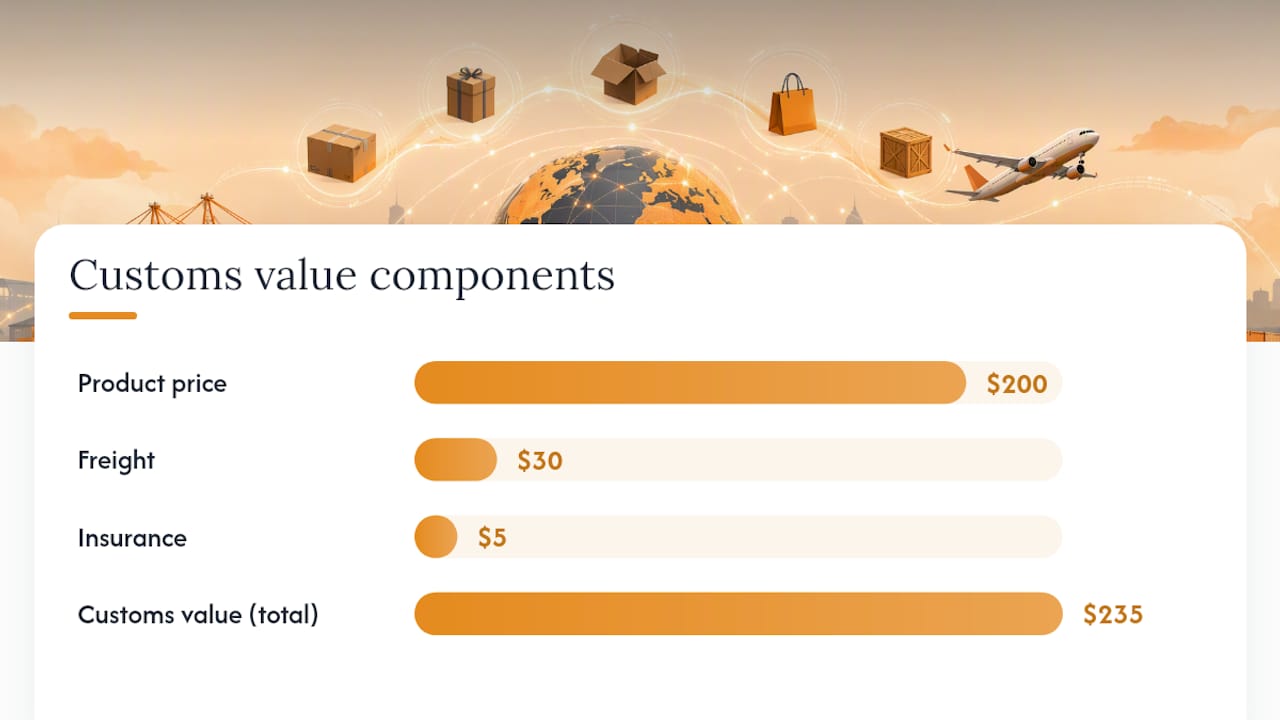
That customs value base is where many sellers get tripped up. Duty is not calculated on the product price alone. If you ship a $200 item with $30 in freight and $5 in insurance, CBP calculates duty on $235, not $200.
Customs duty is also distinct from several other charges that land in the same invoice:
- Import VAT/GST: A consumption tax charged by the destination country on top of duty. The U.S. does not have a federal VAT, but the EU, UK, Canada, and Australia do. For cross-border obligations, these are four separate line items: customs duty, import VAT/GST, sales-tax nexus obligations, and carrier brokerage fees.
- Sales tax: Collected at the point of sale in the U.S. by state, not by CBP. It is separate from import duty.
- Carrier disbursement/brokerage fees: Fees a carrier charges for advancing duty payments on your behalf and processing clearance paperwork. These are not duties, but they show up on the same bill.
The sum of all these charges, plus the product cost itself, is your landed cost. Pricing from product cost alone is one of the fastest ways to destroy your margin on international orders.
De minimis note: CBP allows duty-free entry for shipments valued under $800 (the U.S. de minimis threshold). That threshold applies per shipment, per day, per person, and it can change. Do not build a pricing strategy around it without checking current CBP guidance.
Who is legally responsible: importer of record, Incoterms, and marketplace rules
The importer of record is the entity legally accountable to CBP for correct declarations and duty payment. You can contractually shift who pays duties through Incoterms, but you cannot shift the legal accountability without changing who is named on the customs paperwork.
Import duty is assessed on the declared value of the goods, and the importer-of-record responsibility is typically specified by the commercial terms you agree to with your buyer or carrier.
Here is how the two main options play out in practice:
- DDP (Delivered Duty Paid): You, the seller, prepay all duties, taxes, and clearance fees. You are often listed as the importer of record. The buyer receives the parcel with no additional charges at the door. This is the standard for B2C consumer sales and is required by several major marketplaces.
- DAP/DDU (Delivered at Place / Delivered Duty Unpaid): The buyer pays duties on arrival. The carrier typically advances the payment and then bills the buyer a disbursement fee on top. Buyers who are not expecting this charge often refuse delivery, which costs you the product and the return shipping.
Marketplace policy example: Etsy requires many non-U.S. sellers shipping to U.S. buyers to ship DDP, meaning the seller must prepay tariffs and fold the cost into the listing price. Sellers who ignore this requirement risk losing purchase-protection coverage and receiving chargebacks.
Etsy’s DDP mandate is not a suggestion. It affects pricing, purchase protection, and your ability to dispute buyer claims. If you list on Etsy and ship internationally, your listing price must already include the estimated duty for every destination market.
Pro Tip: Always confirm who is listed as importer of record on your commercial invoice before a shipment leaves. If your carrier or forwarder is acting as importer on your behalf under DDP, get that in writing. Verbal agreements do not hold up with CBP.
Actionable step: ask your shipping partner to show you a sample commercial invoice and confirm it names the correct party as importer of record for your chosen Incoterm.
How duties are calculated: HS codes, customs value, and tariff rates
Getting the duty amount right before you price a product takes three inputs: the correct product classification code, the customs value, and the applicable tariff rate.
-
Find the HS code. Every physical product has a 6-digit Harmonized System (HS) code that identifies it globally. The U.S. extends this to a 10-digit HTS code under the HTSUS. The first 6 digits are internationally standardized; the last 4 are U.S.-specific and determine the exact duty rate. Start your HTS code lookup at the USITC’s online HTSUS database.
-
Calculate the customs value. Take the transaction value of the goods (what you actually paid or charged), add the cost of freight to the U.S. port of entry, and add insurance. That total is your CIF-style customs value, and it is the base CBP uses to calculate duty.
-
Find the tariff rate. Once you have the HTS code, look up the rate in the HTSUS. There are two main rate columns: MFN (Most Favored Nation), which applies to most trading partners, and preferential/FTA rates, which apply when a free trade agreement is in force (e.g., USMCA for Canada and Mexico). Products from countries without a trade agreement with the U.S. pay MFN rates. Additional Section 301 tariffs may apply to goods from China, so always check the full HTSUS entry, not just the base rate.
-
Use a tariff lookup tool. The WTO Tariff Database and Customs Info (Descartes) are the standard tools for cross-checking rates across markets. Carrier landed-cost calculators from DHL, UPS, and FedEx can also estimate total import charges, though they are less precise than a direct HTSUS lookup.
Pro Tip: Misclassifying an HS code is the most common compliance mistake small sellers make. A wrong code can mean underpaying duties (triggering CBP penalties) or overpaying (destroying your margin). If you are unsure, a licensed customs broker can issue a binding ruling request through CBP.
The math looks like this for a simple example:
Practical steps for freelance sellers: estimating duties and handling paperwork
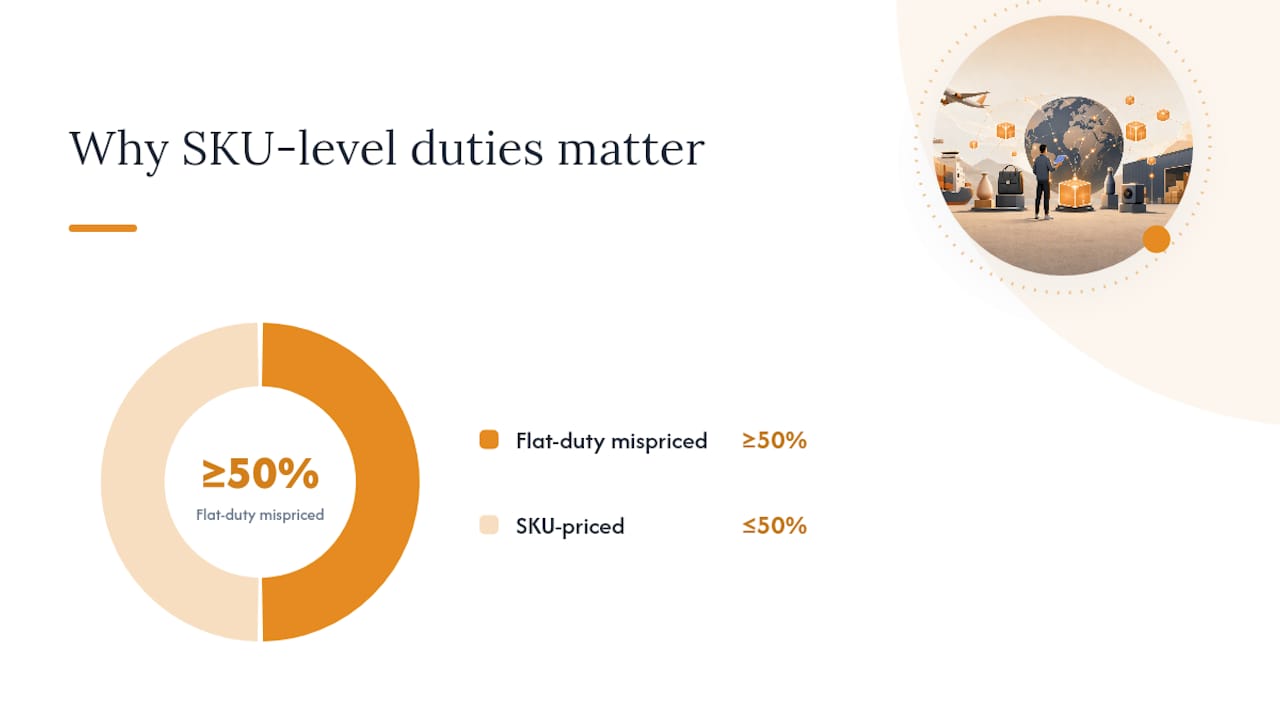
Applying a flat duty percentage across your entire store is a reliable way to misprice at least half your catalog. Duty rates vary by product category, country of origin, and material composition. The only accurate approach is SKU-level estimation.
Estimate duties per SKU:
- Pull the HTS code for each product category you sell.
- Calculate the customs value for a representative unit (product cost + freight share + insurance share).
- Apply the applicable tariff rate from the HTSUS.
- Add carrier brokerage and disbursement fees.
- Record the total as the landed cost for that SKU.
Choose your commercial terms:
- Use DDP for all B2C consumer sales. Buyers do not expect a customs bill at the door, and refused deliveries are expensive.
- Use DAP for B2B sales where the buyer is a registered importer and expects to handle clearance themselves.
- Confirm your carrier or freight forwarder can actually execute DDP for your origin country and destination. Not all carriers offer DDP on all routes.
Documentation checklist:
- Commercial invoice (with accurate declared value, HS code, and country of origin)
- Packing list
- Certificate of origin (required for FTA preferential rates)
- EIN (Employer Identification Number) if you are the U.S. importer of record
- Any product-specific permits or licenses (e.g., FDA registration for food or cosmetics)
Customer-facing communication: Display “duties included” clearly at checkout when shipping DDP. If a buyer asks why your price is higher than a competitor’s, “no surprise customs bill at delivery” is a real answer that converts. For refunds, decide in advance whether you will refund the duty component, since recovering prepaid duties from CBP is possible but takes time.
How customs clearance and brokerage work for small sellers
A customs broker is a licensed professional (licensed by CBP) who files entry documents on your behalf, classifies goods, and ensures duties are paid correctly. For most small-parcel shipments, your carrier handles clearance automatically. For larger commercial shipments or complex products, a dedicated broker is worth the fee.
Carrier disbursement fees are separate from duties. When a carrier ships DAP and advances the duty payment to CBP, it charges the buyer a handling fee, often $10–$30 per shipment, on top of the actual duty. This is the charge that surprises buyers and triggers refused deliveries. Under DDP, you pay the duty upfront and the carrier’s disbursement fee either disappears or is folded into your DDP rate.
Options for small sellers, in order of complexity:
- Carrier clearance (DHL, UPS, FedEx): The simplest option for small parcels. The carrier handles clearance and either bills you (DDP) or the buyer (DAP). Rates are transparent but not always the cheapest for high-volume or high-value shipments.
- Licensed customs broker: Better for commercial shipments over $2,500 (formal entry threshold) or for products with complex classification. Brokers charge a flat fee per entry plus disbursements.
- Freight forwarder with DDP service: The most practical option for sellers importing inventory from Asia. A forwarder like ForwarderOne bundles customs clearance, duty payment, and delivery into a single DDP rate, so you get one invoice and no surprises at the border.
Pro Tip: Always get a clearance quote before booking a shipment, not after. Ask the carrier or broker to break out their disbursement fee, the estimated duty, and any other charges separately. A single line item labeled “import charges” tells you nothing useful for pricing.
Action steps: keep copies of all customs entry documents for at least five years (CBP’s standard audit window), and include brokerage fees in your landed-cost model from day one.
Pricing and bookkeeping: recording prepaid duties and protecting your margins
Prepaid duties are not an operating expense. They are part of the cost of acquiring inventory, which means they belong in your inventory account, not your overhead.
The correct bookkeeping treatment is to capitalize duties into landed cost at the time of import, then move that cost to COGS when the unit sells. This is the approach recommended for sellers operating under DDP mandates, because it keeps gross margin accurate at the SKU level.
Here is a simple journal entry sequence for a DDP shipment:
- At import: Debit Inventory (landed cost = product cost + freight + duty + brokerage). Credit Accounts Payable or Cash.
- At sale: Debit COGS. Credit Inventory (for the landed cost of the unit sold).
If you expense duties directly to overhead, your gross margin looks artificially high and your inventory value is understated. That creates two problems: you underprice future orders, and your financial statements misrepresent the business.
Best-practice checklist:
- Tag every duty payment to the specific SKU or shipment in your accounting software (QuickBooks, Xero, or A2X for marketplace sellers).
- Update your landed cost per SKU after every shipment, since freight rates and duty rates both change.
- Reprice by category whenever landed cost shifts by more than 5%.
- Review your HTS codes and applicable tariff rates quarterly, especially for goods from China where Section 301 rates have changed repeatedly.
What sellers consistently get wrong about customs duties
The most common mistake is treating customs duty as a one-time problem to solve rather than a recurring cost to model. Sellers who figure out their duty rate once and never revisit it get burned every time freight rates shift, tariff schedules update, or a new Section 301 list drops.
The second mistake is conflating “small parcel” with “duty-free.” The U.S. de minimis threshold of $800 per shipment is real, but it applies per shipment per day per person. Sellers who split large orders into multiple small parcels to stay under the threshold are taking a compliance risk that CBP has specifically flagged. And for shipments from China, recent regulatory attention on de minimis abuse means that threshold may not be as reliable a planning tool as it once was.
What high-performing sellers do differently: they build SKU-level landed-cost models before setting prices, choose DDP-capable shipping partners before their first international sale, and treat duty payments as inventory costs from the first entry. They also work with forwarders who can handle customs clearance as part of the shipping contract, so there is no gap between “goods shipped” and “duties paid.”
ForwarderOne’s clients on China-to-U.S. routes avoid most of these pitfalls because DDP is built into the shipment from the start. Customs clearance, duty payment, and FBA delivery happen in one workflow, and the landed cost is known before the goods leave the factory.
ForwarderOne handles DDP and customs clearance so you don’t have to
Calculating duties per SKU, filing customs paperwork, and managing importer-of-record obligations is a real operational burden for a solo seller or small team. ForwarderOne’s DDP shipping service from China to the U.S. handles all of it in a single workflow: customs clearance, duty payment, FBA labeling and prep, and delivery to your fulfillment center or warehouse.
The practical difference for your business: one invoice, one landed cost per shipment, and no buyer-facing customs surprises. To get a quote for your next China-to-U.S. shipment, visit ForwarderOne and share your product details, origin, and destination.
Need duty-paid shipping without customs surprises?
ForwarderOne coordinates China-to-U.S. DDP shipping, customs clearance, duty payment, FBA labeling, and fulfillment-center delivery under one shipment plan.