
If your shipment contains plant material and falls under an APHIS-listed HTS code entered through formal entry, you must file a Lacey Act declaration before or at the time of entry. Phase VII expanded that requirement to a much wider list of products starting December 1, 2024, and paper PPQ 505 forms stopped being accepted on January 6, 2026. The immediate move: contact your suppliers now for genus and species, country of harvest, quantity, unit of measure, and value, and set up electronic filing through ACE or LAWGS.
TL;DR:
- Most importers must file a Lacey Act declaration for shipments containing plant material under an APHIS-listed HTS code, especially when entering through formal customs entry.
- The expanded Phase VII requirements now include a wide range of products such as wood and cork furniture, household items, sporting goods, and footwear with wood or plant components.
- Declaration data must include scientific genus and species, country of harvest, quantity with correct units, and import value, with additional recycled content information for paper products.
- The best compliance approach is to request and verify species, harvest country, and other data from suppliers before production, integrating documentation collection into sourcing workflows.
- Filing should be done via ACE or LAWGS at the time of entry, with proper disclaimer codes applied for exemptions, and records retained for at least five years to support audits.
Who Needs to File a Lacey Act Declaration
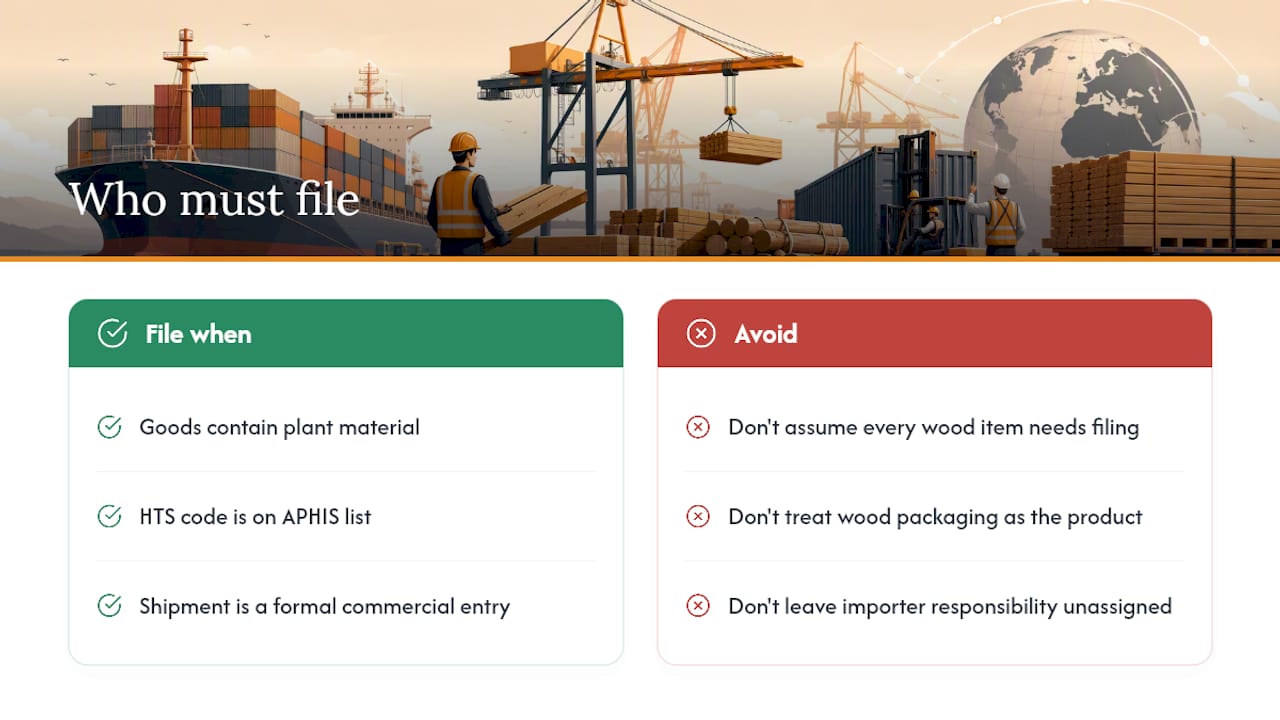
The filing trigger comes down to a three-part test. Your goods contain plant material, the product falls under an HTS code APHIS has listed for declaration, and the shipment enters on a formal entry rather than an informal one. Miss any of the three and you’re likely off the hook, though it pays to check rather than assume.
Formal entries generally apply to commercial shipments valued above a certain threshold, while informal entries below that threshold typically don’t require a Lacey declaration, even if the HTS code is on the list. That distinction trips up a lot of smaller Amazon sellers who assume every wood or bamboo item needs paperwork. A single pallet of rattan furniture worth $1,800 shipped as an informal entry usually skips the declaration; the same furniture consolidated into a $6,000 formal entry does not.
Wood packaging material like pallets and crates is treated differently from wood products being sold. A bamboo cutting board is the item being imported and needs a declaration if it’s on the list. The pallet it ships on typically is not, unless that pallet itself is the commercial product.
The importer of record carries legal responsibility for the declaration’s accuracy, even when a customs broker or freight forwarder physically submits it. Assign that responsibility in writing before your first Phase VII shipment moves, not after CBP flags an entry.
Which Products Phase VII Now Covers
Phase VII of the Lacey Act’s implementation went into effect on December 1, 2024, and it’s the broadest expansion the program has seen.
Product categories now requiring declarations include:
- Furniture made from wood, bamboo, rattan, or cork, including seating and case goods
- Certain essential oils derived from plant sources
- Sporting goods with wood, cane, or bamboo components
- Housewares and kitchen tools made from wood or cork
- Hand tools with wooden handles or components
- Cork products, including stoppers and flooring
- Some footwear incorporating wood or cork elements
The practical move here is mapping your SKU-level HTS codes against APHIS’ implementation schedule rather than guessing based on the product category alone. Two items that look similar on a retail shelf can sit under different HTS chapters, and only one might trigger the filing requirement. A wood-handled kitchen knife might need a declaration while a fully synthetic-handled version of the same knife does not. Check the Federal Register notice covering Phase VII for the specific HTS headings if your product line sits anywhere near the boundary.
What Data Goes on the Declaration
Every Lacey Act declaration needs four core data elements, and vague answers get entries flagged. You need the scientific name broken down to genus and species (not just “oak” or “pine”), the country where the plant material was harvested, the quantity expressed in the correct unit of measure, and the import value.
For composite materials, things get more specific. Products blending multiple plant materials, or wood with non-plant components, may qualify for a Special Use Designation (SUD), which allows reporting at a higher taxonomic level when species-level identification isn’t commercially practical. Paper and paperboard products with recycled content carry their own rule: you report the average percent recycled content rather than a species breakdown for that portion.
Data elements to collect from every supplier before shipment:
- Genus and species (scientific, not common name)
- Country of harvest (not country of manufacture)
- Quantity and unit of measure matching the commercial invoice
- Import value in U.S. dollars
- Percent recycled content, when paper or paperboard is involved
Pro Tip: Build a standing supplier questionnaire that requests this data on every purchase order, not just ones you think will need it, as recommended by BabyLoveGrowth’s structured data audit tools to improve systematic data validation for compliance teams. Species and harvest-country records are far easier to collect before production starts than to chase down after the container has sailed.
Keep supplier declarations, invoices, and any mill certificates or harvest documentation for at least five years. That’s the paper trail auditors ask for first when a declaration gets questioned, and thin documentation is one of the fastest ways to turn a routine review into a longer investigation.
How to File a Lacey Act Declaration Now
The ACE Lacey Act message set is the route most importers use, since it lets the declaration ride along with the entry filing your broker is already submitting through CBP’s Automated Commercial Environment. APHIS also runs its own web portal, LAWGS (Lacey Act Web Governance System), which supports foreign trade zone entries and bulk XML uploads that ACE doesn’t handle as smoothly.
As of January 6, 2026, paper PPQ 505 and 505B forms are no longer accepted anywhere in the process. If your compliance workflow still routes through a printed form and a fax machine, it’s already out of date.
A workable filing sequence looks like this:
- Collect species, harvest country, quantity, and value from suppliers before the shipment leaves origin
- Hand that data to your broker or forwarder ahead of arrival, not after the ship docks
- File through ACE at time of entry, or through LAWGS if you’re moving high volumes or working out of an FTZ
- Apply disclaimer codes A or B in ACE where they legitimately apply, rather than leaving fields blank
Pro Tip: If ACE prompts for a Lacey declaration on a shipment you believe is exempt, don’t just skip the field. Apply the correct disclaimer code and keep documentation showing why the exemption applies. An unexplained blank triggers more scrutiny than a properly coded exemption.
Exemptions and Disclaimer Codes That Prevent Delays
Not every shipment with plant material needs a full declaration, and knowing the exceptions saves real time at entry. APHIS guidance lays out two disclaimer codes that handle the most common exceptions inside ACE.
- Disclaimer Code A applies to products not regulated by APHIS at all, meaning the HTS code doesn’t require a declaration in the first place
- Disclaimer Code B applies to used, recycled, or reclaimed wooden products, including wood packaging material classified under HTSUS 4415
- Packaging-only exception covers plant material used exclusively as packaging, crating, or dunnage, as long as the packaging isn’t itself the commercial item being imported
- De minimis relief applies to informal entries generally valued under $2,500, which typically fall outside declaration requirements regardless of HTS code
The packaging exception is where a lot of confusion happens. A crate of ceramic tile ships with wood packaging that’s exempt. A shipment of decorative wood crates being sold as the product itself is not exempt, because the packaging is the merchandise. Read your commercial invoice the way CBP will read it, not the way you think about the shipment internally.
Penalties and the Due Care Standard
Enforcement under the Lacey Act isn’t theoretical, and the penalty structure escalates fast once intent enters the picture. Civil penalties run up to $10,000 per violation for negligent or unknowing violations. Misdemeanor violations can bring up to one year in prison and fines up to $100,000. Knowing felony violations, generally tied to shipments with a market value above $350, carry penalties of up to five years in prison and fines up to $250,000 for individuals, or $500,000 for organizations.
APHIS applies a risk-based enforcement approach rather than auditing every entry equally, but sloppy or repeated declaration errors raise your profile fast. The strongest defense is an active due care practice: documented supplier declarations, chain-of-custody records tracing harvest to shipment, and periodic verification rather than a one-time certificate collected years ago. If APHIS or CBP contacts you about a discrepancy, disclose proactively, reach out through Lacey.Act.Declaration@usda.gov, and be ready to file retroactive corrections rather than letting the issue sit unresolved.
Building a Lacey Compliance Workflow That Doesn’t Slow You Down
A working compliance process follows a straightforward sequence, but skipping steps out of order is where most delays start.
- Identify which SKUs contain plant material, down to the component level
- Map each affected SKU to its HTS code and check it against the Phase VII list
- Request genus/species and country-of-harvest declarations from suppliers before production
- Prepare ACE or LAWGS data alongside your standard entry paperwork
- File the declaration at time of entry and retain supporting records for at least five years
Timing matters more than most importers expect. Supplier requests need to go out before manufacturing starts, since retroactively identifying wood species after a shipment leaves the factory is difficult and sometimes impossible. Filing itself happens at time of entry, so any missing data becomes a hold, not a paperwork problem you can fix later at your desk.
This is exactly the kind of task a customs broker or forwarder should be built into your process, not bolted onto it after a shipment gets stuck. ForwarderOne coordinates supplier paperwork collection, prepares ACE message data alongside the entry filing, and works through holds when ACE flags a declaration as incomplete. Ask suppliers for mill certificates, invoices listing species by name, and written country-of-harvest statements. These are the documents that satisfy both the declaration itself and the due care standard behind it.
Pro Tip: Request harvest-country documentation as a standard line item on your supplier purchase order template, not as a special request tied to specific shipments. It removes the scramble every time a new SKU crosses into Phase VII territory.
Why Lacey Compliance Works Better as a Routine, Not a Reaction
Most importers treat Lacey declarations as a customs problem to solve at the last minute. That’s backwards. The data points APHIS wants, species, harvest country, quantity, and value, are things your suppliers already know. The failure point is almost always timing: nobody asked until the shipment was already at the port.
Building supplier verification into your sourcing process, before you place the order rather than after the container ships, is the single highest-return move in this whole framework. It costs you one extra email per new SKU and saves you a hold that can sit for weeks. Keep an eye on APHIS’ implementation schedule too. Phase VII won’t be the last expansion, and the importers who get caught flat-footed are usually the ones who assumed the current list was permanent.
— Keven
Let ForwarderOne Handle the Customs Coordination
ForwarderOne is the alternative to juggling supplier emails, ACE data entry, and customs holds on your own. Its all-inclusive DDP shipping workflow bundles customs clearance, duty payment, and delivery into a single process, so Lacey declaration data moves with your entry filing instead of becoming a separate fire drill every time a new SKU crosses into Phase VII territory.

With a dedicated account manager assigned to your account and a claimed on-time delivery rate over 99%, ForwarderOne works specifically with small and mid-sized Amazon sellers moving inventory from China to U.S. fulfillment centers, exactly the importers who get hit hardest by Phase VII’s expanded product list. The team collects supplier documentation, prepares entry data, and troubleshoots ACE holds so a missing genus-and-species field doesn’t sit your inventory at the port during a peak sales window.
If you’re bringing in furniture, housewares, or any product line that now falls under Phase VII, reach out to ForwarderOne’s FBA freight forwarding service for an intake checklist before your next shipment leaves origin.
Where to Verify the Rules Yourself
Regulatory schedules change, so check primary sources directly rather than relying on secondhand summaries.
- APHIS Lacey Act declaration requirements and implementation schedule
- CBP guidance on ACE filing and Lacey Act declarations
- Federal Register notice covering Phase VII product categories
Sources
- Lacey Act Declaration Requirements | Animal and Plant Health Inspection Service
- Guidance on the Lacey Act Declaration | U.S. Customs and Border Protection
- Federal Register: Phase VII and Lacey Act schedule (May 31, 2024)
- Congressional Research Service: Lacey Act overview and penalties
FAQ
Is the Lacey Act Still in Effect?
Yes, the Lacey Act remains active federal law, and enforcement has expanded rather than eased. Phase VII added the broadest set of covered products yet starting December 1, 2024, and paper filing options were fully phased out by January 6, 2026.
What Are the Exemptions From the Lacey Act Declaration?
The main exemptions cover packaging material used exclusively for shipping (not sold as the product itself), used or recycled wooden items filed under Disclaimer Code B, and products not regulated by APHIS at all under Disclaimer Code A. Informal entries generally valued under $2,500 also typically fall outside the declaration requirement.
Does MDF Require a Lacey Act Declaration?
MDF (medium-density fiberboard) products generally require a declaration if they fall under an APHIS-listed HTS code and enter through formal entry, since MDF contains wood fiber. Composite construction may qualify for Special Use Designation reporting rather than full species-level identification, depending on the product’s composition.
What Is the Lacey Act, and Why Does It Apply to Wood Imports?
The Lacey Act is a federal law that prohibits trade in plant and wildlife products harvested or traded in violation of source-country law, and it requires importers of covered plant products to declare species, harvest country, quantity, and value at entry. For wood imports specifically, it’s designed to keep illegally harvested timber out of the U.S. supply chain by forcing documented due diligence at the border.
How Long Do I Need to Keep Lacey Act Declaration Records?
Importers should retain supplier declarations, invoices, and harvest documentation for at least five years after entry. Auditors typically ask for this paperwork first if a declaration is questioned, so organized recordkeeping from the start matters more than reconstructing it later.
Need Lacey Act paperwork checked before shipping?
ForwarderOne helps importers align supplier records, customs filing data, broker handoffs, and DDP delivery plans before wood products reach the port.