A freight forwarder is defined as a third-party logistics intermediary who organizes the transportation of goods from origin to destination without owning any transport assets. Think of them as a travel agent for cargo: they book carriers, manage documentation, coordinate customs clearance, and track delivery on your behalf. Companies like DHL Global Forwarding, Kuehne+Nagel, and Freightos operate in this space at scale. For small businesses and individual importers, a freight forwarder is often the difference between a shipment that clears customs smoothly and one that sits in a warehouse for weeks.
What is a freight forwarder and how do they work?
A freight forwarder acts as an architect of transport, coordinating every link in the supply chain without physically moving cargo themselves. They negotiate with airlines, ocean carriers, and trucking companies on your behalf, then stitch those services together into a single managed workflow. This is the core freight forwarder meaning: coordination, not ownership.
The freight forwarding process follows a consistent sequence regardless of shipment size or destination:
- Shipment specification. You provide cargo details: weight, dimensions, commodity type, origin, and destination. The forwarder uses this to determine the right mode and route.
- Mode selection and carrier booking. The forwarder evaluates air vs. ocean freight based on your timeline and budget, then books space with the appropriate carrier.
- Documentation preparation. The forwarder prepares or reviews the commercial invoice, packing list, and bill of lading. Errors in these documents are the leading cause of customs delays.
- Customs clearance at origin. Export declarations are filed, and the shipment is released by the origin country’s customs authority.
- In-transit tracking. The forwarder monitors the shipment and flags any exceptions, such as port congestion or carrier delays.
- Customs clearance at destination. Import duties and taxes are calculated and paid. The forwarder coordinates with a customs broker or handles this directly.
- Last-mile delivery. The cargo moves from the port or airport to your warehouse, fulfillment center, or customer address.
Pro Tip: Freight forwarders can consolidate your smaller shipment with other cargo in a shared container, a practice called LCL (Less than Container Load). This lowers shipping costs significantly for businesses that don’t fill a full container.
What is a freight forwarder contract and why does it matter?
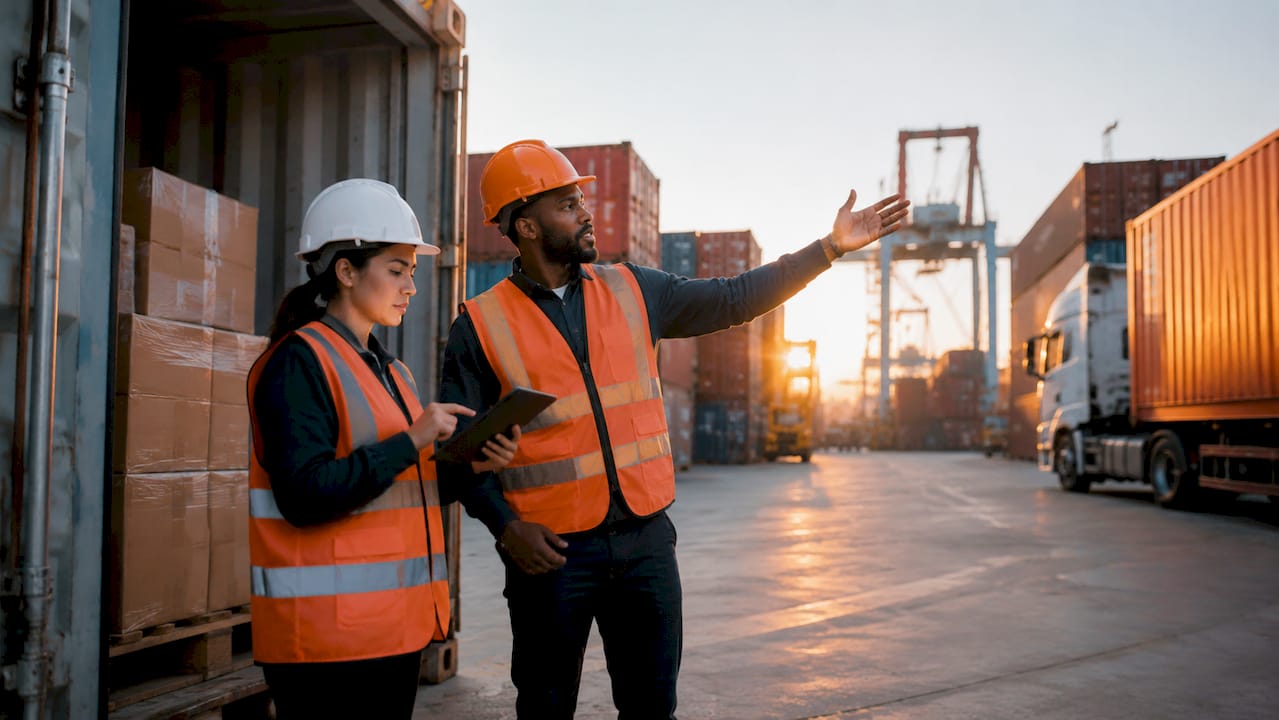
A freight forwarder contract is the legal document that defines the scope of services, liability limits, pricing, and dispute resolution terms between you and your forwarder. Freight forwarding agreements differ significantly depending on whether the forwarder acts as an agent or as a principal. This distinction carries major financial consequences.
Here is what each role means in practice:
- Agent role. The forwarder arranges services on your behalf but does not assume carriage liability. If a carrier loses your cargo, your claim goes against the carrier, not the forwarder.
- Principal role. The forwarder takes on direct transport responsibility, issuing their own bill of lading. They become liable for loss or damage up to the limits stated in the contract.
- Scope of services. Contracts must explicitly list what is included: pickup, export customs, ocean or air freight, import customs, and delivery. Anything not listed is not covered.
- Liability caps. Liability is commonly limited to a fraction of your cargo’s actual value. A cap of $500 per shipment is not unusual, even for a $50,000 consignment.
- Insurance requirements. Most contracts require you to arrange your own cargo insurance. The forwarder’s liability cap is not a substitute for a proper marine cargo policy.
- Governing law and dispute resolution. Contracts should specify which country’s law applies and whether disputes go to arbitration or litigation.
A common misconception is that freight forwarders assume full responsibility for cargo damage. They do not. Most have limited liability embedded in their standard trading conditions, which are often attached as fine print.
Conduct-based contracts also pose a specific risk: if the contract does not explicitly mention packaging compliance, labeling standards, or regulatory requirements, the forwarder is not responsible for violations. You are.
Pro Tip: Before signing, ask your forwarder to identify the exact liability cap per kilogram or per shipment. Then compare that figure to your cargo’s declared value and purchase additional insurance if the gap is significant.
Freight forwarder vs. customs broker vs. carrier: what’s the difference?
These three roles are frequently confused, but they serve distinct functions. Understanding the difference helps you build the right logistics team for your shipment.
| Role | Primary function | Owns transport assets? | Handles customs? |
|---|---|---|---|
| Freight forwarder | Coordinates full shipment lifecycle | No | Often yes, or subcontracts |
| Customs broker | Manages import/export declarations | No | Yes, exclusively |
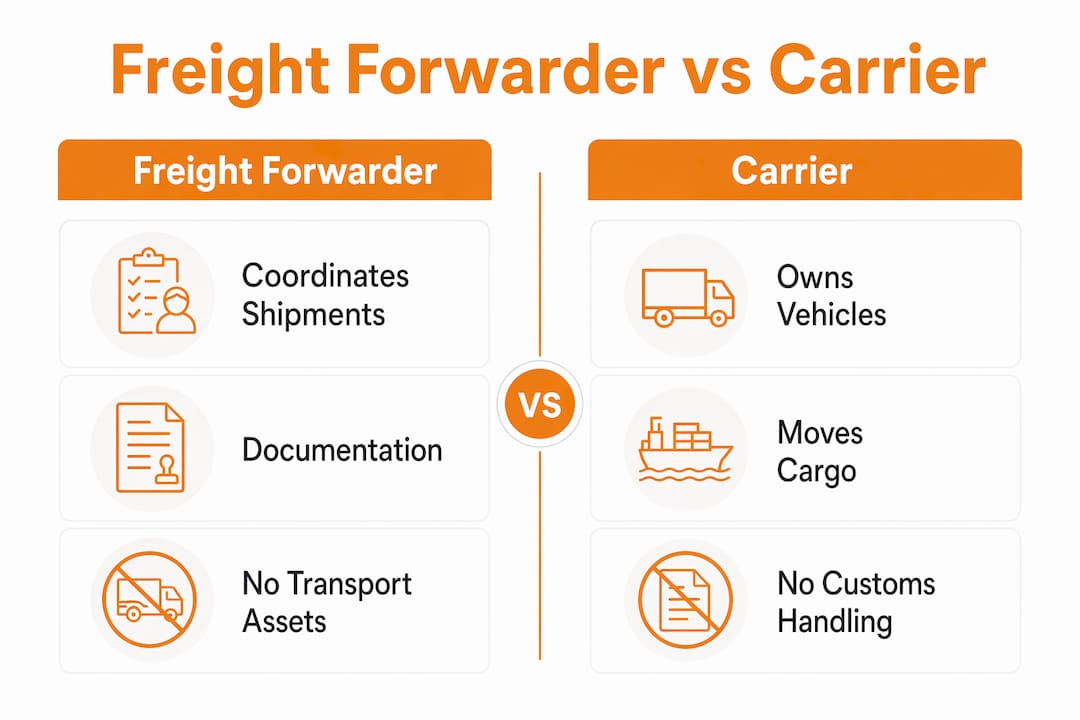
| Carrier | Physically moves cargo | Yes | No |
Freight forwarders differ from customs brokers in scope. A customs broker’s job begins and ends at the border. They classify your goods, file declarations, and pay duties. A freight forwarder manages the entire journey, from factory floor to fulfillment center, and may subcontract customs brokerage as part of that service.
Carriers, such as Maersk for ocean freight or FedEx for air, own the ships, planes, and trucks. They move cargo but do not manage documentation, customs, or delivery coordination beyond their own network.
Many freight forwarders now offer bundled customs brokerage services. For most importers, this is the most efficient arrangement. You get a single point of contact who manages every step, reducing the risk of miscommunication between separate vendors.
When should you use a freight forwarder?
Using a freight forwarder makes sense any time your shipment crosses an international border, involves multiple transport modes, or requires customs clearance. The benefits of using a freight forwarder are most visible in three situations.
- You ship internationally but lack in-house logistics expertise. Managing carrier bookings, export documentation, and import compliance across multiple countries requires specialized knowledge most businesses do not have on staff.
- Your shipments are too small to fill a container. Freight forwarders consolidate cargo from multiple shippers, giving you access to container rates you could not negotiate alone. This is a direct cost reduction through consolidation that smaller businesses rarely achieve on their own.
- You sell on Amazon FBA. Amazon’s fulfillment centers have strict receiving requirements, including labeling standards, pallet configurations, and appointment scheduling. A forwarder who specializes in FBA freight forwarding knows these requirements and prevents costly rejections.
Individual importers benefit too. If you are sourcing products from China, South Korea, or Mexico for the first time, a freight forwarder handles the complexity while you focus on your product and your customers.
How to choose the right freight forwarder
Selecting a freight forwarder is not just about price. The wrong choice costs more in delays, fines, and damaged cargo than any rate savings.
- Check specialization. Some freight forwarders specialize in specific regions or transport modes. A forwarder with deep expertise in China-to-USA ocean freight will outperform a generalist on that lane every time.
- Verify licensing. In the United States, ocean freight forwarders must be licensed by the Federal Maritime Commission (FMC). Air freight forwarders operate under TSA regulations. Ask for license numbers and verify them.
- Assess contract transparency. A reputable forwarder provides a clear, itemized quote with no hidden fees. If the contract is vague about liability or scope, treat that as a red flag.
- Evaluate technology. Real-time freight tracking systems are now standard among quality forwarders. If a provider cannot give you live shipment visibility, their operations are likely behind the curve.
- Ask about value-added services. Cargo insurance, supplier pickup, and customs clearance bundled into one service saves time and reduces vendor management overhead.
Pro Tip: Ask any forwarder you are evaluating for references from clients who ship the same route and cargo type as you. A forwarder with 50 satisfied China-to-USA clients is a stronger choice than one with a broad but shallow network. You can also review forwarder selection criteria specific to Amazon sellers for a structured checklist.
Key Takeaways
A freight forwarder is the most efficient way to manage international shipments because they consolidate carrier access, documentation expertise, and customs knowledge into a single managed service.
| Point | Details |
|---|---|
| Core definition | A freight forwarder coordinates shipments without owning transport assets, acting as your logistics manager. |
| Contract liability | Liability caps often cover only a fraction of cargo value; always secure additional cargo insurance. |
| Role distinction | Forwarders manage the full journey; customs brokers handle only border compliance; carriers move the goods. |
| Cost advantage | Cargo consolidation gives small shippers access to container rates they cannot negotiate independently. |
| Selection criteria | Verify FMC licensing, demand contract transparency, and confirm real-time tracking capability before committing. |
Why I think most shippers underestimate the contract
Most conversations about freight forwarding focus on price and transit time. Those matter, but the contract is where the real risk lives. I have seen businesses lose tens of thousands of dollars on damaged shipments because they assumed their forwarder’s liability covered the full cargo value. It almost never does.
The shift I have noticed in 2026 is that more forwarders are adopting digital contracts with clearer terms, partly because clients are asking better questions. Technology is also changing the game: real-time tracking, automated customs filing, and digital document management are now table stakes for any serious forwarder. If your current provider still emails PDF updates manually, you are working with an outdated operation.
My strongest advice is to integrate your freight forwarder into your supply chain planning before your first shipment, not after your first problem. Forwarders who understand your product category, your shipping cadence, and your peak seasons can negotiate better rates and flag compliance issues before they become customs holds. That proactive relationship is worth more than any rate discount.
— Keven
How ForwarderOne handles freight forwarding for Amazon sellers
ForwarderOne specializes in DDP freight forwarding from China, South Korea, and Mexico to US Amazon fulfillment centers. DDP, or Delivered Duty Paid, means ForwarderOne manages customs clearance, import duties, and final delivery in one workflow. You do not coordinate with separate customs brokers or trucking companies. ForwarderOne’s China-to-USA freight service covers both air and ocean modes, with a dedicated account manager assigned to each client. With over 99% on-time delivery, ForwarderOne is built for sellers who need reliable stock replenishment, especially during peak seasons when delays cost real revenue.
FAQ
What is a freight forwarder in simple terms?
A freight forwarder is a company that organizes the shipping of goods on behalf of businesses or individuals, handling carrier booking, documentation, and customs clearance without owning the transport vehicles themselves.
What does a freight forwarder contract cover?
A freight forwarder contract defines the services provided, liability limits, pricing, insurance requirements, and dispute resolution terms. Liability caps are standard and often limit compensation well below the actual cargo value.
How is a freight forwarder different from a carrier?
A freight forwarder coordinates logistics and manages documentation but does not own ships, planes, or trucks. A carrier physically moves the cargo using its own transport assets.
Do freight forwarders handle customs clearance?
Many freight forwarders offer customs clearance as part of their service, either directly or through a licensed customs broker. Always confirm this is included in your contract before shipping, as it is not automatic with every provider.
When does a small business need a freight forwarder?
A small business needs a freight forwarder when shipping internationally, importing goods subject to customs duties, or sending cargo to Amazon FBA fulfillment centers where strict receiving requirements apply.
Ready to simplify freight forwarding?
Share your supplier city, carton count, cargo value, product category, target Amazon warehouse, and deadline. ForwarderOne will map pickup, freight mode, customs clearance, and delivery into one practical quote.