Ocean freight is defined as the transportation of goods across international waters using cargo ships and standardized containers. It is the backbone of global trade, carrying 80–90% of global trade volume by sea each year. That single fact explains why carriers like Maersk and DP World operate some of the largest fleets on earth, and why freight forwarders exist as a dedicated profession. Whether you are importing consumer goods from China or exporting industrial equipment to Europe, understanding how sea freight works puts you in control of your supply chain.
What is ocean freight and how does it work?
Ocean freight, also called sea freight in industry terminology, is the process of moving cargo aboard commercial vessels between international ports. The system runs on containerization. Standardized steel boxes, most commonly 20-foot and 40-foot units, allow goods to be packed once and transferred between ships, trucks, and rail without repacking. That interoperability is what makes global supply chains possible at scale.
The end-to-end process follows a clear sequence.
- Booking. A shipper or freight forwarder reserves container space with a carrier. This step includes choosing between a Full Container Load (FCL) and a Less-than-Container Load (LCL), which are explained in the next section.
- Cargo pickup and stuffing. Goods are collected from the supplier, packed into the container, and sealed. Packing lists, commercial invoices, and a bill of lading are prepared at this stage.
- Port delivery and cut-off. The container is delivered to the origin port terminal before the carrier’s cut-off deadline. Missing the cut-off date pushes the shipment to the next available sailing, which can delay delivery by a week or more.
- Vessel loading. Port cranes lift containers onto the ship. Modern container vessels can carry more than 20,000 twenty-foot equivalent units (TEUs) in a single voyage.
- Ocean transit. The vessel sails to the destination port. Transit times vary by route: cross-Atlantic voyages average around 15 days, while trans-Pacific routes from Asia to the US West Coast run 30–45 days or longer depending on port congestion.
- Customs clearance. At the destination port, customs authorities review the shipment’s documentation. Errors or missing paperwork trigger holds and storage fees.
- Final delivery. Once cleared, the container is trucked or railed to the consignee’s warehouse or fulfillment center.
Pro Tip: Book your container space at least three to four weeks before your target ship date on trans-Pacific routes. Vessel capacity fills quickly, especially ahead of peak retail seasons like Q4.
What are the types of ocean freight services?
The two core service types are FCL and LCL. Choosing the right one depends on your cargo volume and budget.

Full Container Load (FCL) means you rent the entire container for your cargo alone. Nobody else’s goods share your box. FCL is faster because the container moves directly from origin port to destination port without consolidation stops. It also reduces handling, which lowers the risk of damage. FCL makes economic sense when your cargo fills roughly 50% or more of a standard container.
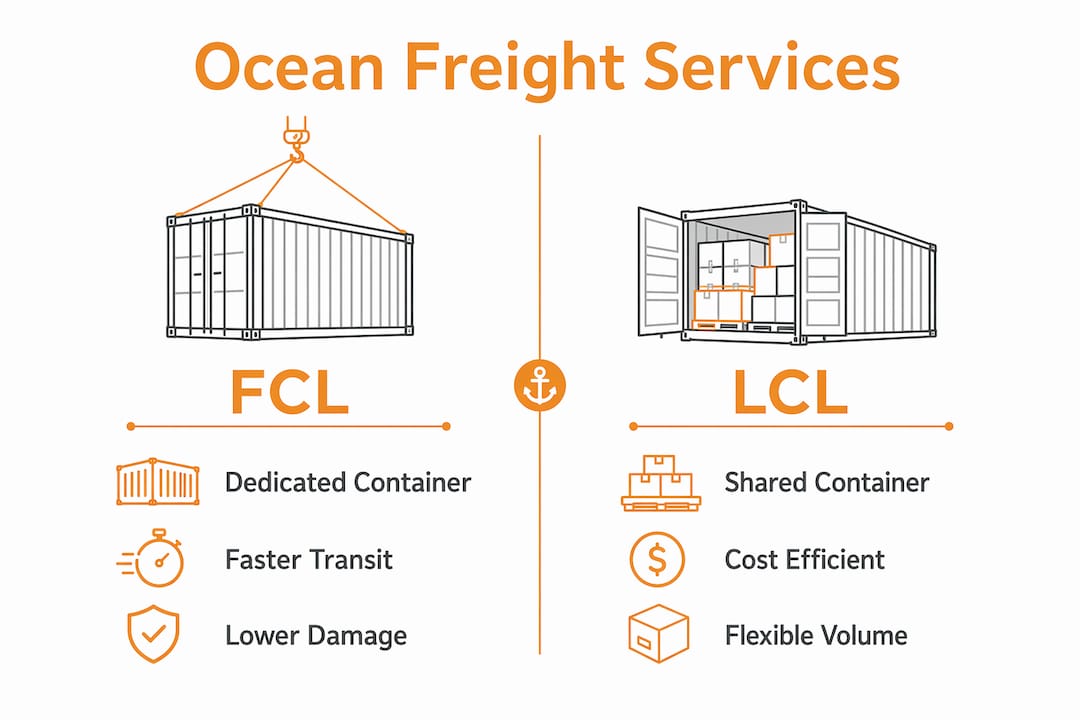
Less-than-Container Load (LCL) means your cargo shares space with other shippers’ goods inside one container. A freight forwarder consolidates multiple small shipments into a single box. LCL requires cargo consolidation and deconsolidation, which adds handling steps and increases the risk of damage and delays. LCL is the right call for smaller shipments that do not justify the cost of a full container.
| Feature | FCL | LCL |
|---|---|---|
| Container use | Dedicated to one shipper | Shared with other shippers |
| Cost structure | Fixed per container | Charged per cubic meter or weight |
| Transit speed | Faster, fewer stops | Slower due to consolidation |
| Damage risk | Lower | Higher due to extra handling |
| Best for | Large or high-value cargo | Small or trial shipments |
Beyond FCL and LCL, specialized services cover specific cargo types:
- Refrigerated containers (reefers): Temperature-controlled units for perishables, pharmaceuticals, and chemicals.
- Bulk shipping: Loose cargo like grain, coal, or minerals loaded directly into a vessel’s hold without containers.
- Oversized or breakbulk cargo: Heavy machinery or project cargo that does not fit standard containers and requires specialized vessels or deck loading.
How do ocean freight costs and transit times compare?
Ocean freight is significantly cheaper than air freight for high-volume cargo. Air freight costs $5–8 per kilogram on major routes like China to the US, while ocean freight runs $2–4 per kilogram. For a 1,000-kilogram shipment, that difference can reach $4,000 or more on a single order.
| Route | Ocean Transit Time | Air Transit Time | Cost Advantage (Ocean) |
|---|---|---|---|
| China to US West Coast | 30–45 days | 5–7 days | Significantly lower per kg |
| China to US East Coast | 35–50 days | 5–7 days | Significantly lower per kg |
| Europe to US | ~15 days | 3–5 days | Significantly lower per kg |
The cost of an ocean freight shipment is not just the base rate. Freight rates often change post-booking due to surcharges applied after the initial quote. Common additions include the Bunker Adjustment Factor (BAF) for fuel price changes, port handling fees, documentation fees, and destination delivery charges. The gap between your initial quote and your final invoice can be substantial if you do not account for these line items upfront.
For a detailed breakdown of how these cost components stack up, the freight cost factors guide from ForwarderOne covers each surcharge category with practical examples for sellers.
Pro Tip: Always ask your freight forwarder for an all-in quote that includes BAF, port fees, and destination charges. A low base rate with high surcharges often costs more than a slightly higher all-in rate.
What are best practices for managing ocean freight?
Sea freight is an end-to-end management process, not just a ship voyage. The businesses that handle it well treat every stage, from documentation to final delivery, with the same attention they give to the transit itself.
Work with a qualified freight forwarder. A freight forwarder handles carrier negotiations, documentation, customs filing, and delivery coordination on your behalf. Selecting the right partner is one of the highest-leverage decisions in your logistics setup. ForwarderOne’s guide on choosing a freight forwarder walks through the specific criteria that matter most for Amazon sellers importing from Asia.
Prioritize shipment visibility. Real-time ocean freight tracking helps you anticipate port congestion, vessel delays, and customs holds before they become inventory crises. Platforms like project44 provide carrier-level tracking data that goes beyond the basic estimated arrival date. ForwarderOne’s article on freight tracking systems explains how visibility tools reduce supply chain risk in practical terms.
Understand Incoterms before you sign anything. Incoterms define who pays costs and bears risk at each stage of the shipment. A shipper using EXW (Ex Works) is responsible for everything from the supplier’s factory door. A shipper using DDP (Delivered Duty Paid) transfers nearly all responsibility to the carrier or forwarder. Misreading your Incoterms can result in unexpected customs bills, insurance gaps, or liability disputes.
Get your documentation right the first time. Missing or incorrect paperwork is the top cause of customs holds and port storage fees. The core documents for most ocean freight shipments include the commercial invoice, packing list, bill of lading, and any required import permits or certificates of origin.
- Verify that the HS (Harmonized System) tariff codes on your commercial invoice match the actual goods.
- Confirm that the consignee name and address on the bill of lading match your customs broker’s records exactly.
- Submit all documents to your customs broker at least 48 hours before vessel arrival.
Never miss a cut-off date. The terminal cut-off is the last moment your container can arrive at the port and still make the scheduled sailing. Missing the cut-off means your cargo waits for the next vessel, which on some routes runs only once a week. Build a two-day buffer into your cargo delivery schedule to absorb last-minute supplier or trucking delays.
Key takeaways
Ocean freight is the most cost-effective method for moving large cargo volumes internationally, but it requires precise documentation, schedule discipline, and the right service type to deliver on time and on budget.
| Point | Details |
|---|---|
| Ocean freight dominates global trade | Sea freight carries 80–90% of global trade volume, making it the default mode for international shipping. |
| FCL vs. LCL choice matters | Choose FCL for large or high-value cargo; use LCL only when volume is too small to justify a full container. |
| Costs go beyond the base rate | Surcharges like BAF and port fees regularly increase the final invoice above the initial quote. |
| Documentation drives customs outcomes | Incorrect or missing paperwork is the leading cause of port holds and added storage costs. |
| Cut-off dates are non-negotiable | Missing a terminal cut-off delays your shipment to the next sailing, which can set back delivery by a week or more. |
Why ocean freight rewards the prepared shipper
I have spent years watching businesses treat ocean freight as a commodity purchase, the way you might buy a plane ticket. They shop for the lowest rate, book it, and assume the rest handles itself. That approach works fine until it doesn’t, and when it fails, it fails expensively.
The shippers I have seen succeed consistently do two things differently. First, they treat documentation as a pre-departure checklist, not an afterthought. One wrong HS code or a mismatched consignee address can hold a container at port for days while storage fees accumulate. Second, they build schedule buffers into their inventory planning rather than assuming best-case transit times. A 30-day trans-Pacific route can easily become 45 days when port congestion hits, and that gap empties shelves fast.
The cost advantage of ocean freight over air is real and significant. But that advantage only materializes if your shipment clears customs cleanly and arrives when your planning assumed it would. The businesses that capture the full benefit of sea freight are the ones that invest in visibility tools, qualified forwarders, and disciplined documentation practices. The ones that don’t are the ones calling their forwarder in a panic two weeks before a product launch.
— Keven
How ForwarderOne handles ocean freight for Amazon sellers
If you are an Amazon seller importing from China, Korea, or Mexico, ocean freight logistics can absorb time and attention that should go toward growing your business. ForwarderOne specializes in DDP freight forwarding services that cover the full shipment lifecycle, from supplier pickup to Amazon FBA fulfillment center delivery, with customs, duties, and port fees included in one workflow.
ForwarderOne delivers over 99% on-time performance and assigns a dedicated account manager to each client, so you always have a direct contact when questions arise. For sellers moving inventory on the China to USA DDP sea freight route, ForwarderOne removes the complexity of managing carriers, customs brokers, and last-mile delivery separately. You get one point of contact, one invoice, and full shipment visibility from origin to fulfillment center.
FAQ
What is the ocean freight definition in simple terms?
Ocean freight is the commercial transportation of goods by sea using cargo ships and containers. It covers the full process from origin port loading to destination port delivery, including customs clearance.
How long does ocean freight shipping take?
Transit times depend on the route. Asia to the US West Coast takes 30–45 days, cross-Atlantic routes average around 15 days, and customs clearance adds additional time at the destination port.
Is ocean freight cheaper than air freight?
Ocean freight costs significantly less per kilogram than air freight. Air freight runs $5–8 per kilogram on major routes, while ocean freight averages $2–4 per kilogram, making sea the preferred option for high-volume or heavy cargo.
What is the difference between FCL and LCL?
FCL (Full Container Load) gives you a dedicated container for your cargo alone, offering faster transit and lower damage risk. LCL (Less-than-Container Load) shares container space with other shippers, which costs less for small shipments but involves more handling and longer transit.
What documents are required for ocean freight?
The core documents are a commercial invoice, packing list, bill of lading, and any required import permits or certificates of origin. Incorrect or missing paperwork is the leading cause of customs holds and port storage fees.
Planning an ocean freight shipment?
Share your supplier location, carton count, cargo volume, Amazon destination, and target check-in date. ForwarderOne will compare FCL, LCL, and hybrid options with customs and final delivery included.