A freight forwarder is a specialized logistics partner who manages the full scope of international shipping, from carrier coordination and customs clearance to final delivery. Startups entering global trade quickly discover that international shipping is not a single transaction but a chain of handoffs, each one capable of causing delays, fines, or lost inventory. Understanding why startups need freight forwarders comes down to one fact: the complexity of cross-border logistics exceeds what most founding teams can manage without dedicated expertise. This guide breaks down the operational challenges, tangible benefits, and technology shifts that make freight forwarding for startups a practical necessity in 2026.
Why startups need freight forwarders: the core case
Freight forwarders act as a single accountability point in complex supply chains, letting startups focus on growth rather than operational firefighting. That single point of contact covers supplier pickups, port logistics, customs documentation, and last-mile delivery coordination. Without it, a startup founder is personally managing relationships with carriers, customs brokers, warehouses, and delivery agents across multiple countries.
The industry term for what freight forwarders provide is “third-party logistics coordination,” though most founders simply call it outsourced shipping management. Both phrases describe the same reality: handing off the operational system so your team can focus on product and sales. For a startup with a lean team, that trade-off is almost always worth it.

What operational challenges do startups face without freight forwarders?
Managing international shipping without a freight forwarder means coordinating every stage manually. Startups often underestimate how many parties are involved: the factory, the domestic trucking company, the port agent, the ocean or air carrier, the customs broker at the destination, the drayage company, and the final-mile carrier. Each handoff is a failure point.
Freight forwarders manage the operational system connecting pickups, customs, port logistics, and last-mile delivery. These are precisely the handoffs that cause most delays and cost overruns. A missed document at customs can hold a container for days. A miscommunication with a drayage company can trigger detention fees that exceed the original freight cost.
The hidden financial risks are significant. Demurrage and detention fees from container delays can surpass freight forwarding service costs entirely. That means a startup trying to save money by skipping a forwarder can end up paying more in penalties than the forwarder’s fee would have cost.
Common operational pain points for startups managing shipping alone include:
- Documentation errors: Incorrect commercial invoices, packing lists, or bills of lading trigger customs holds.
- Compliance gaps: Tariff classification mistakes lead to fines or shipment seizures.
- Scaling friction: Manual shipping coordination that works for 10 shipments breaks down at 100.
- Carrier negotiation: Startups lack the volume to negotiate competitive rates directly with carriers.
- Exception management: When something goes wrong, there is no dedicated expert to resolve it quickly.
Pro Tip: Keep a running log of every fee you pay outside the base freight cost, including customs penalties, storage charges, and rerouting costs. After three shipments, that log will show you exactly what a freight forwarder would have prevented.
How do freight forwarders add tangible value to startups?
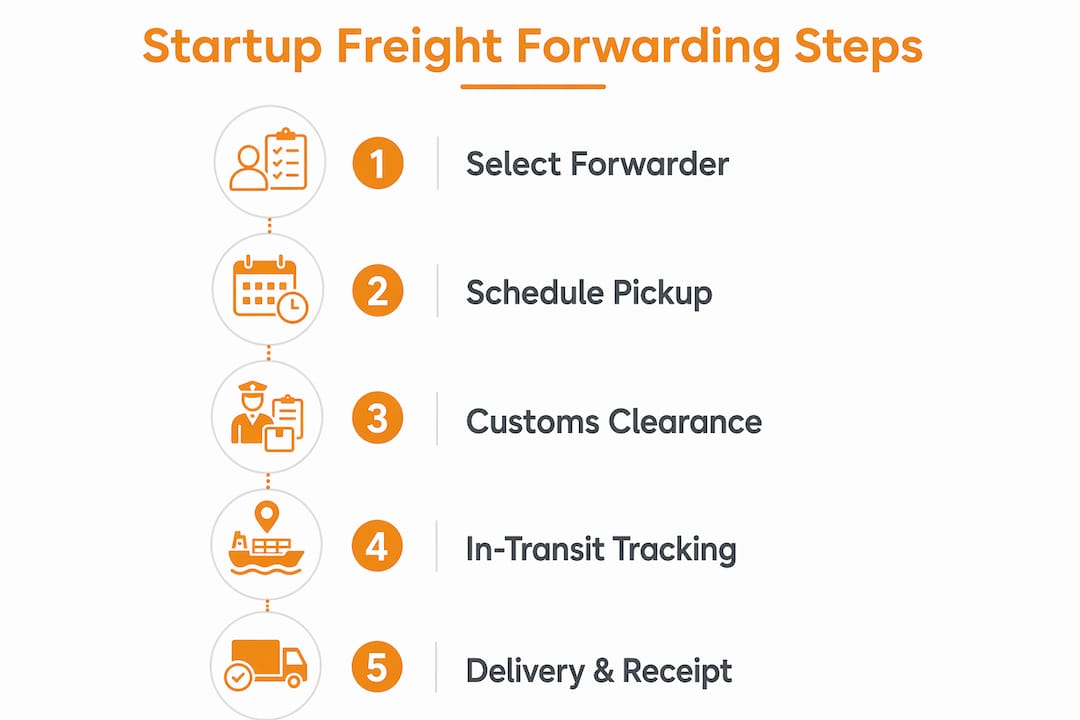
The benefits of freight forwarding for startups go well beyond booking a container. A freight forwarder brings carrier relationships, compliance knowledge, and operational infrastructure that would take years for a startup to build independently.
Customs expertise is one of the most critical advantages. Freight forwarders prevent delays, fines, and shipment seizures by managing documentation, tariffs, and regulatory compliance. International trade rules change frequently, and a forwarder tracks those changes so you do not have to.
Here is how freight forwarders add concrete value across the shipping process:
- Carrier and route selection: Forwarders compare rates and transit times across multiple carriers, selecting the best option for your budget and deadline.
- LCL consolidation: Less-than-container-load (LCL) services let startups ship small volumes via ocean freight without paying for a full container.
- Customs clearance: Forwarders prepare and submit all required documentation, reducing the risk of holds or penalties.
- Cargo insurance: Forwarders broker cargo insurance policies, protecting your inventory against loss or damage in transit.
- Real-time tracking: Freight tracking platforms give startups live shipment visibility, supporting better inventory planning and customer communication.
- Volume pricing: Forwarders aggregate shipments across multiple clients, giving startups access to carrier rates that would otherwise require much higher volumes.
The pricing advantage alone is often decisive. A startup shipping 5 pallets per month cannot negotiate the same ocean freight rate as a forwarder moving thousands of containers annually. That rate gap directly affects your landed cost and your margins.
How is technology transforming freight forwarding for startups in 2026?
Technology is changing what freight forwarders can deliver, and startups are the direct beneficiaries. The most visible change is in quoting speed. AI-powered platforms can reduce quote turnaround to about 1 hour for air freight and 2–3 hours for ocean freight. That speed means startups can make sourcing and pricing decisions faster than ever before.
The financial impact of AI quoting is measurable. Companies using integrated AI quoting see a 5% average reduction in quoted rates by automatically surfacing better routing options. For a startup shipping $500,000 in freight annually, that 5% translates to $25,000 in savings.
Agentic AI adoption in supply chain management is projected to scale from 5% in 2026 to 60% by 2030. That shift moves freight forwarders from manual data entry toward high-value advisory roles, which benefits startups who need strategic guidance, not just booking confirmations.
Key technology advances reshaping freight forwarding include:
- Automated documentation: AI reduces manual errors in bills of lading, customs entries, and compliance filings.
- Dynamic rate discovery: Platforms scan carrier networks in real time to surface the best available rates.
- Exception alerts: Automated systems flag delays, port congestion, or customs holds before they escalate.
- Digital tracking dashboards: Startups get a single view of all shipments across carriers and modes.
Small and mid-sized forwarders use AI tools to compete by speeding quote responses and improving pricing intelligence while maintaining relationship-driven service. That combination matters for startups. You get the speed of a digital platform with the accountability of a dedicated contact who knows your business.
Pro Tip: When evaluating a freight forwarder, ask specifically about their quoting technology and tracking platform. A forwarder still relying on email-based quotes and manual tracking updates will slow you down as you scale.
| Capability | Manual approach | Tech-enabled forwarder |
|---|---|---|
| Quote turnaround | 24–48 hours | 1–3 hours |
| Rate accuracy | Carrier-by-carrier checks | AI-driven multi-carrier scan |
| Shipment visibility | Email updates | Live tracking dashboard |
| Exception handling | Reactive, after delays occur | Proactive alerts before impact |
When should startups partner with a freight forwarder?
The right time to bring in a freight forwarder is earlier than most founders expect. The common mistake is waiting until shipping volume is “high enough” to justify the cost. By then, the startup has already absorbed preventable losses in fees, delays, and staff time.
Startups should view freight forwarders as an operational extension that implements repeatable standard operating procedures (SOPs) early, easing scaling and reducing logistics friction. Building those SOPs at 10 shipments per month is far easier than retrofitting them at 100.
Clear signals that a startup needs a freight forwarder now:
- You are shipping internationally for the first time and have no customs experience.
- Your team spends more than a few hours per week managing carrier communications.
- You have experienced a customs delay, fine, or shipment hold in the past year.
- Your shipping volume is growing faster than your team’s capacity to manage it.
- You are expanding into new markets with unfamiliar trade regulations.
Partial use of a forwarder is also a valid approach. Some startups handle domestic logistics internally while outsourcing only international shipments. Others use a forwarder for ocean freight but manage air freight directly. The key is matching the forwarder’s scope to your actual risk exposure.
Choosing the right forwarder matters as much as the decision to use one. Look for a partner with direct experience in your product category, your origin countries, and your destination markets. A forwarder specializing in Amazon FBA shipping will understand FBA compliance requirements that a generalist forwarder might miss.
Pro Tip: Ask any forwarder candidate for two or three references from clients at your current shipping volume. A forwarder who excels with enterprise accounts may not give your startup the attention it needs.
Key Takeaways
Freight forwarders are not a luxury for startups. They are the operational infrastructure that makes international shipping repeatable, compliant, and cost-effective from day one.
| Point | Details |
|---|---|
| Single accountability point | Freight forwarders manage every handoff, reducing the failure points that cause delays and cost overruns. |
| Hidden cost prevention | Demurrage and detention fees can exceed forwarder service costs, making professional management a net saving. |
| Customs compliance | Expert documentation management prevents fines, holds, and shipment seizures under changing trade rules. |
| Technology advantage | AI-enabled forwarders cut quote times to 1–3 hours and surface better rates automatically. |
| Early partnership pays off | Building logistics SOPs at low volume is far easier than fixing ad-hoc processes after rapid growth. |
The mistake I see startups make most often
Most startup founders I have worked with treat logistics as a back-office problem to solve later. They spend months perfecting their product and their marketing, then scramble to figure out shipping when their first large order arrives. That scramble is expensive.
The misconception I hear most often is that freight forwarders are just booking agents who add a markup to carrier rates. That framing misses the point entirely. The real value is in the expertise that prevents costly mistakes: the customs broker who catches a tariff classification error before it triggers a fine, the operations manager who spots a port congestion alert and reroutes your shipment before it sits for two weeks.
Startups that bring in a freight forwarder early build something more valuable than a vendor relationship. They build a logistics infrastructure that scales with them. When you go from 20 shipments a month to 200, you are not rebuilding your shipping process from scratch. You are just turning up the volume on a system that already works.
The other thing I would push back on is the idea that technology has made freight forwarders less necessary. AI has made good forwarders faster and more accurate. It has not replaced the judgment calls that matter most: knowing when to hold a shipment, when to escalate a customs issue, and when a carrier’s quoted transit time is unrealistic. That judgment comes from experience, not an algorithm.
— Keven
ForwarderOne makes freight forwarding practical for startups
Startups shipping from China, Korea, or Mexico to US fulfillment centers face exactly the complexity this article describes. ForwarderOne is built for that situation.
ForwarderOne’s DDP freight forwarding services cover customs, duties, and delivery in a single workflow, removing the coordination burden from your team. With over 99% on-time delivery and a dedicated account manager for every client, ForwarderOne gives startups the reliability of an enterprise logistics operation without the overhead. Whether you are shipping your first container or scaling to meet holiday demand, ForwarderOne’s Amazon FBA freight solutions are designed to grow with you.
FAQ
What does a freight forwarder actually do for a startup?
A freight forwarder manages the full chain of international shipping, including carrier booking, customs documentation, compliance, and delivery coordination. They act as a single point of contact so startups do not have to manage multiple vendors across each shipment.
How do freight forwarders save startups money?
Freight forwarders access volume-based carrier rates that startups cannot negotiate independently, and they prevent costly fees like demurrage and detention charges through expert timing and compliance management.
When is the right time for a startup to hire a freight forwarder?
The right time is before your first international shipment. Building repeatable shipping SOPs early prevents the costly, ad-hoc processes that slow startups down during rapid growth.
Is AI replacing freight forwarders in 2026?
AI augments freight forwarders rather than replacing them. Agentic AI adoption in supply chain management is projected to grow from 5% in 2026 to 60% by 2030, but the technology enhances forwarders’ speed and pricing accuracy while preserving the human expertise startups rely on.
What should a startup look for when choosing a freight forwarder?
Look for a forwarder with direct experience in your product category, origin countries, and destination markets. For Amazon sellers, a forwarder with specific FBA compliance knowledge is more valuable than a generalist with broader coverage.
Need a freight workflow that fits startup volume?
ForwarderOne can help map supplier pickup, customs clearance, DDP delivery, and shipment visibility without forcing your team to manage every carrier handoff.