U.S. Customs and Border Protection uses four primary exam paths: non-intrusive imaging (VACIS/NII), tailgate inspections, intensive exams at a Centralized Examination Station, and document reviews. Each carries different time and cost implications, and CBP or a Participating Government Agency like the USDA or FDA can trigger any of them. If your shipment gets flagged, contact your broker or forwarder immediately, gather your invoice, packing list, and bill of lading, and check the disposition code in ACE to see exactly where you stand.
TL;DR:
- Most customs exams escalate from non-intrusive imaging to tailgate or intensive inspection based on image clarity, weight mismatches, or irregular density readings.
- Costs increase significantly at each stage, from about $150 to $350 for imaging to over $2,500 for full inspections at a Centralized Examination Station.
- Addressing documentation discrepancies early by maintaining consistent classifications and accurate paperwork can prevent escalation and delays.
- Customs holds often stem from mismatched data, missing forms, or commodity misclassification, with regulated goods facing longer delays due to agency testing and certification.
- Immediate action on hold notices, coordinated through a broker, and understanding the rights to challenge findings can reduce overall downtime and costs.
What Is a Customs Hold vs. a Customs Exam?
A hold is a status flag in the Automated Commercial Environment (ACE) that stops your cargo from moving until a condition is cleared. An exam is the actual physical or visual inspection that resolves certain holds. Not every hold requires a physical look at your goods. Some clear the moment a document gets uploaded or corrected.
CBP places most holds, but PGAs like the USDA and FDA can flag a shipment independently based on the commodity, whether or not CBP has any concerns of its own. That distinction matters because the agency behind the hold determines who you’re actually negotiating with.
- Manifest or entry hold: cargo data doesn’t match, or a required form is missing.
- PGA hold: a regulated commodity (food, plants, electronics, cosmetics) needs agency sign-off.
- Physical exam hold: CBP wants eyes, imaging, or hands on the actual cargo.
- Statistical or random hold: no red flag at all, just part of routine sampling.
Your entry status in ACE will usually show a specific disposition code tied to the hold type, which is the fastest way to know which agency you need to satisfy.
How Customs Exams Escalate From a Quick Scan to a Full Unpack
CBP generally moves through a three-tier physical exam process, and understanding the order helps you gauge how bad the situation actually is. CBP confirms cargo entering the United States is subject to physical examination as part of its standard enforcement authority, and the industry has settled on fairly consistent language for describing each tier.
- NII / VACIS / X-ray exam. This is a non-intrusive scan, usually completed without ever opening the container. Industry help centers report fees in the range of $150 to $350 per container, plus drayage to move the box to the scanning site. Turnaround is often same-day to a few days if nothing looks off in the image.
- Tailgate exam. CBP breaks the seal and inspects cargo at the rear of the container without a full offload. This step usually happens when the imaging flagged something ambiguous rather than a clear violation. Expect one to three extra days and moderate additional fees on top of the NII cost.
- Intensive exam. The container gets moved to a Centralized Examination Station (CES), a privately operated facility contracted to devan cargo for full inspection. CBP or the CES may pull samples for lab testing. Costs at this stage can run from roughly $1,000 to $2,500 or more, depending on labor, port, and how much of the container needs unpacking.
- Document review. This one runs in parallel to the others and sometimes stands alone. CBP reviews paperwork and can clear cargo without ever touching it physically if the entry data checks out.
Non-intrusive inspection is faster and cheaper, but it can trigger an escalation. A blurry X-ray image, a mismatched weight, or an odd density reading is often enough to push a shipment from NII straight to tailgate or intensive. The single biggest lever you control is documentation accuracy before the box ever reaches port, because clean paperwork rarely survives an escalation on its own.
Manifest Holds, PGA Holds, and the Other Codes You’ll See in ACE
Beyond the three physical exam tiers, several hold categories show up regularly in ACE and each one resolves differently.
- Manifest hold: the carrier’s cargo manifest doesn’t match the entry filing. Usually resolved by correcting or resubmitting data, not by opening the container.
- CET (Cargo Enforcement Team) or A-TCET hold: targeted enforcement action, often tied to intelligence about the importer, commodity, or country of origin.
- PGA commercial enforcement hold: an agency like the FDA or USDA needs to review or test the product before release.
- Statistical validation hold: random sampling with no specific suspicion attached, purely for CBP’s compliance data.
- Detention: goods are held after examination pending a decision, sometimes tied to admissibility questions rather than paperwork.
PGA holds tend to be the slowest and least predictable of the group. The FDA can require prior notice confirmation or lab testing on food and cosmetics, the USDA may need a phytosanitary certificate for agricultural goods, and the Consumer Product Safety Commission can ask for testing documentation on children’s products or electronics. PGA holds can dramatically extend delays because testing and certification timelines run on the agency’s schedule, not CBP’s. If your product category touches food, plants, or regulated consumer goods, budget extra buffer time before you even book the shipment.
Why Shipments Get Flagged, and What It Actually Costs You
Selection isn’t arbitrary, even though it often feels that way to a first-time importer. Common triggers include commodity risk, documentation discrepancies, importer history, intelligence or sanctions flags, and straightforward random sampling. A new importer number, a commodity code with a history of misdeclaration, or a supplier CBP has flagged before will all raise your odds regardless of how clean your specific shipment is.
The cost curve escalates sharply as you move up the exam tiers, and drayage, storage, and CES handling fees stack on top of the base exam charge at every stage.
| Exam type | Typical timeline | Typical cost range | Who usually pays |
|---|---|---|---|
| Document review | Hours to 2 days | Minimal to none | Importer (broker time) |
| NII / VACIS / X-ray | 1 to 3 days | $150 to $350 | Importer |
| Tailgate | 2 to 3 days | Moderate, above NII cost | Importer |
| Intensive / CES | up to several days | $1,000 to $2,500+ | Importer |
Beyond the exam fee itself, demurrage and storage charges accrue daily once your free time at the terminal expires, often faster than importers expect. If lab testing finds a genuine violation, you’re also looking at possible seizure, fines, or destruction of goods, on top of every fee already paid to get that far.
What to Do the Moment You Get a Hold Notice
Speed matters more than almost anything else once ACE shows a hold. Every day your container sits is a day closer to demurrage charges and, if you’re shipping into Amazon FBA, a day closer to a stockout during peak season.
- Contact your broker or forwarder the same day the hold posts.
- Pull your commercial invoice, packing list, bill of lading, and power of attorney (Form 5291) immediately.
- Check the exact disposition code in ACE to confirm which agency issued the hold.
- If it’s a PGA hold, ask your broker what certificate or test result the agency specifically needs.
Brokers coordinate directly with CBP and the CES on your behalf, submitting corrected paperwork or scheduling the physical inspection so you’re not making calls into a system you don’t have access to. ForwarderOne handles this coordination as part of its DDP customs service, backed by a dedicated account manager and a track record of over 99% on-time delivery even when shipments hit friction at the port.
Pro Tip: If you’re running multiple containers and only one gets held, don’t let it stall the others. Ask your broker to separate the entries so clean containers keep moving while the flagged one works through review.
Your Rights If You Disagree With an Exam Finding
Importers have a formal path to challenge an exam outcome, and it starts with understanding what CBP actually decided. If CBP or a PGA determines your goods are inadmissible, overvalued, or misclassified based on the exam, you’ll receive a written notice explaining the specific finding and the code section behind it.
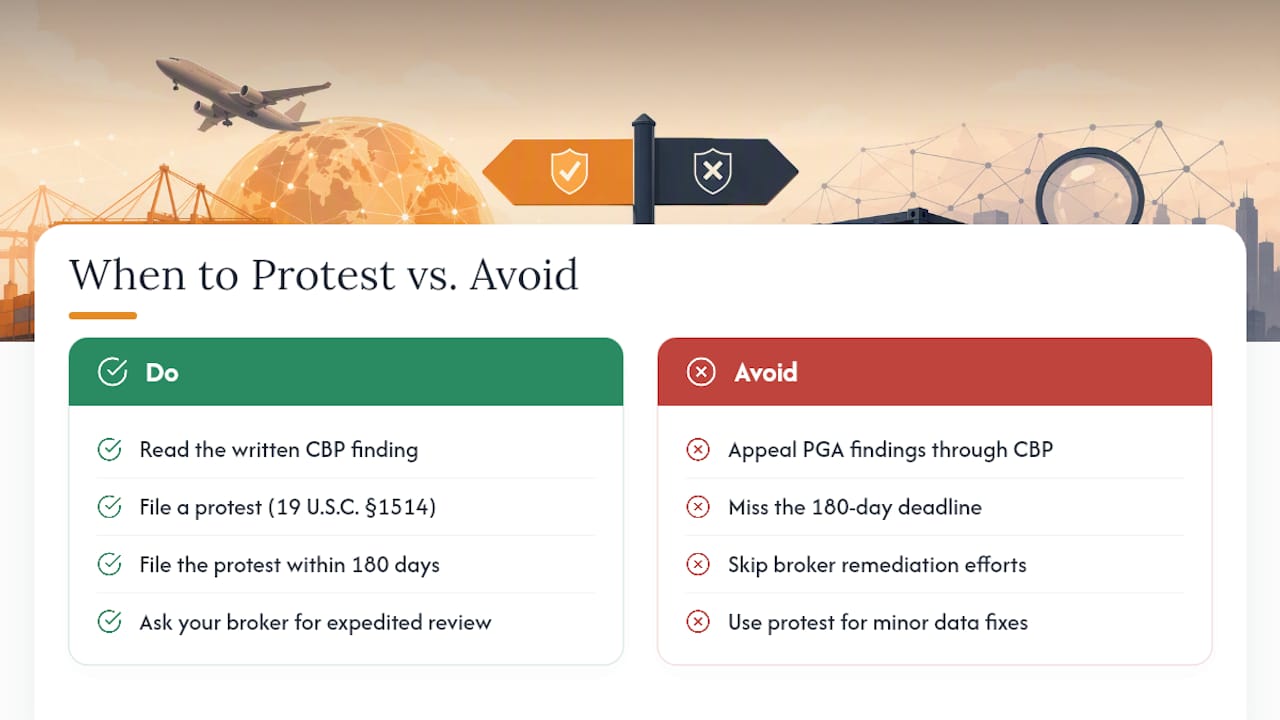
From there, you generally have the right to file a protest under 19 U.S.C. § 1514, typically within 180 days of the decision, disputing classification, valuation, duty rate, or admissibility determinations. For urgent situations involving perishable or time-sensitive FBA inventory, you can also request expedited review or an internal advice ruling through your broker before the formal protest window closes.
If the dispute involves a PGA finding rather than a CBP classification issue, the appeal usually runs through that agency’s own process. An FDA refusal, for instance, follows FDA import alert procedures, not a CBP protest. Mixing up which agency governs your appeal is one of the most common mistakes importers make, and it wastes time you don’t have if inventory is already accruing storage fees.
The practical reality is that most disputes never reach a formal protest. Brokers resolve the vast majority of contested findings by supplying additional documentation, lab results, or corrected data directly to the examining officer, often within days. Reserve the formal protest for genuine disagreements over classification or valuation where the financial stakes justify the time it takes to work through the process.
How to Reduce Your Odds of Getting Flagged in the First Place
You can’t eliminate exam risk entirely, but you can meaningfully lower it with a few habits most importers skip. Clean, consistent documentation is the single highest-leverage move available to you, because most exams that escalate do so after a discrepancy already existed on paper.
Keep your HTS classifications consistent shipment to shipment. Switching codes for the same product, even accidentally, builds a pattern CBP’s systems flag automatically. Match your invoice values, weights, and quantities exactly against your packing list and bill of lading every single time, since small mismatches are one of the most common reasons shipments get held.
Work with the same broker and forwarder consistently rather than switching for small savings. A stable import history with recognized entities tends to draw less scrutiny than a pattern of one-off filings through different intermediaries. If your product falls under FDA, USDA, or CPSC jurisdiction, get your prior notice, certificates, or test documentation lined up before the vessel even departs, not after it arrives.
Finally, treat your supplier relationships as part of your compliance profile. A supplier with a history of underdeclared values or incorrect country-of-origin marking can drag your shipments into extra scrutiny even when your own paperwork is flawless. Vetting new suppliers before your first shipment is far cheaper than untangling a detained container after the fact.
Air, Sea, and Land: How Exam Types Differ by Mode
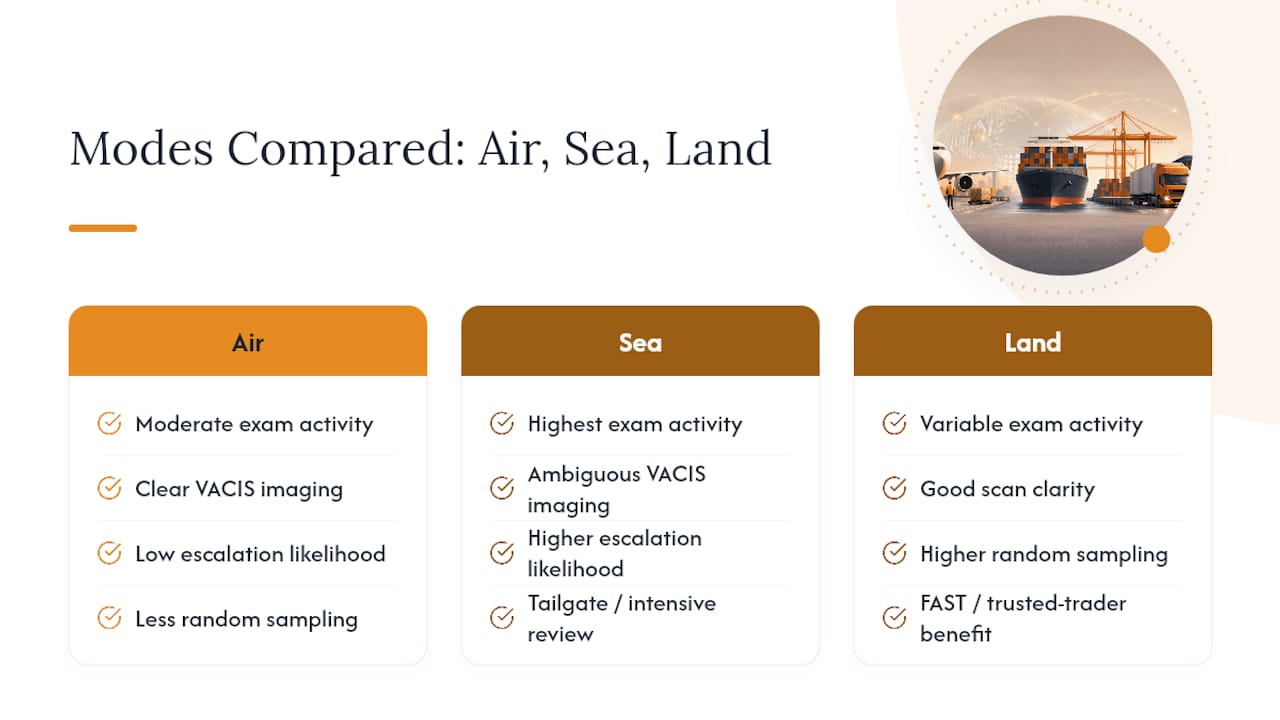
Ocean freight sees the most physical exam activity simply because containers are large, dense, and harder to scan cleanly. VACIS imaging works well on ocean containers, but ambiguous density readings from tightly packed pallets push a disproportionate share of sea shipments into tailgate or intensive review. If you ship FBA inventory by ocean, budget for the full escalation path as a real possibility, not an edge case.
Air cargo moves faster through CBP by necessity, since air shipments typically carry higher-value, time-sensitive goods and smaller volumes per shipment. Exams still happen, but the non-intrusive imaging tends to resolve most air cargo questions without escalating, partly because air containers and pallets are easier to scan clearly than a fully loaded ocean container.
Land border crossings from Mexico and Canada run through a different rhythm entirely, with FAST and other trusted-trader programs speeding qualified carriers through primary inspection while everyone else faces a higher relative exam rate. Truck shipments also face more frequent random sampling at land ports than air or sea, partly because inspection infrastructure at land crossings handles a different volume pattern than a major seaport’s CES network.
Whatever the mode, the underlying triggers stay the same: commodity risk, documentation accuracy, and importer history matter more than the transport method itself.
What Actually Slows Importers Down
Most importers assume exams are about bad luck. They’re usually about bad paperwork. In years of watching shipments move through CBP scrutiny, the pattern holds: a mismatched HTS code or a packing list that doesn’t match the invoice causes more delay than any random targeting algorithm ever will.
The biggest blind spot is timing. Importers scramble to gather documents after a hold posts instead of having them ready before the vessel departs. For FBA sellers, that gap is where stockouts happen. Prioritize release actions that protect your highest-velocity SKUs first, and let slower movers wait their turn in the queue.
— Keven
Let ForwarderOne Handle the Exam So You Don’t Have To
ForwarderOne is the alternative to juggling a broker, a CES, and three federal agencies on your own when a container gets flagged. Its DDP service folds customs clearance, duty payment, and delivery into one workflow, with a dedicated account manager tracking your shipment’s disposition code and coordinating directly with CBP or the CES if an exam hits.
When ForwarderOne handles an examined shipment, you get a single point of contact instead of a broker, a drayage company, and a CES all reporting separately. That coordination is part of why the company maintains over 99% on-time delivery even across shipments that face inspection delays. For small and mid-sized Amazon sellers, that reliability directly protects stock availability heading into peak season.
If you’re moving inventory from China to a US fulfillment center and want customs risk handled by a team that does this daily, check out ForwarderOne’s DDP shipping service from China to the USA or get a quote through the small business Amazon FBA freight forwarding page to see how a managed workflow compares to handling it piecemeal.
Where to Verify These Rules Yourself
Confirm exam procedures directly with CBP’s cargo examination guidance, review ACE disposition codes for status meanings, and check USDA import requirements for regulated agricultural goods before shipping.
This article is general information for logistics planning, not legal, customs, or tax advice. Confirm product status, tariff treatment, and filing obligations with a licensed broker, qualified counsel, or the relevant agency before shipping.
Sources
- Cargo Examination
- Types of Customs Exams
- Customs Examination Procedures: Types, Costs & Penalties - LegalClarity
- Customs Holds & Exams: Types, Codes & Timelines (2026)
FAQ
What Are the Different Types of US Customs Forms?
The core forms include the commercial invoice with HTS classification, packing list, bill of lading or air waybill, and a power of attorney (Form 5291) authorizing your broker to file on your behalf; regulated goods may also need PGA-specific certificates.
How Many Types of Customs Exams Are There?
CBP generally uses four categories: document review, non-intrusive imaging (VACIS/NII), tailgate inspection, and intensive exams at a Centralized Examination Station, with PGA holds layered on top for regulated commodities.
How Many People Pass the Customs Broker Exam?
Pass rates for the CBP broker license exam vary by sitting and aren’t part of the exam-type framework covered here; check CBP’s official exam results pages for the current pass rate for a specific exam date.
How Much Does the VACIS Exam Cost?
VACIS or NII imaging exams typically run $150 to $350 per container, not including drayage to move the container to the scanning site.
Need a customs exam response plan?
ForwarderOne coordinates broker, drayage, exam-site, duty, and delivery updates through one DDP workflow for sellers that cannot afford blind delays.